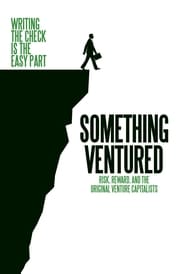
Something Ventured
Descargar subtítols en English
Información d'a versión
Etiquetas
Anvista previa d'os subtitulos en English
As primeras 200 linias.
I was in my laboratory probably talking to students.
Here's a call comes out of the blue.
This young guy wanted to know is the technology
ready to be commercialized.
Then he said the magic word.
He says I have access to some money that would allow us
to get started, and I said OK.
I said, where does the money originate?
And he said, I'm a junior member at a venture capital firm.
I went to look up what venture capital meant.
I hadn't heard of it before.
The risks were just enormous.
They came to me with no business plan.
Willing to risk everything.
You have to be a street fighter.
Tick, tick, tick, tick, tick, tick, tick.
We didn't know what we were doing.
Silicon Valley.
Technical break through.
$100,000.
$1 million. MAN: $10 billion.
Intel.
Apple. MAN: Genentech.
Cisco.
Good markets create companies.
Rolling company.
The sky's the limit.
The rest is history.
I don't know how to write a business plan.
I can only tell you how we read them, and we start at the back,
and if the numbers are big, we look at the front.
See what kind of business it is.
You have to look at the way conventional wisdom works
and abandon it.
No one has ever accused me of underestimating myself.
Jobs and Wozniak came up to see me.
Steve Jobs is a national treasure.
He is so visionary and so bright.
I had to fire him, though.
These men didn't always
wield such influence and power.
In the beginning, they barely knew what they were doing.
50 years ago, they were just young guys
from modest means who thought they could help
build innovative companies.
This is the story of a handful of men who stirred up
a revolution in finance and technology
because they saw opportunity where others only saw risk.
Venture capital... I don't think I thought of it first,
but I don't know anyone who used the term before I did.
Back in the spring of 1957,
Arthur Rock was just a Junior banker on Wall Street,
but then one day an unsolicited letter arrived at the office.
The letter was unusual, and no one else at his brokerage firm
knew what to do with it.
It was a cry for help, and it would
forever change the trajectory of Arthur Rock's life.
You gotta be lucky.
Everybody's gonna be lucky at sometime or another.
Thing I'd say is I was lucky to be lucky early.
The letter on Arthur Rock's desk
had come from eight engineers in California,
a group of brilliant young men who had soon become
known as the traitorous eight.
We were young guys, a bunch of young engineers
and scientists mostly, working together
at Shockley Semiconductor.
They were having a hard time with Shockley,
and they were going to leave.
Things had deteriorated at Shockley lab.
He was a very difficult person to work with, and a group of us
started considering the possibility
at least of these leaving.
So anyhow we did write...
This prospectus is to introduce a group of senior scientists
and engineers who have been working together at Shockley.
Semiconductor laboratory.
Shockley had just won a Nobel Prize.
It was probably a little presumptuous of us to think
we could push him aside.
A group feeling arose to the effect
that, rather than leave one by one,
we believe we are much more valuable
to an employer as a group.
These were, by their resumes, very superior people,
and I thought, gee, maybe there's
something here, something more valuable
than just to be an employee.
That something that Arthur
saw inspired him to step out of this ordinary role
as a Wall Street banker.
And that's when we met Arthur Rock.
Arthur came out to meet with a group of us,
and Arthur said, you ought to start your own company,
and we'll find financing for you.
They hadn't thought of this idea themselves.
Nobody thought of starting their own company
in those days.
It was a new idea, but it was a good.
At that time, there was no venture capital,
so starting companies was new.
It was innovative.
Arthur Rock had to get creative about finding capital
for the traitorous eight.
His bank had contacts with rich families
like the Rockefeller's and the Whitney's, but they
weren't interested in backing a start up all
the way out in California.
So we made a list of companies.
In fact, we sat down with the Wall Street Journal.
Looking for companies to ask to invest in these eight fellas
in forming a new company.
I think we had 35 companies.
All of them said no.
No.
The attempt to start a new company
might have ended then and there with the traitorous eight
returning to the job search and Arthur Rock admitting defeat,
but then Arthur received one last lead.
We were pretty much at wits end,
and somebody suggested that I see Sherman Fairchild.
Sherman Fairchild was an entrepreneur himself
and also a very wealthy man.
He right away saw the possibilities
and decided that Fairchild Camera
and Instrument would invest the $1.5 million
we were looking for.
I call myself the accidental entrepreneur.
With the $1.5 million Arthur raised,
the traitorous eight started Fairchild Semiconductor
in Mountain View, California, a sleepy rural town 35
miles south of San Francisco.
Fairchild was the first company to manufacture
the sophisticated silicon chips that would
power computers, rockets, and spacecraft, paving
the way for the high tech age.
In time, the fruit orchards surrounding Fairchild
would give way to electronics companies,
and the area would become famous as the Silicon Valley.
If they hadn't stayed together and formed Fairchild.
Semiconductor, probably there'd be
no silicon in Silicon Valley.
Arthur Rock had gotten a taste of something
exciting and significant, but as it turns out,
he wasn't the only one trying to figure out
how to fund young companies.
Just up the road from Fairchild, a handful of businessmen
were experimenting with their own version of venture capital
together around a lunch table in San Francisco.
In the '50s and '60s,
there were a group of us in San Francisco that
used to get interested in small high tech companies
down the peninsula.
There were, I think, five of us in our group.
We all had jobs.
We had other time on our hands, too.
We decided we'd just put a little investment
club together.
We were just a bunch of young men
in San Francisco who knew each other and respected each other.
What it was like was a very close fraternity.
I guess I can use that word carefully.
We had a table of six or eight for lunch.
None of us had enough money todo an investment by ourselves,
so we had to have help.
If one of us ran across an entrepreneur
who was trying to start a company,
we'd invite him up for lunch.
And after lunch, we'd ask him to step out onto the street corner
for a while, and give was 10 minutes,
and we'd make up our mind as to whether we wanted to invest
in his company or not.
I don't remember that.
We didn't do that.
We were to classy to do that.
That's a little bit quick, I think.
I mean, if the guy's a real nut, you say goodbye to him
without asking to go get a cup of coffee.
Two members of the group
wanted to do even more than gather around a lunch table
every six weeks.
In 1962, Pitch Johnson and Bill Draper
put up all their personal savings,
quit their day jobs to form a partnership,
and hit the streets.
Pitch and I each got a Pontiac leased, and went around,
and knocked on doors, and if it sounded like ABC electronics,
then we'd go in, ask the president to sit down,
and tell us what you do?
You know?
Well, what do you do?
Well, venture capital.
Well, what's that?
My kids would go to school.
What does your dad do?
My dad's a policeman.
My dad's a fireman.
My dad's a banker.
And what does your dad do?
Oh, he's a venture capitalist?
Something Ventured subtitles in other languages
More English subtitles for Something Ventured
- Something Ventured 2011 720p WEBRip x264 AAC-[YTS MX] · 20 downloads · 2020-06-22
- Something Ventured 2011 WEBRip x264-ION10 · 19 downloads · 2020-06-04
- Something Ventured 2011 1080p WEBRip x265-RARBG eng · 47 downloads · 2020-06-02
- Something Ventured 2011 1080p WEBRip x265-RARBG eng sdh · 38 downloads · 2020-06-02
- Someng Ventured 2011 DVDRip READNFO XViD-sC0rp Eng · 37 downloads · 2014-12-16
Comentarios
No comments yet. Be the first to leave one.