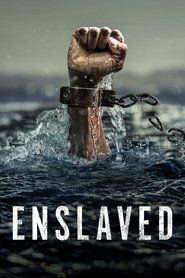
Enslaved
Descargar subtítols en English
Información d'a versión
Etiquetas
Download English Subtitle Files for Mobile (2)
Anvista previa d'os subtitulos en English
As primeras 171 linias.
More than 2 million Africans were lost at sea
when they were trafficked to the "New World."
Over 400 years, some 12 million were enslaved and abused.
None of that would have happened
if it didn't generate money... Lots of it.
This place was all slave plantations.
The people were treated like garbage,
like a way of making a profit.
Every mistake you make, the whip comes out.
Right here, people made deals that effected slavery?
It's a center of business concerned with the slave trade.
This is ground zero for sugar in the Americas...
Plantations just like this one where we're standing.
600,000 people were bought into slavery
by Bristol merchants, on Bristol ships.
Who profited?
Who are the people that profited the most?
I'm sensing the souls of 600, and I want to find them.
Afua, if we were standing here 200 years ago,
we would have been deemed fit for market.
Much of the world we live in today
was built on the backs of enslaved Africans.
To find out how this happened...
Follow the money. That's what we need to do.
We've made it to the capital of Suriname,
a small country in South America.
350 years ago, it was a Dutch slave colony
that existed for the sole purpose
of enriching the Netherlands.
We are here to investigate
one of the most horrific crimes
of the transatlantic slave trade.
Oh, my gosh, you guys.
It had been practically forgotten
for nearly 300 years.
- How are you? - You must be Leo. I'm Kinga.
Doctor Leo Balai has invited us
to this old Dutch fort to help solve the mystery
of a sunken slave ship called "The Leusden."
I want to tell you a story.
I think nobody wanted to tell, but a story I need to tell
because it is so important.
It's a story about the biggest mass murder
in the history of the transatlantic slave trade.
They had a smooth trip. Only 44 days.
Then the ship got stuck.
It hit the sandbank,
and that was the beginning of the end.
Here, right here in front of us was where
"The Leusden" was supposed to enter the Suriname River
to sell the "cargo."
Imagine, that 200, 300 years ago,
this place was all slave plantations.
More than 600 slave plantations
with tens of thousands of slaves to make a profit
for people who wanted to get rich.
It was here where everything happened,
where people were treated like cargo,
like a way of making a profit.
Transporting millions of slaves
across the Atlantic
required a tremendous amount of resources and money.
How did this make financial sense for Europeans?
I've come to London, once the center of the slave trade,
to look for some answers.
As you can see, we are in the heart
of the financial sector of the city of London.
And where I am going to take you is a very surprising place
that actually is the very heartbeat
of the Atlantic slaving system.
This is the site of the Jamaica Coffee House.
You can't really understand what happens
to the world of slavery and the slave trade
unless you think of coffee.
- Thank you. - Thank you very much indeed.
Why coffee and what does it have to do with slavery?
Well, in the 17th century, coffee takes off in England.
Merchants bring it here, and they mix it with sugar.
It's a very bitter drink, as was tea, as was chocolate.
And all three drinks are mixed with sugar.
Sugar, coffee, chocolate,
all these things that you mentioned highly addictive.
Yes. And all of them grown by the Africans
who were shipped in the millions.
Sugar is the engine behind the emergence of coffee drinking
and the proliferation of coffee shops
in the city of London like this one.
This coffee shop becomes the focus point for merchants,
for seamen from the slave corners of the empire.
Right here in the 1600s
people sat down and made deals that effected slavery?
Not only made deals about slavery.
But you would come and find out what the price of sugar was
and what the price of slaves were.
What was the fate of the ships
that were traveling back and forth?
It's a center of information, and it becomes a focus
for business concerned with the slave trade.
To fulfill Europe's massive demand for sugar,
Brazil became its biggest supplier.
So I've come to Brazil to see firsthand
where it all started.
Professor, so nice to meet you.
- Nice to meet you. - You ready to go?
- Yeah. - Let's go.
This was the first place in the Americas
that the sugar industry started to rely on slave labor.
At first Europeans enslaved indigenous people.
But so many died when they were exposed to European diseases
that they came up with a solution:
enslave Africans.
Millions and millions of African slaves
were brought here just to cultivate this crop.
So this is ground zero for sugar in the Americas,
plantations just like this one where we are standing.
Yes.
With first light, we set out with Dr. Balai
on a journey in search of the lost slave ship,
"The Leusden."
- Hi. - Nice to meet you.
Kinga Phillips.
- Hi. Alannah. - Yves. Nice to meet you.
The ship was stuck on the sandbank,
and water came into the ship.
They tried to mend it, to prevent the water
from coming in, but it didn't stop.
The captain decided the ship was lost.
He also decided that the "cargo" was lost.
The captives were of no value anymore.
The 664 Africans who perished
could have survived,
but the captain had a different idea.
I want to show you what was supposed to be
the final destination of the enslaved Africans
on board "The Leusden."
Around this whole territory
there were all slave plantations over here.
So, these were the highways basically.
These were the highways
and also the slaves digged those creeks.
They digged it out until the Atlantic Ocean.
A hundred miles...
If you look around, you can't imagine
that there were thousands of Black people living over here,
died over here, were massacred sometimes over here
because they had to make sugar and coffee.
Sugar was the curse of Black people,
because Europeans wanted sugar.
Watch your head.
You have to be careful in the creek
because everything is overgrowing now.
Nature takes everything back.
Watch it, watch it, watch it, watch it.
So, nature is covering up the crime.
Yes.
Snake, snake, snake.
Easy, easy.
We-We-We-We can continue. We can continue.
No, it was in the tree right there.
- On the branch. - It's a boa.
Heads up.
This it? Are we getting off?
Yes, we're getting off.
You, you can come.
This place was flatland...
...with sugar canes.
Thousands of slaves working day and night.
This was all flat, clear, no jungle?
No jungle.
The slave owners were so inventive
to stop the slaves from running away
Enslaved subtitles in other languages
More English subtitles for Enslaved
- Enslaved S01E06 Abolition 1080p AMZN WEB-DL DDP5 1 H 264-TEPES · 5 downloads · 2020-10-21
- Enslaved S01E05 Resistance 1080p AMZN WEB-DL DDP5 1 H 264-TEPES · 4 downloads · 2020-10-13
- Enslaved S01E05 Resistance 1080p AMZN WEB-DL DDP5 1 H 264-TEPES · 5 downloads · 2020-10-13
- Enslaved S01E04 New World Cultures 1080p AMZN WEB-DL DDP5 1 H 264-TEPES · 7 downloads · 2020-10-06
- Enslaved S01E04 New World Cultures 1080p AMZN WEB-DL DDP5 1 H 264-TEPES · 6 downloads · 2020-10-06
- Enslaved S01E03 Follow the Money 1080p AMZN WEB-DL DDP5 1 H 264-TEPES · 5 downloads · 2020-10-01
- Enslaved S01E02 Rationalization 1080p AMZN WEB-DL DDP5 1 H 264-TEPES · 4 downloads · 2020-09-26
- Enslaved S01E02 Rationalization 1080p AMZN WEB-DL DDP5 1 H 264-TEPES · 6 downloads · 2020-09-26
Comentarios
No comments yet. Be the first to leave one.