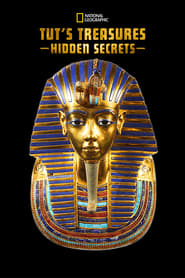
Tut's Treasures: Hidden Secrets
Descargar subtítols en English
Información d'a versión
Etiquetas
Download English Subtitle Files for Mobile (3)
Anvista previa d'os subtitulos en English
As primeras 200 linias.
Tutankhamun's spectacular treasures...
Now, for the first time since they were discovered,
all 5,398 objects are being brought together
in a new $1 billion museum.
This will be the first time many of them have been seen for a century.
Look at the horse. Look at the horse, look at the horse!
Scientists have been using the latest imaging and forensic technology
to unlock long buried mysteries...
to reveal the man behind the mask.
So many tiny details are visible again.
This wasn't just a hoard of treasure, it was a veritable arsenal.
Not of a boy king...
but a warrior on a global stage.
Egypt's spectacular Tutankhamun.
He's the most famous, most studied pharaoh in history.
But even today, Tutankhamun's treasures still have much to reveal.
Now, the most comprehensive forensic examination
of all Tutankhamun's 5,000 treasures is underway.
And several key objects have captured experts' attention.
At the heart of the investigation...
A mysterious dagger found on Tutankhamun's mummified body...
Priceless golden chariot decorations painstakingly reconstructed
after resting in fragments for three and half thousand years...
And the leather remains of a strange armored tunic.
These three treasures will tell us much more about the real Tutankhamun.
Not as a boy, but as a warrior.
It's a new chapter in a story that began in the Valley of the Kings,
on the afternoon of November 26th, 1922.
In the barren desert west of the Nile, British archaeologist Howard Carter
made the greatest archaeological discovery of all time.
The almost completely intact tomb of an ancient Egyptian pharaoh.
Tutankhamun.
Egyptologist Dr. Chris Naunton has been given a rare chance
to get up close to Howard Carter's personal account
of the momentous discovery.
This is Howard Carter's journal
and it's amazing for me to see this because this,
it really is as close as you get to the very moment
that Carter looked on this incredible haul of objects for the very first time.
This meticulously handwritten entry
records Carter's astonishment as he peered inside the tomb...
becoming the first person to gaze on its wonders
for three and a half thousand years.
Says, "The interior of the chamber
"gradually loomed before one with it's strange and wonderful medley
"of extraordinary and beautiful objects heaped upon one another.
"When Lord Carnarvon said to me 'Can you see anything?'
I replied to him, 'Yes, it is wonderful'."
Tutankhamen's treasures captivated the world.
In the months and years following their discovery,
they were painstakingly excavated and transferred to the Cairo Museum.
Since then, millions of visitors have marveled at many of the items
found in Tutankhamun's tomb.
These iconic treasures paint a picture of a pampered boy king
who died tragically young.
This is the Tutankhamun every school child knows.
A boy too young to rule.
An emotionally and physically weak puppet ruler.
But this image is based on the tiny handful of Tutankhamun's treasures
on display in the Cairo museum,
that make up just a fraction of the 5,000 objects
found in Tutankhamun's burial chamber.
The rest have been locked away in the museum's basement...
until now.
The new Grand Egyptian Museum
is now gathering together all of Tutankhamun's treasures
with the aim of putting the whole collection on display
for the first time since their discovery in 1922.
The treasures in these boxes will shed new light
on the story of Tutankhamun.
Thousands of objects were simply packed away
when they were first unearthed
and have never been studied or analyzed.
But now, in the cutting-edge labs and store rooms
of the Grand Egyptian Museum,
all this is about to change.
Behind this unassuming door lies an Egyptologist's paradise.
Wow. Welcome to storage 93,
especially for artifacts of Tutankhamun.
Filled with priceless treasures and dripping with gold,
in this room Tutankhamun's prized possessions are being brought together,
to be stored and conserved in climate-controlled conditions.
There's some boats. Some staffs. There are beds.
Chris Naunton is one of a tiny handful of experts to gain entry.
This is a super exciting moment to be here,
to see all of this material
being readied for exhibition in the new museum.
It's once in a lifetime kind of chance to see this.
The last time these treasures were together
was inside Tutankhamun's tomb.
Professor Salima Ikram believes it's only now,
by seeing the treasures together,
that Egyptologists can begin to tell the full story of the pharaoh's life.
There is so much material in the tomb of Tutankhamun.
It's really a bit like an attic, where, you know, people's mothers
had put all of their bits and pieces so that they have their memories;
they have their entire life encapsulated from babyhood onwards.
And Tutankhamun's tomb is like opening up his attic
and being able to see inside his past life.
Seen together, Tutankhamun's treasures
are now painting a radical new portrait.
Not the boy king as many had thought,
this is Tutankhamun, the warrior king.
Inside the tomb Howard Carter found six chariots,
seven throw sticks,
four daggers, dozens of bows, hundreds of arrows, eight shields
and a unique and sophisticated set of armor.
So this wasn't just a hoard of treasure, it was a veritable arsenal of weapons.
But these weren't the toys of a boy king,
it would seem they were the weapons of a man.
People romantically call Tutankhamun the boy king
and that's because he came to throne when he was nine and a half,
but he died when he was about 19.
And by the age of 14 in ancient Egypt, you were a man.
So really, it's more of a romantic myth calling him the boy king
because he really was a proper, truly grown up king.
Today, this king's story is being rewritten by the artifacts
he took to the afterlife.
And there's one treasure Tutankhamun seems to have highly valued.
Tucked away in a corner of the Cairo Museum
lies a small dagger with a big secret.
The latest technology has revealed
startling new information about this weapon,
soon to be moved to the Grand Egyptian Museum.
Information that is out of this world.
The sheer scale of Tutankhamun's treasures is breathtaking.
From golden effigies to elaborate beds, to simple items of clothing.
But Tutankhamun was also buried with an arsenal of weapons.
NAUNTON: Just drawer, after drawer, after drawer all containing arrows.
This entire section just for this one kind of object.
It's amazing.
In this second millennia BC stockpile,
there's one weapon that Tutankhamun seemed to have highly treasured.
Since its discovery,
this spectacular dagger has been on display in the Cairo Museum.
Tucked away in a corner, passed by as visitors flock
to Tutankhamun's big-ticket treasures.
It might not be the most famous object
that was discovered in the tomb,
but I think this dagger is one of the most interesting.
This deadly weapon contains a secret
that's been hidden in plain sight for nearly a century.
Now the dagger has been reanalyzed to reveal Tutankhamun as a warrior,
hungry for power, in this world and beyond.
The dagger was found inside Tutankhamun's coffin.
It was resting directly on his body.
This was one of the most important objects
for Tutankhamun it seems.
It was found very close to the mummy just above the king's abdomen.
It's clear there was something special
about this dagger to Tutankhamun.
And there's no doubting its beauty.
Its handle is extremely finely decorated
in gold, and these bands, which are inlaid with precious materials,
the pommel at the end is made of rock crystal,
this sheath made of beaten gold
is decorated with this very intricate floral pattern.
But Tutankhamun's tomb was dripping in gold and gems.
So why was this dagger buried inside his coffin on his body?
What made it so precious?
The answer lies in the dagger's blade.
Perhaps the most interesting aspect of it
actually is the blade, which is made of iron.
Iron is one of the most common elements on Earth.
But in Tutankhamun's Egypt, iron was rarer than gold.
Three and a half thousand years ago
iron was almost non-existent in Egypt,
we don't get any archaeological evidence for iron smelting
in this part of the world until the 6th century BC.
That's 800 years after Tutankhamun died.
The iron in the dagger's blade wasn't mined or smelted in Egypt.
So where did it come from?
The mystery has puzzled experts
since the dagger's discovery nearly a century ago.
But until recently, there was no way to know
where the iron in the blade came from,
without destroying it.
Now thanks to the use of advanced non-destructive x-ray analysis,
curators can shed new light on this ancient mystery.
Because there's more than iron in this blade.
This technique allows us to see
the kind of unique chemical fingerprint of the blade of this dagger.
And crucially, it tells us the percentage of the various different elements.
Iron occurs in nature mixed with other elements,
and this mixture is unique to each source of the metal.
By identifying the blade's unique chemical fingerprint,
the curators have been able to pinpoint its origin.
So, I just need everyone to move away
three meters please, for health and safety.
because we're now going to run the X-ray.
The machine fires high energy x-rays into the dagger blade.
And it's the energy reflected back
that reveals the elements contained inside.
DR. ELNAGGAR (off screen): Okay, it's done.
So what we have now is the result of the X-ray test,
and we can see the elements here of the chemical composition.
And we can see now three peaks which are of the iron and nickel and cobalt.
Okay.
What the curators found
was the proportion of nickel was unusually high.
Tut's Treasures: Hidden Secrets subtitles in other languages
More English subtitles for Tut's Treasures: Hidden Secrets
- Tuts Treasuresdden Secrets Series 1 3of3 Tales from the Tomb 720p HDTV x264 AAC · 32 downloads · 2019-05-04
- Tuts Treasuresdden Secrets Series 1 2of3 Golden Mask 720p HDTV x264 AAC · 29 downloads · 2019-05-04
- Tuts Treasuresdden Secrets Series 1 1of3 Treasures Rediscovered 720p HDTV x264 AAC · 38 downloads · 2019-05-02
Comentarios
No comments yet. Be the first to leave one.