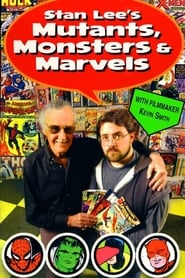
Stan Lee's Mutants, Monsters & Marvels
Descargar subtítols en English
Información d'a versión
Etiquetas
Anvista previa d'os subtitulos en English
As primeras 200 linias.
What year is Spider-Man?
At what point do you create Spider-Man?
Right after The Hulk, I think.
Again, Martin said, "We're doing good. Let's do another one, Stan."
So, when I was a kid,
I had read a pulp magazine called The Spider,
and I always liked it.
But that isn't what gave me the idea.
That's when I had to find a name.
But what gave me the idea was, I wanted...
You know, in superheroes, the most important thing
is to get a new power, and you run out of powers.
A guy can fly, a guy is strong, what's left?
Figured if a guy could stick to walls, you know, like an insect...
So I wrote down a list of names.
"Insect-Man" didn't have it. "Mosquito-Man" wasn't dramatic.
Finally, I hit on "Spider-Man."
"Spider-Man." Man, that sounded dramatic.
It had a ring to it. Still does.
And then I remembered I had loved that Pulp Magazine called The Spider.
And it was called The Spider, Master of Men.
There was nothing spiderish about him.
It was just a name he had. He was just a guy in a hat and, you know,
he hit people.
But I liked the name. So I thought, "I'll call him Spider-Man."
When I proposed the name to Martin, my publisher...
Now, he had been on board with everything,
you know, The Fantastic Four, The Hulk...
He thought I could do no wrong.
So I told him about Spider-Man. He said, "You're crazy."
Said, "Stan, people hate spiders.
"You can't do a book called Spider-Man."
And he said, "And you want him to be a teenager?
"Teenagers can only be sidekicks."
And then he said, "And you want him to have problems?"
Because I told him I wanted him to worry about money, pimples...
'Cause up until that point,
the traditional heroes, people like...
Well, The Fantastic Four, there were no money problems.
Reed Richards is the brilliant inventor,
and the problems were more on a cosmic scale.
And their real-life... They didn't have real-life identities.
I gave them later on,
but you're right, in the beginning, they didn't.
So Peter Parker and Spider-Man...
Well, the Peter Parker half of Spider-Man
is more like the first character to come along
that actually had a life outside of the suit, where the problems
were almost as epic as what he was facing while in costume.
That's why "Problems" were small,
the problems that everybody deals with.
That's just what I tried for.
Basically, if we had a formula at all,
the formula was, we know we're doing fantasy.
We have guys who can fly, burst into flame, all that.
But write them as realistically as possible.
If those people really existed,
what would their lives be like?
And that's what I was trying to do.
So, when I told Martin about it, he said,
"Absolutely not. It's the dumbest idea I ever heard, Stan.
"You've lost it, Stan."
Well, I then did, I guess, The X-Men and a few others.
Daredevil and Iron Man,
and I can't remember chronologically whether it was before or after,
but it was during that period.
But I always felt, "I want to do Spider-Man." I thought it would be good.
We had a magazine called Amazing Fantasy, which I did with Steve Ditko.
He's really one of the greats.
For some reason, I loved the book,
but they weren't superheroes.
What it was, there was little five...
Originally, it was Amazing Adult Fantasy.
That's right. That's right.
And I wanted stories for older readers,
so I tried to write science-fiction stories, very short ones,
with O. Henry endings, with surprise endings,
and each book might have had four or five of those stories.
I thought they were great, but they didn't feature men in tights.
So the public, that wasn't what they wanted at that time.
So we were gonna drop the book.
Now, when you're putting out the last issue of a book, nobody really cares,
you can do...
So I figured, "Aha! I'm gonna put Spider-Man in there."
I call Jack Kirby, who's so good at this sort of thing,
and I said, "Jack, I want you to do a character of mine called Spider-Man."
I told him what it should be.
But I said, "Don't make him look like Captain America.
"I want just an average guy."
I was gonna say "like me," but, of course, I didn't think I was average.
I thought of myself as Captain America.
So he did the first few pages,
and I came over to his board and I looked at it,
and I said, "No, that's not what I want, Jack."
I said, "Look, forget it. I'll give it to somebody else."
It was too bold, too heroic, too bulky.
Yeah, the guy looked like you. He looked really heroic.
Yeah, and I'm not Spider-Man.
So, Jack said, "Fine." You know, it was nothing.
We didn't think Spider-Man meant anything.
And Jack had a million other things to do.
I said, "I'll get somebody else." He said, "Sure."
I thought, "Steve Ditko would be perfect for it."
He drew people that looked like the kind of people
you'd meet in the street, you know?
So, I gave it to Steve, and, oh, man, was I ever right in picking Steve.
He did a beautiful job. And we published it.
We put it on the cover of the last issue of Amazing whatever.
Amazing Fantasy.
And, um, sent it out and forgot about it.
Months later, after the sales figures kicked in...
It takes months, or it took months...
'Cause back in the day, it'd take almost nine months, I read,
A long time.
The figures came out, and Martin came in to me one day,
and he said, "Stan,
"do you remember that Spider-Man character of yours that we both liked so much?"
And he said, "How about doing a series of him?"
And you know...
And there we were.
What do you think about Spider-Man caught on?
Do you think it was really just the "I can relate to this guy" aspect of it?
I think there were a lot of reasons.
I think perhaps the main reason was the "I can relate to him."
'Cause he was shy. He wasn't that successful with girls.
He had to worry about his family.
I think most teenagers reading it
thought to themselves, "Hey, that could be me!"
You know, so there certainly was that identification.
But beyond that, I think, I must say, truthfully,
You know, Doc Ock,I came up with some great stories
the Green Goblin,
the Sandman, and...
Everything worked.
And visually,
Very striking character, too.
'Cause the way Steve would have him crawling on walls
and swinging on webs, it just...
Everything came together perfectly.
And it's very...
One of the very few comic book characters, even back then,
that was covered from head to toe.
Like, even Captain America, you still have this much of his face.
Spider-Man's completely enveloped in his costume.
You know the good thing about that?
You could be any kid.
You could be black. You could be Asian.
You could be Indian. You could be anything,
and imagine you were in that costume.
So I think that made it relevant to everybody everywhere.
And that was accidental.
I don't think we planned it that way, but it was very fortuitous.
You get credited with...
And I know you're not even comfortable with it,
with creator of this, creator of this.
And you're always the first person in the room
to point out that it wasn't just you.
As you said before, it was a very collaborative medium.
And I know there are people that...
In the case of Jack Kirby,
"Oh, there must be a point of contention between Stan and Jack," blah, blah, blah.
And that's not the case. Let's talk about that.
Well, what happened was, Steve is really the guy who brought this to a point.
Obviously, Spider-Man was my idea.
Even gave it to Jack first, didn't want it, then gave it to Steve.
Steve feels since he drew it,
and gave it life, so to speak,
that he created it as much as I did.
Now, in my heart of hearts,
I feel the guy who comes up with the concept
is the guy who created it.
But Steve feels, and I hope he doesn't...
When he sees this, doesn't feel I'm quoting him wrong.
He feels that the person who physically gives it life is the co-creator,
otherwise, all I had was an idea which was nothing solid.
Now, while I don't really agree with that,
I have enough respect for Steve, and for the other artists,
that I am very happy and very comfortable
to call myself the co-creator of all of these things.
And you coined the phrase,
"With great power comes great responsibility."
Which everyone that knows Spider-Man knows that line.
You know, it's funny. I never thought it would catch on that way,
but sometimes people'll meet me, "Hey, didn't you do Spider-Man?"
I'll say "Yeah." They'll say, "With great power..."
It's incredible! I love it.
So at what point do you hand over the reins of Spider-Man, and to whom?
And was that tough?
Well, artistically, Steve eventually left after,
I don't know, 20, 30, 40, some amount of books,
and John Romita took over as the artist.
And I said to him, "You know, John..."
John doesn't draw like Steve. His style is different.
But I said, "We don't want to disturb the readers
"by suddenly seeing a totally different style.
"Do you think you could make it look like Steve for a while?"
Bless him. He did such a great job.
Those first few issues looked like Steve had done them.
But then, little by little, he began to draw it in his own style,
and it became his strip.
Stan Lee's Mutants, Monsters & Marvels subtitles in other languages
More English subtitles for Stan Lee's Mutants, Monsters & Marvels
- Stan Lee's Mutants Monsters and Marvels 2002 WEBRip iTunes · 9 downloads · 2023-02-23
- Stan Lee's Mutants Monsters & Marvels 2002 WEB-DL DSNP · 11 downloads · 2023-02-04
Comentarios
No comments yet. Be the first to leave one.