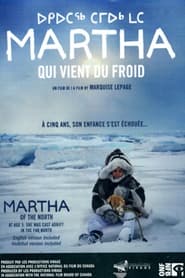
Martha of the North
تنزيل الترجمة English
معلومات الإصدار
الوسوم
معاينة ترجمة English
أول 186 سطر.
Some people call it "the Roof of the World."
For others, it's the North Pole.
This is where I grew up,
in the northernmost inhabited place in Canada,
Grise Fiord.
We came here when I was just a little girl -
me and my family.
That was many years ago,
so some of my memories are clouded.
But others are still vivid.
So that's how I will tell my story -
with some chapters crystal clear and others a bit hazy.
My name is Martha -
or "Maata," as we say in Inuktitut.
I was born in 1950
in Inukjuak in northern Quebec,
on the shore of Hudson Bay.
: Not many people have heard of Inukjuak.
But they've seen it.
The famous film "Nanook of the North,"
directed by Robert Flaherty,
projected images of Inukjuak on screens all over the world.
Back when the film was made,
the Inuit had very little contact with white men
beyond the fur trade.
The rest of the world barely knew the Inuit existed.
"Nanook of the North" is still considered
one of the greatest films of all time,
a cinematic masterpiece.
"Nanook" introduced the world to the magnificent,
untrammelled wilderness of the North
and its hardy, cheerful inhabitants.
The film has been translated into many languages
and been shown on every continent.
"Nanook of the North" premiered in New York in 1922
and was an immediate hit,
turning its creator, Robert Flaherty,
into an international celebrity.
Hi.
1922 is also the year my father was born
in the small settlement of Inukjuak.
My father was called Josephie, or "Josepie."
: Josephie grew up to learn about the land
in the exact location where "Nanook" had been filmed.
- My father spent his first few years
in the bosom of his maternal family,
mainly with his mother,
Maggie Nuyurlutuk.
He was still a toddler
when she fell ill and died very young.
Then, his stepfather,
Paddy Aqiatusuk,
adopted my father, who was now an orphan.
Paddy was known as an amazing carver.
: His works have been exhibited in Europe
and have a prominent place in major collections of Inuit art.
- Paddy was also a skilled hunter.
He taught my father everything an Inuk man needs to know
about hunting and fishing and his ancestral land.
: When Josephie grew up
and started a family with Rynee, the two men stayed close
and were always there for each other.
- My father knew the lay of the land
like the back of his hand. He had travelled
every square inch of it by kayak, dogsled and on foot.
He was a very good hunter.
He could run like the wind.
When I walked with him, he was so quick,
I had a hard time keeping up.
Like the other men,
my father would return from the hunt with plenty of game,
happy to be able to feed his family.
Being a good hunter is a necessity,
as well as a source of pride for the Inuit.
In Inukjuak, when I was small,
I loved to go blueberry picking with my mother.
On Sundays, we'd all go visit family members
who all lived within walking distance.
I used to have lots of fun with my cousins,
and play with the dogs.
We also loved to look after the younger ones.
In those days,
we were a happy family.
My parents were a fun-loving couple.
I remember my father's laugh and the way he smiled.
He smiled a lot back then.
: But life in Inukjuak was never easy.
The winters were long and harsh.
In "Nanook,"
Robert Flaherty praises the courage of the Inuit.
- Robert Flaherty also pointed out
that in Inukjuak and across the Ungava Peninsula,
the climate is so severe that our people
are the only ones who can survive there.
And as he said,
"they do it with a smile."
: This film may well have been instrumental
in convincing the world that only the "Eskimos,"
as they were called,
could ever cope with the harsh conditions in the far North.
It may have just been a coincidence,
but the same year "Nanook" was released, 1922,
a project began to take shape to move Inuit families
from northern Quebec to the high Arctic.
- But it wasn't until the early 1950s
that the RCMP officers approached families in Inukjuak
to tell them about the project.
In 1953, my cousin John's family
was one of those asked to undertake the "experiment."
- They told us that it was for our own benefit,
for our own good.
That our lives would improve
and that we would be living in a better place.
Family and community
are the heart and soul of Inuit life.
Moving far away from loved ones and familiar territory
must have been frightening even for the most adventurous.
: The RCMP reassured the worried Inuit
they were being relocated to a place chosen by people
with expert knowledge of the Arctic.
A place where game was plentiful.
- They told us that there were a lot of animals,
and that we would have an opportunity
to catch a lot of foxes
and make some money if we wanted to.
So they described it in very glowing terms.
Paddy, my dad's stepfather,
also took up the offer to go north.
He left with his wife and two of his children:
teenaged Minnie and little Larry.
I was not quite four
when we got moved,
I was just about four.
- I remember that time. We were getting ready to go -
people were busy packing and families being left behind.
There was a lot to do,
because we were taking all our belongings with us,
even our dogs.
: As well as the plentiful game,
the Inuit were promised
they could return home within two years
if the new place wasn't to their liking.
And since the group was assured they would be settled together,
they could continue their age-old custom
of "lending a hand."
- Inukjuak wasn't very developed at the time,
but there was a health clinic,
a store, a school.
We left all that behind.
On July 26, 1953,
seven Inukjuak families boarded the CD Howe,
an enormous icebreaker,
for the 2,000-kilometre journey north.
- From the moment they were separated,
Paddy must have started to miss Martha's father,
Josephie.
He thought about him all the time,
and within a few months,
he sent a message asking Josephie to join them.
He wanted him by his side.
: To honour his step-father's request,
Josephie agreed to make the trip to the Arctic.
- In July 1955, my parents and we three children -
Peter, six months old; Mary, three years old;
and myself, aged five - boarded the CD Howe,
the same ship that took Paddy
and the other Inukjuak families away two years earlier.
- I had no idea what to expect. But I wasn't worried.
I brought along all our possessions:
our tent, pots and pans, blankets.
Several other families
were also going to join relatives
who'd been relocated to the Arctic.
: They'd all been told
their relatives were eager to see them again
and wanted them to share in the bounty of this new home.
But no one could tell us
the name of the place we were going.
- All they said was that it was great
and there was lots and lots of game.
- Like most Inuit, we didn't own much,
so there were few material possessions to worry about.
The main thing we left behind were the people,
people who were dear to us.
As we sailed away,
I watched the land where I was born disappear.
More English subtitles for Martha of the North
- Martha Of The North 2009 WEBRip x264-ION10 · 11 downloads · 2021-10-12
التعليقات
No comments yet. Be the first to leave one.