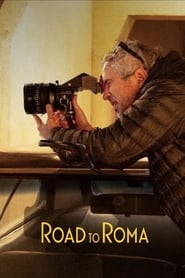
Road to Roma (Camino a Roma)
تنزيل الترجمة English
معلومات الإصدار
الوسوم
معاينة ترجمة English
أول 200 سطر.
A NETFLIX ORIGINAL DOCUMENTARY
Action!
Hurry up! Move!
Move!
The fire is spreading. Hurry!
Now, Poncho!
I think that childhood shapes your life.
I've had a close relationship with cinema since I was very young.
I think cinema is also tied to a feeling of loneliness,
so cinema and loneliness go hand in hand in a way.
The film came together over a period of many years
in different ways.
To be honest, I don't know when Roma began
and when it was just part of the process of remembering.
There was no screenplay at first. I wasn't going to write one.
I wanted to start by recreating the sensory part of it.
I had hundreds of notes about my memories.
Memories that were not just anecdotes and events,
but also small details.
I do a lot of research for my films.
For Children of Men, I did extensive research
into the work of many scholars
who had predicted certain trends for the 21st century.
With Gravity, I focused
on the workings of movement in zero gravity.
But this was all about memory.
My work with the art department, with Eugenio and Barbara,
was never about lists.
It had a lot more to do with abstractions.
They used their own particular memories
to create an interpretation of what I had asked for.
We started having a much more open, extensive dialogue,
than what was merely on a piece of paper.
Those are my comments about this.
We couldn't find the tiles we needed anywhere.
It was hard to find the exact ones since I was only describing them.
Suddenly, while we're looking at locations,
we're in a location that doesn't work, in a bathroom,
but with the exact tiles we needed.
So we came across the tiles, and once I'd seen them,
it threw open so many doors in my memory and I began to remember other details.
It starts being a matter of...
opening doors, and opening doors, and opening doors.
That was the film for me.
Taking as many details I could find in my memory,
and capturing them.
In order to recreate the house, we needed the right furniture.
My family's furniture was spread around Colima, Tijuana...
Some was in Veracruz.
So, we had to start collecting it,
asking family members to let us borrow furniture.
I think we got 70-80% of the actual furniture.
Identical reproductions were made of the ones we didn't get,
which Eugenio took care of.
I had some costume ideas based on my memories,
but it was crucial to check them against photos of the streets,
to see how the clothes I remembered matched the clothes of the time.
Diving into my memory without a screenplay
and with a narrative outline that was very loose,
meant that whatever was real about this film
would be the result of those sensations.
The same mess, but everywhere.
One more thing, the fridge mess.
The fridge needs to be full of bags, parcels, etc.
It should be impossible to find anything in there.
- Aluminum foil and... - Yes.
All kinds of Tupperware.
- Were those around? - Yeah.
All right, then lots of those.
I wanted to be sure that I as I put together a scene,
I'd get a vivid feeling about the time and space
and even the smells from my memories.
- It looks like a pianola, but I like it. - It has a heavy presence.
Exactly, that's right.
That's so cool.
- Is it right in the middle? - In the middle of this.
- Of the cube. - And this as well.
My work on previous screenplays has been very focused on the narrative.
My brother Carlos and I call it "narrative plumbing."
Which is the structure of the story, how information flows,
and how the dramatic weight is split among the characters.
There was none of that here.
We first decided what moments to capture,
and then the story grew around those moments.
That's what's beautiful.
The story emerges from your relationship with what's happening,
with the filmic event itself.
Our other shot, the next shot, is right here.
We need some paint, because it looks very dark.
Maybe we should open this a little bit...
These windows need to be open.
It was a process of remembering, and I suddenly started taking notes.
The character of Cleo is based on Libo, Liboria.
I asked her endless questions every day for weeks on end,
digging in her memory.
I kept a very precise logbook on her daily routine.
Not just her activities, but also the tiniest details.
Like how she sat on the bed after she woke up.
What did she do first? What was the first thing she saw?
Then what would she do? Where would she go?
When she made breakfast, what did she make first?
She was totally on board and found it very interesting.
In Y Tu MamáTambién,
the person who plays Tenoch's nanny is none other than Libo.
I cast her in that role.
Hello? One moment, please.
It's for you.
I was interested in the nanny's story
because Libo and I have had many conversations.
For example, about her childhood in Tepelmeme, Oaxaca.
Tenoch thought he had never been to Tepelmeme,
the hometown of Leodegaria Victoria,
Leo, his nanny, who moved to Mexico City when she was 13.
She grew up with many limitations.
As a kid, I was shocked by her descriptions
of feeling cold or hungry, for example.
As a kid from a middle-class background,
those things seemed abstract, since I was so far removed from them.
When we began the casting process,
we saw thousands of women,
and I didn't care if they were professional actors or not.
I was looking for the right person.
We were constrained in that sense,
because for one thing they had to look just like the actual people,
both in terms of the photographs we had, and what I could remember.
They had to embody the essence of those characters.
And on top of that, they had to be able to act.
I dropped the white vase.
Really?
While I was cleaning, I dropped it.
It broke.
I wanted these people to be who they are.
I didn't want someone to play an indigenous woman.
Rather, I wanted to work with an indigenous woman
and for her to bring in things that I didn't know about.
The mystery of another person one can't ever fathom.
Then he gave me a letter.
But this letter was part of a bunch of letters,
and they all slipped out of his hands and fell to the ground.
And I can recognize Moisés's crooked handwriting.
So I picked up the letter and opened it.
I started having interviews with some candidates.
One of them said she could speak Mixtec,
that she even spoke Mixtec better than Spanish.
We had this short scene, and I said, "What if we try doing it in Mixtec?"
Then immediately, it all made sense to me,
because if we're looking at the disparity that exists in our country
between class and ethnic group,
the effect is even more pronounced when an ethnic group speaks
several indigenous languages other than Spanish.
And yes, it was written by Moisés.
"I can't stop thinking about you. I miss you," he'd say.
- Poor thing. - Him? No way.
I liked the fact that they could speak to each other
in a language that the rest of the family couldn't understand.
They were able to share private moments while speaking their native tongue.
He'd write the same love letter to all the girls.
No way.
That bastard sent the same letter to every girl.
- What? I can't believe it. - He did!
I already raised this, so I need to fix it.
It all went up when she sat down.
One, two, three.
There is also a mostly symbolic element.
The film begins with a shot of the ground,
and ends on a shot of the sky.
But when we show the ground, you see a reflection of the sky.
The shot will begin here, which will be dry.
She is going to use the hose and buckets of water,
to rinse the courtyard.
- Should I take a bucket and pour it out? - Yes, good idea.
Like a curtain falling evenly across the frame.
That reflection starts to become much more alive
and more real than the ground, which symbolizes reality.
On the other hand, it's part of my memories of Mexico.
Something that's still present today: the planes flying overhead.
That sound is closely tied to life in Mexico City.
The presence of other places,
suggested by an object flying overhead, which doesn't belong in the sky.
It's a piece of metal.
Here's the thing.
You have to let the soap suds and dirty water enter the frame,
then wait for the next wave of even darker water.
When the two tones of soap suds come together, it looks lovely.
Quote unquote lovely.
And then it explodes.
The actors were never given the script.
When Cleo comes back...
They didn't know what was going to happen.
That's what we're doing next.
So, there you go. You guys, I'll explain over there.
I had told each actor
things that only they knew.
Once we had blocked a scene, which is always necessary
because we need a camera in there too,
I limited rehearsals, so as not to waste good moments.
Basically, we rehearsed as we shot.
Why are we doing just this part so many times?
You know how in movies they use one shot, then a different shot?
That's what we're doing.
Road to Roma subtitles in other languages
التعليقات
No comments yet. Be the first to leave one.