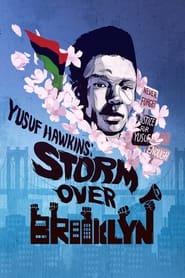
Yusuf Hawkins: Storm Over Brooklyn
تنزيل الترجمة English
معلومات الإصدار
الوسوم
معاينة ترجمة English
أول 190 سطر.
The only thing worse in politics than being wrong,
is being boring.
I'm not sick of winning yet.
And we're crying out as a nation.
Thank you for having me.
(indistinct chatter, static over radio)
Eyewitness: Police? 777,
um, on Bay Ridge Avenue and 20th Avenue,
somebody just got shot. Somebody just got shot.
A bunch of white boys just shot a black guy.
Emergency dispatcher: Where are the people that did it?
Eyewitness: They just ran around the corner on, um, 68th Street.
Emergency dispatcher: They were on foot?
Eyewitness: Yeah, on foot. A bunch of white boys.
Emergency dispatcher: Thank you. Police will be there.
EMS will be notified.
Gerald Dickens: There are certain calls that you never forget.
This was one of the bigger ones
besides the World Trade Center.
When I got here, my tires were smokin'.
When I got to about this car here,
I saw a body lying right here.
His shirt was cut or ripped halfway down his chest,
and as I opened it, I saw the two bullet holes
right over the heart.
I later found out his name was Yusuf Hawkins.
He looked like a good kid.
You know, didn't look like a thug or anything.
I felt his pulse. It's possible he's still viable.
We packaged him, put him in the ambulance,
and then started responding down towards Maimonides Hospital.
There was a police officer from the 6-2 precinct
riding in the front of the ambulance with me.
And, uh, en route, he told me, "This is a racial incident."
He had a sense that there's gonna be problems now in the neighborhood.
Crowd (chanting): Yusuf! Yusuf! Yusuf! Yusuf! Yusuf! Yusuf!
Darlene Brown: My grandparents' house was the center.
Freddy, Yusuf, Amir.
They lived downstairs and I lived upstairs.
Felicia Brown: They would come up, we would go down.
We would sit on the porch. We would make sure, you know,
they didn't go too far when they were young.
Amir Hawkins: Every barbecue, every birthday.
That's where we all met up as a family.
485 Hegeman Avenue.
I've known Yusuf since I was...
Jesus, six or seven.
Amir, Yusuf, and Freddy was outside.
We all started playing,
and we've been hanging out, playing ball,
doing whatever, since then.
Christopher Graham: I moved right next door to Amir,
Yusuf, and, um, Freddy.
That's how we met, 'cause we was neighbors.
And so we seen each other every day,
and we hanged out every day.
If they wasn't at my house, I was at their house,
and Diane, you know, she treated me like her own.
Interviewer: The name Yusuf, where'd that come from?
Well, his father named him that.
My sons didn't know their father,
because Moses was not here.
He left when, uh, Amir was, like,
17 months.
And then I, I never heard from him.
Freddy Hawkins: He wasn't talked about much, you know?
I mean, I thought about him, but, you know...
He haven't ran across my mind that much.
I know people that have their fathers
in their lives, or at least seeing, you know,
them every, you know, their kids every now and then, but...
you know, I didn't see him.
Amir: It wasn't nothing that made us feel like,
you know, we're...
we're short of a family, you know?
Or we're missing out on anything.
You know, now, one might say, "Well, you were missing out on something,"
but we didn't know it.
Mainly it was me, it was Christopher,
it was Luther, and it was, uh, Yusuf.
We rode bikes all the time,
and we used to ride bikes in Starrett City.
We rode from East New York to Bedford-Stuyvesant.
We rode Atlantic Avenue.
We'd ride from one side of town to the next.
Graham: Prospect Park...
We rode everywhere.
We even rode across the Brooklyn Bridge to Central Park.
There was no white people in East New York.
You know. We had Dominicans, we had Puerto Ricans,
but we didn't have no white people unless they was on drugs,
or they was undercover police.
So, regardless of which way it went,
they wasn't gonna get messed with,
because if they was customers,
you don't want to beat 'em up,
'cause you want 'em to come back.
If they're police,
you definitely don't wanna mess with them.
Amir: And Yusuf would get upset
if he didn't know where I was, you know?
Stay away from trouble. Do the right thing.
Just what a big brother should be.
Darlene: Yusuf, he inspired Diane.
He inspired his brothers.
He had that little spark in him. I saw it early on.
Especially that picture that you see when he's standing by the gate
in front of the house.
I'm like, "My cousin's going places."
Graham: I remember one time when, uh,
we was standing out on the block, and it was a,
a friend across the street named Ronnie,
and, you know, ain't no tellin' what Ronnie would have ate.
And it was like some peanuts or some old candy
that was on the concrete,
and Yusuf went over there.
He just started stomping it out, crushing it up.
So I said, "Yusuf, what you doin'?"
He was like, "I'm stomping this out, because somebody here
will eat off the-- off, you know, the street."
That's the kind of person Yusuf was.
He knew that if he would have left it down there,
everybody would have went about their way,
then Ronnie would have probably came back and ate that,
because like I said, there was no silver spoons in East New York back then.
Some people were just going through it worse than others.
Reverend Conrad Tillard: Well, I was transferred to New York
in June of 1988.
At the time, I was the national,
uh, student, uh, and youth minister,
uh, for the nation of Islam.
And of course, the nation represented
the, uh, black nationalist movement, the more militant aspect,
of the traditional civil rights movement.
The mode of operation of the white man is to throw the rock.
Reverend Tillard: I had not been in New York a very long time
before the Yusuf Hawkins tragedy took place.
In the 1980s in New York,
the racial divisions were over the top.
This sort of continuing cycle of police murders,
and racial crime.
Newscaster: Over the past eight years, the number of reported
racial attacks in New York City has increased dramatically.
Newscaster 2: Police say three black men were savagely beaten
by a gang of white attackers at Howard Beach.
One of the victims, a 23-year-old construction worker,
was chased to his death.
Reverend Tillard: People in this post-Obama era
want to look at the, the New York in the '80s and '90s
in the lens of today
just don't quite understand the climate here.
-Reporter: Is there a lot of crime here? -Woman: There is,
against the whites by the blacks,
and that's why they're not welcome here any longer.
If they'd behave themselves in this neighborhood,
maybe they could walk the streets and be free.
Reverend Tillard: And it is in that setting
that Al Sharpton emerged
as the preeminent spokesperson for the anger.
Reverend Al Sharpton: In the name of those that you covered up,
in the name of those that you spat on their grave,
by questioning whether Eleanor Bumpurs caused the cops to kill her,
whether Michael Stewart caused the police to beat him to death.
Every time a black man or woman came to the bar of justice,
you denied him justice.
And now you want to know why your opinions don't matter to us?
'Cause you've proven you're not big enough
to get past the color of our skins.
Newscaster: Wilding. New York City police say that
it's new teenage slang for rampaging and wolf packs.
Newscaster 2: A woman jogging in New York Central Park last Wednesday night,
raped and nearly beaten to death.
Ed Koch: These, uh, alleged, uh, perpetrators,
we always have to say alleged, because that's the requirement.
When those grandmothers say, "But he's a good boy!
He never did anything!" Don't you believe it.
-(phone ringing) -(phone clicks)
I think it was my older cousin Felicia
took the phone call.
And she was like, "Moses. Moses who?"
The three of them were so happy, they didn't know what to do with themselves.
Their father came back.
Luther Sylvester: I remember his dad popped up.
I was like, "Yusuf, who is that?"
He's like, "That's my dad."
I was kinda, like, for all the years that I've known him,
I ain't never seen his father.
Amir: I saw it, you know. My mom got pretty excited.
Interviewer: How'd you feel about him?
-At that time? -Interviewer: Yeah.
More English subtitles for Yusuf Hawkins: Storm Over Brooklyn
- Storm Over Brooklyn 2020 1080p WEBRip x264-RARBG · 20 downloads · 2020-08-15
- Storm Over Brooklyn 2020 1080p WEBRip x264-RARBG · 14 downloads · 2020-08-15
- Yusuf Hawkins Storm Over Brooklyn 2020 WEBRip x264-ION10 · 19 downloads · 2020-08-13
التعليقات
No comments yet. Be the first to leave one.