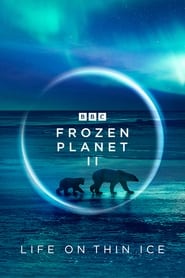
Frozen Planet II
تنزيل الترجمة English
معلومات الإصدار
الوسوم
معاينة ترجمة English
أول 188 سطر.
In winter, at the top of the planet
lies an icy wilderness...
...not of land but of frozen water.
The Arctic Ocean.
Its surface forms an almost solid platform
that is bigger than the whole of the United States.
Its presence and condition
dominates the lives of all the many and varied animals
that live both on it...
...and beneath it.
In the coming months, the sun's warmth
will melt much of it and expose the rich waters beneath.
To survive here, life must adapt to this world
that alternates between ice and water.
After three months of winter darkness,
the sun rises across Arctic Norway.
A newly emerged polar bear mother
encourages her cubs
to take their first tentative steps on the sea ice.
Cubs will stay with their mothers for two years,
learning the skills needed to survive out here.
But thereafter, they will be on their own.
Further out on the sea ice...
...this young female bear, less than six years old,
is already fully independent.
She's superbly adapted to life
on the frozen ocean,
protected from the cold by thick, insulating fat
and a double layer of fur.
This time of year is the best time for feeding.
The ringed seals on which she depends
feed on fish,
and are swimming 40 metres beneath her.
But after ten minutes down there,
they must return to the few gaps in the ice
to take a breath and rest.
She has acute hearing
and one of the most sensitive noses in nature.
She can detect a seal's lair beneath two metres
of snow and ice.
Timing is everything.
Only one in ten attempts is successful...
...So for a young bear, each meal is very important.
But a male has picked up the scent of the Kill.
Large males pose a real threat...
...and could inflict fatal injuries in a fight.
But she stands her ground.
Remarkably, rather than fight...
...they start to play.
And then,
they set off to explore together.
Well fed and still young,
these two seem to be forming a friendship.
She shows off the swimming skills
that enable her to move with ease between water and ice.
She's behind you!
Dancing on ice...
...apparently just for the joy of it.
After three hours together, they part company...
...and return once again to their solitary lives.
Polar bears thrive at this time of year
thanks to the huge platform of sea ice on which they can hunt.
The Arctic Ocean lies
across the top of the northern hemisphere
and over the North Pole itself...
...and is surrounded by three continents -
Europe, North America and Asia.
In winter, the sea ice extends
across an area of over five million square miles.
But off the coast of Arctic Russia,
a tiny pocket of water has been kept open...
...by the continuous stirring of 30 trapped beluga whales.
These four-metre-long arctic whales are superbly adapted
for hunting far beneath the surface of the sea ice.
Nonetheless, being mammals,
they must return to the surface to breathe
every 15 minutes or so.
But this cold spell is exceptionally severe.
And there's not another breathing hole within 20 miles.
Nearby fish and squid disappeared long ago.
These emaciated whales have been imprisoned by the ice
for five months, and they're now starving.
Their only chance of escape will come
when there is a change in the season.
As spring finally reaches the north of the planet,
air temperatures creep above freezing.
The impenetrable ice ceiling begins to fracture.
Small life-saving channels open up...
...bringing freedom.
But spring is a dangerous time for beluga.
As tides and currents pull ice apart,
the beluga find themselves
in a labyrinth of shifting ice floes
that could close their breathing holes
at any point, and so drown them.
Using their sophisticated sonar,
they try to find a way through the icy maze...
...and eventually reach a patch of open water.
They're not the only whales here.
Narwhal,
the unicorns of the sea,
are closely related to beluga.
In a rarely seen encounter,
these two kinds of whales appear to socialise.
Who knows what's going on between them?
But soon, they set off together
through the shifting fields of ice...
...a journey of up to 1,000 miles...
...before they reach ice-free waters,
where they can rear their young.
As the spring sunshine strengthens,
the broken pack ice off the coast of Greenland
becomes a nursery.
A harp seal pup...
...born just a week ago.
He has little fat.
His thick fur
is his only protection from the arctic chill.
In between dozes, he waits for his mother to return.
She has only one pup a year...
...and will produce milk for only 12 days,
one of the shortest nursing periods in nature.
That is just long enough
for him to develop a thick layer of blubber...
...thanks to his mother's milk, which is 50% fat.
And his mother stays alongside
while he learns an important survival skill
for any seal...
...how to swim.
He may not be keen to take the plunge.
The salt water is minus two degrees Celsius, after all.
Pups start with a doggy paddle.
Mum stays reassuringly close.
Still developing his insulating blubber,
a pup is at risk of hypothermia,
So needs to rest
and warm up.
Each day,
he puts on another two kilos...
...and practises swimming
for just a little longer.
Since birth, this pup has tripled in weight,
and he's now at ease in this curious other world.
12 days gone by.
A mother's work is done.
In producing milk, she's lost a third of her body weight.
Now she must return to her feeding grounds.
She will never see her pup again.
The next four weeks he spends alone,
sticking close to the ice platform...
...surviving on his fat reserves
as his downy fleece is replaced by a sleek coat
more suited to swimming.
But temperatures in the Arctic are now
rising faster than ever before...
...creating storms that break up the ice floes
earlier each spring.
Harp seal pups are being tipped into freezing waters
before they're ready to endure long periods at sea.
In some pupping areas,
almost none survive.
As spring turns to summer,
life on the sea ice suddenly begins to proliferate.
The daylight increases,
and algae that had remained dormant
within the ice all winter
begin to bloom.
This upside-down meadow is now cropped
by plankton.
For a little skeleton shrimp
living at the bottom of a towering forest of kelp,
the best way to get a share of the food...
...Is to climb.
If you're only two centimetres long...
...this is like scaling a skyscraper.
And yet it's not alone.
Hundreds of fellow shrimps
are attempting the same ascent.
A new mother
has parked her brood halfway up.
And she's not about to give way.
This one is a determined commuter.
But the mother's drive to protect her young
is now causing a traffic jam.
At last...
...many have made it to the topmost branches
of this underwater forest.
And it's been well worth the effort.
Frozen Planet II subtitles in other languages
More English subtitles for Frozen Planet II
- BBC Wild Isles 2of6 1080p HDTV x265 AAC MVGroup org · 37 downloads · 2023-03-21
- Frozen Planet II S01E06 2160p UHD BluRay x265 10bit HDR TrueHD 7 1 Atmos-GUHZER · 64 downloads · 2023-03-17
- Frozen Planet II S01E05 2160p UHD BluRay x265 10bit HDR TrueHD 7 1 Atmos-GUHZER · 70 downloads · 2023-03-17
- Frozen Planet II S01E04 2160p UHD BluRay x265 10bit HDR TrueHD 7 1 Atmos-GUHZER · 63 downloads · 2023-03-17
- Frozen Planet II S01E03 2160p UHD BluRay x265 10bit HDR TrueHD 7 1 Atmos-GUHZER · 61 downloads · 2023-03-17
- Frozen Planet II S01E02 2160p UHD BluRay x265 10bit HDR TrueHD 7 1 Atmos-GUHZER · 87 downloads · 2023-03-17
- Frozen Planet II S01E01 2160p UHD BluRay x265 10bit HDR TrueHD 7 1 Atmos-GUHZER · 88 downloads · 2023-03-17
- Frozen Planet II S01 Worlds of Wonder WEB · 97 downloads · 2023-01-02
التعليقات
No comments yet. Be the first to leave one.