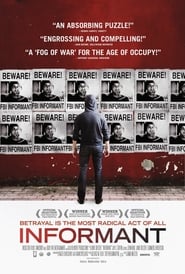
Informant
تنزيل الترجمة English
معلومات الإصدار
الوسوم
معاينة ترجمة English
أول 200 سطر.
Newswoman: We turn now to a story out of Austin, Texas,
that's shocked social justice activists nation wide.
Brandon Darby has admitted to wearing recording devices
and wearing a transmitter embedded in his belt.
He's expected to testify in the trial of two Texas activists
who were arrested on charges of making and possessing Molotov cocktails.
Newsman: Two Texas men are charged with plotting to attack police with Molotov cocktails.
Newswoman: David McKay and Bradley Crowder could face up to ten years in prison.
Man: To say that Brandon Darby didn't give those guys a fair chance
It's a travesty what he did. It's a travesty what he did.
Where am I looking?
Interviewer: Look straight into the camera.
It's not looking straight at me.
You're looking straight at it right now.
- Am I? - Yep, yeah.
- Tell me when. - We're ready. We're rolling.
I'm gonna start over. I'm sorry, man.
I've received a lot of direct death threats.
I've had to go to trial and testify
against someone sending me death threats.
People put images of me with "kill him" on the Internet.
The U.S. Attorney's office offered me
the witness protection program, but this is my home.
This group, they use Molotov cocktails, they threaten violence.
No it doesn't work, man.
Because it's not about them, it's about the whole fucking Left
and their support of these fuckers.
Okay, let's just get you, just talk, speak your mind.
- Okay... - And just try to focus on this...
- and just tell it to us. - Okay, go ahead, man.
This is my home. I'm not going to leave.
as the founder of the New Orleans-based group Common Ground Relief,
which he helped start after Hurricane Katrina.
How's this?
- What is that? - Interviewer: Interview...
Where do I look?
- Always in the camera. - Into that thing?
Strange.
One second for the focus.
All right, I'm ready.
My name is Brandon Darby and I work with the Common Ground Collective
in New Orleans, Louisiana. We're in the Lower Ninth Ward.
We've been here between four and five months,
working with... with people from around the country, and with locals.
To get water and food and medicine, medical care...
The people here were left to die.
What I saw was awful. You know?
If I'd had an appropriate weapon
I would have, I would have attacked my government
for what they were doing to people. I honestly would have.
Newsman: Much of New Orleans is flooded, and now we're having to deal with it.
Newsman 2: It's just this incredible misery.
We were at the New Orleans Convention Center today...
You turn the TV on and you see these images,
and you're like, what's going on?
Newsman: ...with their babies, literally living in raw sewage.
Brandon: It was like wow, this is fucked up.
You know, this is wrong. How could this happen?
Newsman: Just a horrible scene down there.
And my friend's there, and I couldn't get him to leave before the storm.
I had no idea if he was alive or dead.
And it bothered me... profoundly.
'Cause you can't really know the guy and not, not care about...
you know not like the guy, you know, like he's one of those people.
I began to call people, and I said hey,
"You know, we should go get King, you know?"
We're talking and he says, man, let's go get him.
So we arrive.
We had gone through what used to be a neighborhood.
And we saw dead bodies everywhere.
I wasn't even ready to deal with it.
Brandon: Some people had returned, to look for loved ones.
There was a guy whose dad stayed in a yellow house.
A little ways up the road we saw a part of a yellow house,
and we had this big debate on whether we should go tell him
or let him find it for himself?
And we decided that emotionally we couldn't handle it.
So we let him find it for himself.
And we had a lot of those experiences,
going into the city of New Orleans.
And it was really fucking sad, you know?
Scott: So he gets in his truck and he goes across the bridge.
Brandon: I was just determined that,
there was no way in hell that I was not go and get King,
or at least know if he was dead, you know? There's no way.
That's it there.
So this was all underwater.
I parked my truck and I started walking.
I ended up under an overpass.
The law enforcement on the overpass stopped me and told me I couldn't be there.
And I said you're up there, I'm down here.
Sorry. Tough shit, you know?
And they talked and they were like, let us call you an airboat.
I get in the airboat-- it's Army Rangers.
And they're like, well, this is gonna take too long.
And I started getting this really weird feeling that they weren't actually
trying to help me go get my friend.
The one thing I had going for me was everyone was afraid of the water.
And then I said, "You can get me at my friend's house at this address."
I got on a fencepost. And I think it's that fence post.
And I just held on to the fence post, so I could stay up.
And they were saying things like, "You're gonna get so sick from that water.
You need to get out the water now. Come back."
And I was like, "No-- Go get my friend, and I'll get in your boat.
Sorry, go get him and then I'll get in your boat."
And then I had a cell phone call.
Cause I had my phone in my mouth when I swam from here to over there.
And it was him. He was like, "Brandon."
And I was like, "Oh shit, where are you at?
You don't know what, the situation I'm in.
Where are you? Don't tell me you're in Texas."
And he was like, "No, I'm in this boat with these Rangers."
And I was like, oh shit.
It was the Army Rangers who had initially picked me up.
And they, they went to his address and got him.
In a moment, in a, you know, flash of an eye,
how the whole infrastructure could just dissolve.
I had been surrounded by water by this time about maybe ten days.
"Your friend sent us to get you. Do you know Brandon?"
I said, "Yeah" and I just laughed and said, "Wow."
Brandon calls. "I got King." And man, I cried.
And I cried, like it was one of the most joyous times of my life.
Cause I'd almost given up hope that he would be alive.
You have all kind of signs all over the community
saying that we kill looters, but what constitutes a looter?
Scott: They put all these really hateful signs.
But then they decided to take it on themselves
to have armed militia patrols.
These guys were policing their community,
and they identified enemy as black.
And so they had in fact become racist and because
they were armed and they were using that, they were using force,
they had become racist militias.
Scott: We go and we cover up a dead body that was bullet-riddled.
And the question is, who killed this man?
And then there's another one two streets over.
And I'm like, who killed this man?
- Was it the vigilantes? - We shot 'em!
- Woman: They were looters! - You had to do what you had to do.
If you had to shoot somebody you had to shoot somebody.
Don't go into a white woman's home and tell her you're gonna take it over.
- Woman: No. You don't do that. - No.
We don't allow that around these parts.
No way is this happening. Not in front of me, you know?
Not in front of me, I'm not letting this happen.
Even if it kills me, it's wrong.
It's just wrong, I'd rather die saying hell no to this.
And that's what we-- that's the decision we made.
Brandon and I, when we brought guns,
we brought a lot of semiautomatic weapons,
we brought a lot of high-powered rifles.
And we fucking... and us and people from this community
sat on the porch and said, "no more."
Get the fuck out of here. This is not a place to fuck with.
Like this is... it's over.
You know I was ready for guerrilla warfare
and Scott was the one who was actually
and he was like well we need to be prepared for that,
if indeed something else happens and they start trying to kill black people again.
But we also-- here's a chance to organize.
This is gonna be a chance for us as anarchists to do something
that is not just fighting in the streets or resisting corporate power, state power.
Scott and Malik really used their activist connections in a really positive way.
They'd started a clinic, I mean they did amazing stuff.
Man: They were giving out food, water.
If you had medical problems, they were there with everything.
It was amazing.
We put it on the Internet
and we ask people that are activists or organizers in those cities
to print as many of those out and bring them to the churches,
bring them to the shelters, and bring them to the hotels,
and bring them, that will get the word out.
We want to get as many people back home as we can,
as soon as possible.
'Cause they trying to put a time limit on us.
We don't have a church for people to organize it from.
This pastor right here, he says that he's willing to open his home up,
it's called Eagle Wings, open his church up for people to use.
So we already had had a lot of support in the community,
but law enforcement was not happy with us.
I'm Scott Crow, I'm one of the co-organizers, co-founder.
You got any paperwork saying officially who you are?
What kind of group you are?
- I have my ID. - Let me see that.
You know here are a bunch of radicals hanging out
and associating with former Black Panther Party members.
Frankly, I really felt-- and the literature that I read on Common Ground--
That... a mission to overthrow the United States government.
Chief Bryson, the head of the Fifth District showed up,
and he had two U.S. Marshals with him.
He just said "Okay, what the hell are you doing in my city?
What are you doing here?" And I told him, I said,
"I'm trying to foment radical social change, that's what we're trying to do."
We're gonna shine a light on the neglect that has happened in this community.
Lisa: Common Ground was this convergence.
There's the anarchist influence, obviously the Black Panther influence.
We're showing the city of New Orleans that the days of old is gone.
That a new progressive city will be built.
Malik: Brandon Darby, one of the true heroes of Katrina,
is staying in the Lower Ninth Ward, in an act of civil disobedience.
Informant subtitles in other languages
التعليقات
No comments yet. Be the first to leave one.