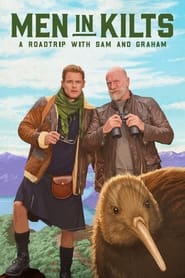
Men in Kilts: A Roadtrip with Sam and Graham
Stáhnout English titulky
Informace o verzi
Tagy
Náhled titulků v jazyce English
Prvních 186 řádků.
[Sam humming "The Skye Boat Song"]
Don't.
Stop.
Yes?
Faster!
We're going the wrong way.
Here we are on our way
to begin the next chapter.
Um, song and dance.
Song and dance, which is
a really big part of Scottish culture.
Scotland:
there is perhaps no other country
where music has played such an important role,
from celebration to battle
and everything in between.
Music and the dances that follow
are forever entwined in the nation's history.
And of course, there is one instrument
that is synonymous with Scottish music:
the bagpipe.
The pipes are a part of everything,
from Highland dancing to marching bands
and even traditional folk parties
like ceilidhs.
There is a musical tradition
that runs deep in Scotland,
as song and dance are how Highlanders
passed on their history and culture.
We can truly feel it in the voices,
the movement, and the passion of the people
who carry on that legacy today.
We've set up camp in the heart of the Highlands,
Glencoe.
We'll be joined by one of the people
keeping traditional Scottish music alive,
Gillebride MacMillan,
who plays Gwyllyn the Bard inOutlander.
-Gillebride. - Hello, my friend.
Not a bad clearing you have here.
-How are you, sir? -Not bad. Yourself?
Excuse me. My mouth's full.
-How you doing? -How are you?
I'm just full of Sam's porridge.
-Um... -Looks good.
Please join us. Take a seat.
So you're a Gaelic speaker.
I am. Gaelic's my first language.
Yes, I had no English before I went to school.
And people still speak Gaelic in Scotland.
We see a lot of the road signs are in Gaelic.
There are about 70,000
Gaelic speakers here in Scotland.
Is it the first language of the western isles?
It is, yeah.
So when I was growing up, it would be the first language
of about 90% of the population.
It's very much alive and kicking.
And then how it lives on, though,
is through storytelling, isn't it?
You must yourself hold a lot of...
a lot of stories and songs.
Yes, I suppose I've got any song for any occasion.
Well, then we have an occasion.
Give us a song.
So... curious.
Were you much of a musical theater guy
in your younger days, when you started out?
Were you doing a lot of singing and dancing?
-No. -No, none?
-No, I have to admit-- -No musicals, no?
No, no, I have to admit
that I can't sing or dance.
I need help... musically speaking.
Well, I-I've had a terrible history with musicals,
and I did sing in Outlander.
- -Uh, that was--
it-it had a mixed reception.
Yeah.
"The Maid Get to the Mill by Nicht."
Oh, God, here we go.
No, I'm not gonna sing it.
-Yes, you know the one. -Yeah.
If you ever travel the world...
-Mm. -...no matter what country
you go to,
I-I always seem to encounter bagpipes somewhere,
-in the most random places. -Yes, absolutely.
I was--I remember Santa Monica in-in Los Angeles,
and I remember hearing
-just on the wind... -Yeah.
...the call of the bagpipes.
Some people really do not like them at all.
Well, I think we're gonna convert a lot of people,
because they are magnificent.
We're gonna meet fabulous Iain MacGillivray,
-and he's such a great piper. -Isn't he?
Such a wonderful ambassador
for piping and for Scotland and for his clan.
Is he not the youngest
chief or commander--
-Clan-clan chief. -Clan chief, yes.
And we're gonna meet him at Doune Castle.
Ah, which holds very, very strong memories...
Very good memories...
- ...for both of us. - ..for both of us.
If those walls could speak...
-This is Doune Castle. -Yes, it is, but...
but is it Doune Castle?
It's actually Castle Leoch.
Castle Leoch, your-your home.
My home, exactly.
That was my room at the top there.
Yeah, it's-yeah, it's the one that's been knocked off.
Thanks.
But we're here to meet
this fantastic piper, Iain MacGillivray.
- Iain. -Nice to meet you gentlemen.
-How you doing, Graham? - Ah.
Good to see you.
Now, tell us about the pipes, though.
It's one of the most ancient forms of music
in all of Europe and especially in Scotland.
And this is a big part
of, obviously, Scottish culture as well.
It's a, you know, quite iconic instrument
and also was, uh, um, was an instrument of war.
It became outlawed, or at least,
you weren't allowed to use it unless it was
part of the military; is that right?
I mean, the pipers were there
to kind of drum the spirit,
and it was meant to put fear into the enemies.
-Totally. -A lot of these pipers
would've been taken to the battlefield,
and they would've marched into battle.
And he would've piped for a bit,
and then he would've handed the pipes to...
whoever, and then...
"You hold these; I'm gonna go fight them."
"I don't-- I hold them the last time.
I'm not gonna hold them this time."
When the British Empire started to spread,
they used the Scots on the front line of battle.
Mm-hmm, yeah.
And rather than just being a lone piper,
it became an orchestral set of bagpipes and drums,
so multiple pipers, multiple drummers.
Mm.
And then suddenly, you come
to this First World War.
-Pipes are still being used. - Yes.
Scots regiments are still in kilts.
-Yes, the marching bands. -Then you get
to the Second World War and this amazing story
of Bill Millin.
A piper stormed the beaches of Normandy
playing his pipes, hurling himself
-across the landing craft-- - Yeah, yeah.
The Germans thought he was crazy.
They couldn't believe a piper--
I love it.
And he marched up and down for, like, half an hour.
Yeah, yeah.
And the Germans stopped shooting at him
because they couldn't believe
that anybody would be this insane.
It-it's quite a remarkable story, that, yeah.
-I mean, it's-- -Ah, it's fantastic.
That-that-that symbolizes
literally the essence of bagpiping
in Scottish music as well as on the battlefield.
Music is so embedded in the culture.
It's in your blood. It's in your blood.
It's-it's in our genes.
That's gonna live with us with the rest of our days,
-and I'm-I'm so proud of that. - That's right.
You've got a little bit of a surprise as well
for Graham.
Well, one of your great-relatives
is Simon McTavish of the North West Company
fur trade in Canada.
-Right. -Well, one of our ancestors,
Willie McGillivray, was his uncle,
so we are distantly related...
-Oh, my God. -...which is pretty amazing.
Men in Kilts: A Roadtrip with Sam and Graham subtitles in other languages
More English subtitles for Men in Kilts: A Roadtrip with Sam and Graham
- S01 080p AMZN WEB-DL DDP 5 1 H 264-FLUX · 72 downloads · 2021-04-12
- men in kilts a roadtrip with sam and graham s01e05 1080p web h264-whosnext · 33 downloads · 2021-03-26
- men in kilts a roadtrip with sam and graham s01e04 1080p web h264-whosnext · 32 downloads · 2021-03-16
- Men in Kilts A Roadtrip with Sam and Graham S01E01 XviD-AFG · 27 downloads · 2021-02-17
- Men in Kilts A Roadtrip with Sam and Graham S01E01 1080p WEB H264-WHOSNEXT · 34 downloads · 2021-02-17
Komentáře
No comments yet. Be the first to leave one.