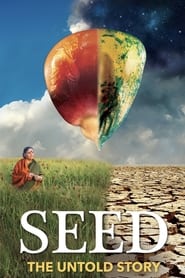
Seed: The Untold Story
Stáhnout English titulky
Informace o verzi
Tagy
Náhled titulků v jazyce English
Prvních 200 řádků.
Subtitles by explosiveskull
When I first came here,
we are a hippy, back to nature, self-sufficient thing.
We were watching too many David Crockett,
Daniel Boone movies
and reading too much Thoreau.
We were trying to seek a different vision.
The first time I saw bean collections and so on,
it was like woo, a jewelry store, lit up,
and I've always just been dazzled by diversity.
I don't like people that are all straight, all gay,
all communist, all Christian,
let them all be there
and absolutely the different kinds of seeds.
My great grandfather was a farmer.
Looking through our family photo album,
I just wish that I could like somehow step into that photo,
say "Hi great grandma. It's me, Billy,
"can I have some of these?"
because I know for a fact
that 90 something percent of the things are now extinct.
They're my family, and they're gone.
I have this horrible vision someday
that the creator would look down
and he'd come look around and say,
"Well, where is this, well where did that go?
"I created this, where did it go?
"How come it's not here?"
I see myself as Noah, not God.
Noah didn't get to decide
whether the crocodiles came on the Ark or not,
or the black flies.
His job was to load 'em on,
ok, that's my job.
I have thousands of varieties that I am maintaining,
People of the future, plant breeders, and gardeners,
they will decide.
What the heck did Will save that for?
I don't get to make that decision.
My job is to keep these all on the Ark,
keep them alive for 40 days and 40 nights
until the flood's over.
I may discover 10 years from now
that that seed will be in huge demand
because it has in its genes
some resistance to some disease
which is only now evolving.
In many many cases,
what I've got is not available anywhere else.
She's my sweetheart.
The year that I fail to grow a variety
is the year it is lost to me.
And in some cases perhaps lost to the planet,
some of these things are right on the edge of extinction.
We have this collection of several hundred
potatoes that are purple or black skinned
and with yellow flesh,
some with a purple skin hot pink flecks in them.
We have in the collection a variety of lumpers.
Most of the Irish in the 1830s and 40s were growing lumpers,
big yielder,
and none of those varieties
had any resistance to late blight.
This is the potato that killed a million Irishmen.
Because of the fact that they were the one or two
or three varieties that were totally vulnerable.
This is the variety that explains why O
is the biggest section of the South Boston phone directory.
Genetic diversity is the hedge between us and global famine.
The diversity in our seed stocks is as endangered
as a panda or a golden eagle or a polar bear right now.
We have the largest seed shortage
in history.
It's this beautiful dance
between the plant and the humans,
that find each other
and make a culture possible.
In Mesoamerica over 10,000 years ago,
corn found humans, and humans found corn.
Corn really is this beautiful co-creation
between plants and humans.
The domestication of corn
was centered in the Oaxacan Valley of Mexico.
The incredible evolutionary leaps that we took with corn
is a miracle.
It ignited this sacred connection that
Corn seeds moved along the entire spine of the Americas.
It became this revolution,
it became this new way of being able to feed ourselves.
It's what fueled you from a small tribe to an empire.
Spies and traders and anyone who was around
and saw what it was doing grabbed a handful and took off.
It took 4,700 years to get it to the U.S. border.
Then about a thousand years ago,
corn is everywhere in what we now call the United States.
Corn becomes so elastic and adaptive
that now we see corn being grown on every continent.
As keepers of the corn,
the corn has come up with us though our migrations,
sustaining us.
Our first mothers were the Blue Corn
and White Corn women.
This is my grandmother, my grandfather,
my mom, my dad, my brother, my sister,
my kids, my grandkids and myself.
We all are one.
My father said "Son,
"never, never let go of the corn.
"When I pass on,
"carry on the way of the corn."
I've always been a farmer all my life.
From the day that I can remember,
I was out there with my grandparents,
my uncles and my father.
The spiritual people gave us the corn.
They say when the corn hears you,
then they start dancing with you with the leaves fluttering.
Crow, crow damage, but we still bring it in.
Everything is brought in.
People are too attracted to the big and beautiful.
But the Hopi woman and man say that
even this little one here is special,
because every corn seed has life.
Everything is special.
And I'll plant these, I'll plant this.
We don't throw them away.
We take care of them.
In the womb, human people are seeds.
We see the seeds,
being planted into the womb of the mother earth.
They may be calling me daddy
and say "Daddy, I'm glad I'm here with you," you know,
'cause these are my children.
Indian people, we talk in one language,
the language of the seeds.
The most important thing in my heart
it's taking seeds anywhere I can go.
My grandfather tell me one time,
"This is very important for life,"
and he put me before he died,
before he died he put me,
full of the seeds in my hand and he said this is life.
And put always in your pocket.
Because if you have seeds in your pocket,
you can walk and eat the seeds
and if you have money, you cannot eat the money.
This is gold! Seeds, they are our own medicine.
When we have to eat, we give a little bit to the earth.
I am working now for seven years in Tesuque Pueblo.
We lost our seeds,
we lost our food.
Pero, when you losing the seeds,
you losing completely your traditional ways of eating.
I bring some of the crops
to these Pueblo people.
Quinoa, Amaranth.
The lost crops of the Incas.
It's part of this prophecy, the condor and the eagle.
Exchanging seeds, exchanging knowledge.
In all these bags you see,
we have different type of the seeds.
This trailer there was not one seed.
Seven years
we fill up with our work, with our sweat,
and this is food for the future.
These seeds,
they're not very happy because they're one
on the top of the other one.
They are beginning to tell us "We need a new house."
A place where they can have a home,
like us.
Native Seeds/SEARCH is a seed bank.
Most of the seeds came to us through Native Americans.
As modern creatures, we're in debt to that.
They are the last expression of these stewards
going back thousands of years
that took care of these things
and made sure that we got them.
I had somebody the other day call this Fort Knox.
There's just so much wealth in here.
There's about two thousand different varieties
of invaluable agricultural crops.
All 38 generations,
all this energy comes down into the seed,
you get to hold it and then all the future
and the millions more that can come out goes out.
And you are at that point when you hold those seeds
in your hands.
Right here is the mother corn.
This is the ancient ancestor from which all corn came.
And that's what we're losing.
I mean we just don't have the time left again
on this small planet to recreate all this stuff.
That's why it's so invaluable.
Once it's gone, it's gone.
Seeds are living embryos. They do have a life span.
We try to grow everything out every 10 years,
that's why we have the 60 acre farm here.
We are hugely vulnerable
with all of those seeds.
Seed: The Untold Story subtitles in other languages
More English subtitles for Seed: The Untold Story
- Seed The Untold Story 2016 LiMiTED DVDRip x264-LPD · 24 downloads · 2017-12-12
Komentáře
No comments yet. Be the first to leave one.