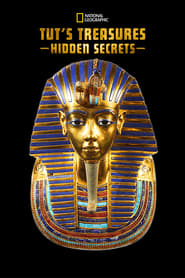
Tut's Treasures: Hidden Secrets
Stáhnout English titulky
Informace o verzi
Tagy
Náhled titulků v jazyce English
Prvních 200 řádků.
Tutankhamun's spectacular treasures.
Now, for the first time since they were discovered,
all 5,398 objects are being brought together in
a new $1-billion museum.
This will be the first time many of them have been seen for a century.
Look at the horse. Look at the horse, look at the horse!
Scientists have been using the latest imaging and forensic technology
to unlock long buried mysteries to reveal the man behind the mask.
So many tiny details are visible again.
Now some of Tutankhamun's most personal items suggest a pharaoh who
was wracked by illness.
And mysterious remains buried alongside him expose the dark secrets of his
royal family tree.
He had a child with his own sister.
Together, they suggest Tutankhamun and his
family were destined to die out.
What was left behind, are the magnificent treasures of a spectacular legacy.
Tutankhamun was the last pharaoh of his royal family line.
He died at age 19 leaving no heirs.
And within decades Tutankhamun's dynasty collapsed and
disappeared from history.
Ancient Egyptian records ceased to even mention the boy king.
Tutankhamun, his father, and his successor were erased from official history.
But experts have questioned how the most famous king of ancient Egypt and his whole
family could have disappeared without a trace.
Now, the most comprehensive forensic examinations of Tutankhamun's treasures are
helping unravel the mystery.
And it's the most personal items, many never seen before, that have shed remarkable new
light on Tutankhamun's short, troubled life.
Custom made shoes, unlike any others from ancient Egypt.
A hoard of walking sticks hidden for decades in the basement of the Cairo Museum.
And the most unexpected and unsettling discovery in the pharaoh's tomb...
two tiny human mummies that were buried with him.
The evidence produced by these finds reveal a life wracked with pain and
tragic personal loss.
A complex and disturbing family tree and political battles that sentenced the
young pharaoh to 3,000 years of oblivion.
Gathered from museum across Egypt, all of Tutankhamun's items are now on their way to
be reunited at the new Grand Egyptian Museum for the first time since
Howard Carter opened the young pharaoh's tomb in 1922.
More than 5,000 objects were discovered, but only a few have been on display...
until now.
Egyptologist Chris Naunton is one of the first people to witness some of the objects
that have been hidden in the vaults of the old Cairo Museum for nearly a century.
-A lot of these things are going to be seen for the first time here in
the Grand Egyptian Museum.
But before they go on display here they are all being all looked at,
assessed for their state of conservation and where work is required,
that work is happening here.
For scientists, it's a once in a lifetime opportunity to analyze all the
objects up close before the new museum opens to the public.
Among the thousands of artifacts, there was one discovery that disturbed
Carter more than any other.
He recorded it in his journals, now kept at the Griffith Institute
in Oxford, England.
-This section of the published report deals with perhaps the most poignant
objects that Carter came across in the tomb.
Inside the treasury he found the evidence that Tutankhamun had not been buried alone.
Piled among gilded shrines and treasure chests,
in a plain and undecorated box,
lay two miniature sarcophagi.
Inside these coffins were two tiny mummified skeletons.
-It's quite clear that this had quite an effect on Carter himself and
that's evident from what he wrote about them.
He says, 'These pathetic remains give much food for thought.
With little doubt, they were the offspring of Tutankhamun, although there is nothing to
tell us emphatically.'
To Carter, they were a mystery neither he nor technology could answer
at the time.
Now Egyptologists are using forensic science and DNA analysis to reveal
the true story of the child mummies.
Among them is Manar el Khial, a conservator at the new Grand Egyptian Museum.
It's the first time she's seen the tiny coffins the mummies were buried in.
-Among many other things have been discovered in his tomb these are particularly
interesting because they look very beautiful and well preserved.
It's also the first time for me to see coffins for baby mummies.
But the skeletons of the babies found in these coffins
weren't fully developed.
They were two premature stillborn girls.
But who were they?
And why were they buried in Tutankhamun's tomb?
It took 21st century DNA technology to provide an answer to this
3,000-year-old-mystery.
Thousands of miles away from Egypt's sand and dust in the mountains of
Bolzano, Italy at the Eurac Institute for Mummy Studies...
biological anthropologist Albert Zink spent a decade perfecting scientific tools to
study ancient remains.
His research included the first ever DNA study of 11 mummies of Tutankhamun's
royal dynasty, found in the Valley of the Kings tombs.
And it was the two still born babies that were the most intriguing.
It was a big mystery, and nobody really knew whether these two children were his
own or whether they were put in as a kind of offering for his afterlife.
Dr. Zink set out to recreate Tutankhamun's genetic map and
determine his relationship to these mummies.
But it was a task with some serious challenges.
-That's a quite complicated and complex process because the DNA,
the genetic information in a human body, it degrades after somebody dies.
And it degrades quite quickly.
It depends for sure on the temperature, the humidity, the environment.
Zink finally managed to extract enough precious DNA from these still
born fetuses to compare it with the DNA of Tutankhamun.
The results suggested these babies could have been the future
of Tutankhamun's dynasty.
-The few markers we had, they showed some similarity to the markers
in king Tutankhamun,
so it's still likely that they are related to him; that these two fetuses
are his own children.
Zink's results suggest that Tutankhamun, the most powerful man in Egypt,
could have been a grieving father.
But now for the conservators of the Grand Egyptian Museum another
tragedy is unfolding.
The babies could soon be lost forever.
It's now believed that having lost his only two children,
Tutankhamun was buried with their mummified remains in his tomb,
to be reunited with them in the afterlife.
After Howard Carter discovered them in 1922 he stored the fetuses
in a local hospital,
where they remained hidden in a drawer for almost 100 years.
But atmospheric conditions have taken their toll on these tiny bodies.
Now, the two stillborn baby girls are in an extremely fragile state.
-It's too bad. It's too bad.
Their condition is poor.
And they may have been invaded by insects.
After so long hidden away,
they need urgent help, otherwise they could turn to dust.
-It is very important to preserve all our cultural heritage but for these fetuses
it is very important to preserve them because they consist of organic materials.
The organic materials are very sensitive to environmental changes.
And they can be invaded by living organisms that can eat these organic materials and
finish them all.
The challenge for the conservators is to stop the decay
before it's too late.
-Their condition is getting worse every day, this is really bad.
It's very, very sad for me.
For the director of the Grand Egyptian Museum, Tarek Tawfik,
the next stage will be crucial.
We need now to see how we will deal with this decay,
how can we can move this very fragile fetuses
in order not to lose any of the archaeological substance.
So, it's a very sensitive operation.
Tutankhamun suffered the private tragedy of losing two children before
they were born.
But it wasn't the pharaoh's only misfortune.
At the new Grand Egyptian Museum outside Cairo, the health of Tutankhamun more
than 3,000 years ago, is taking center stage.
Oh nice!
Egyptologists Salima Ikram and
Andre Veldmeijer are now in the fortified storerooms
to examine some of Tutankhamun's 130 walking sticks found in the tomb.
Many of these haven't been seen for a century.
This one is a more fancy one, with a bit more gold.
These everyday belongings of Tutankhamun give a rare glimpse into
how he actually lived.
-They really are one sort of little window into understanding what this man
was all about.
Salima and Andre are looking for signs of wear to better
understand if and how these sticks were used.
-Because these sticks have been conserved, it's sometimes a bit difficult to tell
exactly how they have been used,
because traces of sweat or person's oils have been obscured
by the conservation process that Carter used.
Despite some lost clues, there's still evidence of wear and tear
that could suggest the young king used the sticks.
A lot.
-On the base you can often see on the tip whether things were used or not.
And maybe some of these tips been replaced even during the course
of Tutankhamun's life.
Sometimes the tips of these ones have sort of worn off, but you can see the variety of
ends used, so maybe some of the end tell us about the function,
so maybe some were designed for 'in the palace', some were designed 'in the temple'
others were designed for walking through sand, which would in fact require a far
more sturdier stick, because you depend upon it more, even if you are
completely able bodied.
With signs of wear, could these sticks be evidence that Tutankhamun
was an infirm king?
Other items from the tomb seem to hint at a king who was not as mobile as a healthy
teenager should be.
An inlayed storage box from Tutankhamun's treasure trove, one of the finest examples of
ancient craftsmanship, suggests he did need extra support.
-It's an image of Tutankhamun himself with his wife Ankhesanamun crouching
at his feet and the king his drawing back an arrow.
But he is doing it from a seated position.
And it somehow doesn't feel quite right.
And there is another very beautiful image of the king and his wife on the lid of
this box as well and in that case is shown leaning on a kind of walking stick.
This is not the portrayal of a vigorous, athletic, young pharaoh.
It's a portrayal of somebody who is perhaps a little bit more vulnerable
and weaker than that, somehow.
This walking stick could be one of those now undergoing examination at the
Grand Egyptian Museum.
So what condition could have caused the young king to walk with a stick?
More items recently restored could hold a clue.
Andre has been working for the last seven years on sandals belonging to Tutankhamun.
This is the big surprise, then?
Yes, you can see it now.
-Wow. That is an amazing piece of work.
These sandals have been rescued from almost complete disintegration.
And the gold bosses.
Sweet piece of work.
More than 80 pairs of shoes were discovered in Tutankhamun's tomb.
Tut's Treasures: Hidden Secrets subtitles in other languages
More English subtitles for Tut's Treasures: Hidden Secrets
- Tuts Treasures Hidden Secrets S01 DSNP WEB H264-SHIIIT · 21 downloads · 2026-06-15
- Tuts Treasuresdden Secrets Series 1 2of3 Golden Mask 720p HDTV x264 AAC · 29 downloads · 2019-05-04
- Tuts Treasuresdden Secrets Series 1 1of3 Treasures Rediscovered 720p HDTV x264 AAC · 41 downloads · 2019-05-02
Komentáře
No comments yet. Be the first to leave one.