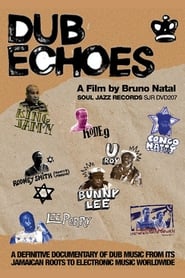
Dub Echoes
Stáhnout English titulky
Náhled titulků v jazyce English
Prvních 200 řádků.
23.976
What is about that little island
that has produced so much brilliant music?
ls it the "suffaration"? ls it the climate? ls it the weed?
Dub music influenced all of those Americans rappers
and all of them, all over the world !
Jamaican music and its practices
engendered the whole of the dance music.
Anyone who's got a bass line in their music
that's dub.
Dub is responsible for the whole musical revolution that we have now.
Dub is the foundation.
l love it. lt's fantastic. lt's what music should be
There's not a lot of thinking about it. You know? lt is just doing it.
You take a beat and you take some sounds and you echo them
and put them through effects...
"Man? You know that song? lt's new!"
New to you!
lf you go back to the late 1 940's
sound systems already were prominent in Jamaica
as a means of bringing the music to the people.
Although there was a thriving jazz scene in Jamaica,
with live jazz music being played at least as early as the 1 920's,
most of these live events catered to the wealthy elite,
so poor people couldn't afford the high price
that these live concerts demanded.
And some of the concerts were also aimed for visitors and tourists.
So the sound system sprung up.
Those guys could rule the whole of Jamaica.
There used to be a sound system named Tom the Great Sebastian,
there was also Duke Reid's the Trojan
and Sir Coxsone's Down Beat, with Machuki.
And Smith the Blues Blaster from the west,
Count Nick the Champ. ..
you had a lot of sound systems.
Someone string up some sound system...
Some.. .
heavily powered amplifiers and speakers,
give a low entry price at the gate,
and just blast rhythm & blues all night.
Because sound system was something l loved the most...
No matter what my grandmother said,
l would still reach dance anyway, you know?
l knew when l come home from dance
l would get locked out,
l had to sleep outside,
but there was no problem, l already had my fun.
To me, that was my greatest fun, the sound system.
and still is my greatest fun.
Exclusivity has always been a major component
of sound system culture in Jamaica.
The way that a given sound system was able to retain loyalty
in a very competitive field.
And, in Jamaica, a way of helping to preserve this
would be to scratch off the labels
so that no one could identify what the song was actually called,
no rival sound could identify what song you had.
Coxsone and Duke Reid started to make their own music in Jamaica.
You get what l mean?
When the rhythm and blues started to dry out,
these guys started to make their own music
to play on the sound systems.
And that's how the record business started in Jamaica.
Sound systems were our radio stations!
You understand?
And when the sound system hit a tune,
all the uptown people started buying it.
ln 1 968, a man called Ruddy Redwood,
operator of a sound system called The Supreme Ruler of Sound,
SRS,
he went to Treasure lsle studio
to run off some material exclusively on acetates,
known in the sound system culture as .
But the engineer forgot to put in the voice
and was gonna stop it and Ruddy said, "make it run. . . "
"Make it play it like that."
"l'll take that to the dance with me on Saturday night."
And that's what he did.
So he played the vocal, which he already had, which everyone knew,
and then he played this version, without vocal.
And he had to play it ten more. .. twenty times.
Tubbs and myself were there that evening.
When that music stopped playing, he put on the vocals fully,
so when they went to Spanish Town and played it,
it was a big hit with the crowd.
So l came back Monday morning and said:
Tubbs over the weekend,
the little mistake they made at Duke's studio,
tore up the place by Rudy's sound system !"
He went back to Duke Reid and said:
"you can put that on the other sound of the record."
And Duke Reid said: "wow, brilliant!"
So basically now, you have a different breed of musicians
who have come up,
like Sly & Robbie, Steelie & Cleevie and the Fire House Crew,
who were basically bands. They were creators.
So they created crazy
and everybody wanted to use them in their projects.
Any studio that was putting out the best sound in dub,
you got Studio One, King Tubby's and Channel one,
a lot of people would flock to these studios
because there was a sound coming from the studio itself.
So it made the studios become popular,
because people would go for that sound,
because they had a sound that they liked,
so they'd go for it. So, King Tubby's, "Scratch" Lee Perry, Studio One,
were the dub king pins of all studios.
And new producers came after Coxsone,
they saw that Coxsone had some good .
So why shouldn't they copy them? And maybe they'd have the same success.
l believe it was as simple as that.
So Coxsone became, in a way, "Coxsone Music",
"Studio One Music",
that was made by musicians at Studio One for Coxsone,
became the backbone of Jamaican music.
Something like... an Alton Ellis' tune,
"l'm Still ln Love With You".
This tune was a hit in the sixties.
Alton Ellis: "l'm still in love with you..."
Ok, good. You say: "ok, it was a hit in the sixties."
Then it was a hit in the seventies.
Althea & Donna.
Did "Uptown top ranking", with the same rhythm track.
You think "ok, it's been a hit twice in ten years,
it will never gonna happen again." Oh yeah?
Sean Paul comes and rides it in the 2000s!
Right? So it's a hit again.
lt was easy to do that
because there was no copyright law in Jamaica
related to recorded music.
But that was straight ,
it wasn't drum and bass.
Drum and bass came in with Tubby's innovations.
You understand?
Tubby started that.
He experimented with a version,
and started to do tricks to the version.
Drop on certain instruments, bringing certain
and things like that. Until it gets like...
And then started to add echo.
And this became exciting.
Thus, dub was born.
What they did was to take the mixing desk
and made that into an instrument.
All of a sudden they pushed the bass and the drum upfront.
And they began to experiment sonically with very little equipment.
A lot of Lee Perry's dubs
were made with two 4-tracks linked together.
That was the foundation of it. l created a brain and a heart.
They created a brain and a heart.
The bass is the brain,
a brain for you to listen,
and the drums are the heartbeat.
That gives you an idea of what the heart is saying in general.
So you put it through a bass drum and make it play.
So that kind of thing gives you an idea. ..
that the bass drum is a living being.
A living been from the heart,
that makes you want to dance.
Dub used to be the name of a plate, they called it a ,
that they would put the dub on.
So people just started branding names, like , dub.
So we would say .
So when you say it's like... back out the rhythm section
and just leave the drum and bass alone.
Dub is electronic music,
that was developed by recording engineers.
We use the music and add sound effects to it,
to come up with different remixes.
Put one spliff fire.
Put me a spliff.
Engineers, in general, just sit at the board
do the electronic part of the music the audio section, like...
You record a music,
record the voices, every instrument, see that it's on the tracks properly.. .
But a producer, no.
He's the man who tell the engineer what to do,
tell the musicians what you want them to play,
and tell the vocalist how you want him to sing the music.
And dub is also when the engineer becomes the artist.
Where the engineer uses his skill on the board
to give a new life to maybe an old .
ln the studio you are making a dub,
you experiment and you know people are going to like it
because you feel the energy of it,
and you experiment with it.
l'm gonna feel it out now.
We don't use music sheets and all that.
lt's just that people are feeling it,
a man sings and a musician feels it, and.. .
, an "A tune" comes.
We started off with these 2-track tapes.
2-track tapes, in the 60s.
Then we moved from them onto 4-track. ..
Those are 4-tracks you see him holding.
Then we moved from those onto 1 6-tracks and 8-tracks.
1 6-tracks and 8-tracks. Then we move onto 24-tracks.
1 6 and 24-tracks.
Then we moved on. ..
Those are some mixed tapes, at a 2-track.
Komentáře
No comments yet. Be the first to leave one.