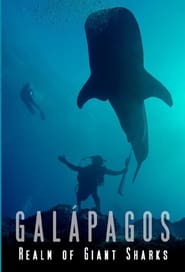
Galapagos Realm Of Giant Sharks
Stáhnout English titulky
Informace o verzi
Tagy
Náhled titulků v jazyce English
Prvních 200 řádků.
A remote island in the Pacific Ocean.
A place forgotten by time.
Here, in one of the last great ocean sanctuaries,
a mysterious parade of giant sharks passes.
Most are pregnant females about to give birth.
What has drawn them here?
And where are they going?
Researchers have come to the Galapagos Island chain to track these dinosaurs of the sea.
To follow them wherever they travel across the globe.
On a journey of discovery
to the Galapagos.
Realm of Giant Sharks.
Jutting out from the sea,
at the far northern end of the Galapagos Archipelago,
is an ancient, crumbling volcano called
Darwin Island.
And just to its south, a magnificent natural arch.
A group of scientists, working under the auspices of the Galapagos National Park,
has just arrived.
In the swirling currents below, something else is slowly approaching.
It's a whale shark, the largest fish ever to have lived.
It's part of a steady stream of giant sharks that passes by Darwin Island.
This team is hoping to find out what draws them to this tiny stretch of ocean,
and where are they going.
They wait on a rocky reef.
Finally,
a massive silhouette appears.
At about twelve meters in length,
this female is almost fully grown.
The team rises up to meet her.
They'll attach satellite tracking devices
anchoring them in the thick skin on her back.
In his log, Team Leader, Jonathan Green, describes the encounter.
The shark had barely flinched.
So at this point, I swim down towards her head.
Once in front, I turn and let the current carry me the full length of her body, past the tail.
Her colossal size is apparent as her body slides by.
The whale shark continues placidly on her way,
seemingly unaware of the procedures going on around her.
Whenever she breaks the surface,
her tags will relay her location via satellite to the scientists.
Ranger, as this whale shark is called,
is now part of one of the most ambitious studies of marine animal migration ever undertaken.
For several weeks, she stayed just north of the Galapagos Islands.
Then she headed south and east to the coast of Peru.
over one thousand kilometers away.
Ranger's is not the only incredible journey documented by this team.
Take the case of Jaws, another mature female.
With tag in place,
Jaws headed north and west
out into the rugged undersea terrain of the Galapagos Rift Zone.
She appeared to be going out to sea.
Instead, she turned around and made her way back to the Galapagos Islands.
Like Ranger, she too went south to the coast of Peru.
Then there's Kimberly, a mere teenager at 5 meters in length.
She arrived at Darwin Island with Jaws and followed her to the west.
Kimberley split off, veering to the south.
Her route took her to another rugged zone known as the East Pacific Rise.
Along the way,
Kimberly zig zagged through the ocean
in a pattern probably associated with feeding.
At a point 3500 kilometers away from Darwin Island
the transmissions showed that her tag had detached and was floating on the surface.
Another creature could have bitten it off.
She may have removed it herself
by rubbing up against rocks.
Or she might have caught by fishermen who discarded it.
Where were these sharks headed?
Were they following familiar routes?
Or possibly shifts in water temperatures,
or the availability of food?
These are questions that captured the imagination of Jonathan Green,
a naturalist and photographer who has worked in the Galapagos for over two decades.
For me, one of the main interests that held me here is as a child,
I was very, very interested in dinosaurs, and this is a real life Jurassic Park situation,
because we've got a 60, 70 million year old animal, in terms of the species.
Sharks have been around for perhaps 300 million years. So they're definitely members of the dinosaur era.
They roam around our earth today, around the planet, and we know absolutely nothing about them.
How can it be that we know more about mice or about the ant than we do about a whale shark?
Whale sharks belong to an ancient class of fish whose bones are made of cartilage,
and to a subclass that includes sharks and rays, the elasmobranchs.
Of at least 500 species alive today, the ground sharks are most common,
including hammerheads and the classic reef sharks.
Whale sharks belong to a relatively small group, called the carpet sharks.
They are known for the particular arrangement of their fins,
and for a distinctive fold of skin near their nostrils and just above their mouths.
These may be sensors, handed down by ancestors that dwelled on murky sea bottoms.
At full size, a whale shark can reach 18 meters in length and 30 tons.
Over a lifetime that can last 70 years, these giants roam the oceans,
scooping up a diet of plankton, krill, and small fish.
Struck by how little was known about how whale sharks live,
Jonathan helped spearhead an effort to get basic data.
He and other dive guides photographed their unique identifying markings,
the pattern of spots that line their bodies.
They submitted these 'Fingerprints' to an international database.
In time, Jonathan enlisted scientists from the Galapagos National Park,
the Charles Darwin Foundation,
and the marine animal tracking program at the University of California at Davis,
in an ambitious project to study the movements of whale sharks that pass by Darwin Island.
Most attempts to track them have begun in places where they come together in large numbers
like the Sea of Cortez, off the Pacific Coast of Mexico.
Here, billions of tiny crustaceans called copepods hatch at once,
turning the sea a milky grey.
That draws dozens of whale sharks to feed on them.
You can often see them feeding vertically to get at the dense food concentrations.
Their arrival is a welcome sight for schools of small fish, which use them as shields.
With a band of skipjack tuna nearby, a school gets as close as it can to the giant shark.
The predators keep their distance.
This is only one of many gathering spots for whale sharks.
You can find them off the coast of Belize,
where they feed on the eggs of snapper fish that spawn here in spring.
Or, you can find them off the coast of western Australia, where coral spawn in massive numbers
just after the full moons of March and April.
Most of the studies that have been done to date
have been focused on aggregation sites where they come together to feed,
and those are mainly smaller individuals, they're mainly males.
We have almost a unique situation here, where we have
a large number of very large, pregnant females.
Nothing is really known about where they go to give birth, how they mate, where they mate.
So there are a lot of questions that still need to be answered out there.
The answers could bring crucial information to the battle to preserve these ancient creatures.
Whale sharks have long been hunted on a small scale for their liver oil,
used as waterproofing for wooden boats.
Known as tofu sharks, they are now targeted by fishing fleets for their characteristic white meat,
and for fins that can fetch around $50,000 each.
Shark fin soup is a staple at weddings and fancy dinners in China.
This custom is believed to be responsible for millions of sharks killed each year.
Whale shark fins are in demand, not so much for soup,
as for bold displays designed to lure shark fin buyers into stores, or customers into restaurants.
Whale sharks are now under the protection of the
of the Convention on International Trade of Endangered Species, or CITES,
and the Convention on Migratory Species.
There is a growing momentum to safeguard them,
especially in countries where tourists spend millions of dollars each year
to swim with these gentle giants.
The docile nature of whale sharks is what allows the Galapagos team to approach them,
then to clip DNA samples from fins or place satellite tracking tags into their skin.
But if startled, a whale shark is capable of moving swiftly out of reach.
At full size, a whale shark is powerful and potentially dangerous.
If the approach is not just right, or the tag inserted too deeply,
the response can be violent.
In the first of three expeditions to Darwin Island, Jonathan Green and his team
managed to tag 14 whale sharks.
To get reliable results, the team needs at least twice that number.
So they are making the 30 hour journey again on a small but trusty expedition boat, the Queen Mabel.
It's the heart of the cool season, and the boat is carried along by north bound
swells generated by a current that flows from Antarctica up the coast of South America.
On his journey to the Galapagos Islands, Charles Darwin noted 'The singularly low temperature
of the surrounding water, brought here by the Great Southern Polar Current.'
For thousands of humpback and other whales,
it offers a free ride north from summer feeding grounds off Antarctica.
The Humboldt Current is thought to have transported many of the unique creatures
that Darwin observed on these islands.
From the mainland, giant tortoises were probably washed into the sea by storms.
The current carried them across the thousand kilometers of ocean to reach the Galapagos.
They gradually dispersed among the islands, each one a world unto itself.
Down through the generations, the tortoises adapted to unique local conditions
and developed differences, especially in their shells.
Iguanas most likely arrived on rafts of vegetation.
Once here, they adapted to feeding within intertidal zones.
It's in the sea that the Humboldt current has had its greatest impact.
You can see its fertile wake in a satellite image tracking chlorophyl,
a tracer for plankton blooms.
In combination with west bound trade winds, it causes deep nutrient rich water
to well up along the South American Coast,
turning it into one of the world's most productive fisheries.
Rising up onto the Galapagos Plateau,
the Humboldt mixes with the cool waters of the Cromwell Current, surging in from the Pacific,
and with warmer currents moving down from the Equator.
That combination sets off an explosion of sea life.
Manta rays arrive to sift the upper levels of the ocean for microscopic plankton.
When conditions are right, sardines, anchovies, mackerel and other bait fish fill the seas.
That can attract legions of striped marlin from around the region and beyond.
Watching for a school to be caught out in the open,
these swift predators dart up from below.
The school closes ranks, forming a bait ball.
Sea lions join the attack.
The school evades them by twisting and turning as one.
But as fatigue finally sets in,
the predators move in to pick off individuals.
Moving through these fertile waters, riding the north bound current,
a mysterious line of whale sharks is headed for a tiny, remote outpost:
Darwin Island.
What draws them here?
That's the question this team is hoping to answer as they too arrive at Darwin island.
The blue skies give way to low cloud and the ocean reflects gunmetal grey.
The morning is spent activating the satellite tags, removing the old leaders,
and replacing them with shorter, plastic covered steel wire.
We then paint them with an antifouling coat
and hang them to dry in the aft.
The guns are ready, lubricated and cleaned.
Boarding a pair of small boats, the team sets out for the turbulent waters of Darwin's arch.
Their strategy is simple:
Wait on the rocks.
If no whale sharks pass by,
they'll swim out into the current to search for them in open water.
After 30 minutes close to the rocks, we head out to the blue
and almost immediately spot a large female whale shark.
Clear markings, probably young, she is pregnant and measures around 11 meters.
I am able to get alongside and shoot the dart through the dorsal fin,
Galapagos Realm Of Giant Sharks subtitles in other languages
More English subtitles for Galapagos Realm Of Giant Sharks
- Galapagos Realm of Giant Sharks 2014 AMZN-Vimeo WEB 720p · 11 downloads · 2017-01-23
Komentáře
No comments yet. Be the first to leave one.