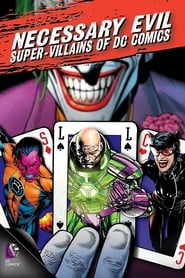
Necessary Evil: Super-Villains of DC Comics
Stáhnout English titulky
Informace o verzi
Tagy
Náhled titulků v jazyce English
Prvních 200 řádků.
Evil has many faces.
A man who laughs.
The master of Metropolis.
The Guardian of fear.
A conqueror of worlds.
Many faces, but just one name:
The superviilain.
Powerful, charismatic...
...intelligent, ruthless.
The superviilain reflects our fears and frustrations...
...the dangers and perils of everyday life.
They commit the heinous crimes we will not.
And in a world where right and wrong are not absolute...
...where shades of gray exist in life as well as the comic page...
...evil isn't just unavoidable, it's necessary.
In the world of comics, one could argue that the villain is even more vital to the story...
...than the just and moral hero.
For without a proper adversary...
...we tack the very essence of story:
Conflict.
After all, isn't it the villain who catapults the hero into action?
Without the villain, there's really no story. The superhero exists and does nothing.
If the villain isn't acting out, Superman stays Clark Kent.
The superheroes are always reacting. The villains are making things happen.
Villains are the ones with a plan. The villains are the ones who are taking the initiative.
If you define "protagonist" as somebody who sets something in motion...
...and "antagonist" as somebody who stops him...
...almost all the villains in comic books are protagonists.
You need that ongoing impetus of the bad guy, the one who's gonna be a challenge...
...the one who is going to threaten society's rules...
...and be put in their place by somebody who upholds those rules.
Not only is there no story or conflict without the villain...
...but it's through the villain that we see our hero at their very core.
We see their many flaws, we see their many weaknesses.
We see what makes them the hero they are.
Without the villain to define the hero...
...you don't have a hero.
You have no anvil from which the superhero is pounded into the shape that he is.
Villains in comic book stories...
...allow the hero or the superhero to really flex their muscles.
The more power the supervillains have...
...the more you can showcase how important that superhero is.
The stronger your villains are, the stronger your hero is. They have to overcome...
...somebody who's smart, powerful...
...who knows what they want and who's on a mission that they believe in.
So if the hero can stop them, you know, it makes them that much better.
All the more true in the DC universe because we have rich villains.
One is Flash and Reverse-Flash. The very names give you what they are.
Reverse-Flash suffered something so horrible.
And he felt like the Flash could have fixed it. He knew that the Flash could go through time.
He'd seen it happen before.
He said, "Why don't you go back, prevent this from happening? Why won't you?"
The guy won't do it.
"Well, he won't do it because he hasn't felt tragedy like I have.
So I'm going to have him feel tragedy to make him a better hero.
You need to be able to take the measures to protect everyone you love.
You wouldn't do it for me. Maybe you'll do it for yourself. So I put you to the test."
The Riddler, he's all about Batman's intellect.
He, to me, is the sword-sharpener. He's the guy that says:
"if you are not clever enough, everybody dies in that way."
He shows in some ways that Batman, at his roots...
...needs to be the greatest detective.
At his heart, he's born in Detective Comics. At the core of the character is Sherlock Holmes.
He's that guy that, because he's human, needs to be smarter than anybody else...
...to solve these crimes.
For me, the Riddler steps on to the stage and challenges that fundamental element...
...of Batman's capabilities that needs to be there almost more than any other.
I mean, that's Batman's superpower. He's the greatest detective of all time.
The relationship between a villain and their rival is more complicated...
...than a question of right versus wrong, good versus evil.
Together, they form a dynamic that is, at times, interdependent.
A villain cannot exist without a hero and a hero, his or her villain.
They're in a symbiotic relationship in that if the villains were to do off the hero...
...I think they would probably find themselves a little listless.
When we did "Death of the Family" story...
...he comes at Batman saying, “Deep down, we really love each other."
And, of course, Batman says, "I hate nothing more on the earth than you, Joker."
The Joker feels that the family that Batman has built around him all these years...
...is dragging him down.
He says, “These people are draining your soul.
These other members, they're sucking the life out of you.
I'm your friend. I wanna make you be the best that you can be...
...so that we can both have a relationship that we could enjoy for so many years...
...without these knuckleheads on the side constantly draining you.
And so I'm gonna take care of them for you, and I will wipe out all these family members...
...so you can be free of their encumbrance."
What the Joker, at his core, is saying is that:
"You might not love us the way that we love you...
...or you might not want to admit you love us the way we love you.
This rogues' gallery that you have," he's like, "All of us love you.
All of us are here only to make you a better superhero."
The question always becomes: What came first, the hero or the villain?
Did the hero introduce himself to society to do better good...
...and because they put on that costume...
...the costumed villain arose to confront him or to challenge him?
Or did the costumed villain arrive first...
...and the hero was created in order to stop that type of villain from succeeding...
...or getting more powerful?
There are threats that Superman has to face...
...where I would tend to think we're grateful Superman is there.
People might say, "if Superman weren't here, would these menaces be coming to Earth?"
Bane comes to Gotham specifically to fight Batman.
This is the Riddler as he originally appeared.
First moved to Gotham because he was attracted by the challenge of Batman.
They both came there to challenge Batman...
...to see if he could be a foe worthy of them, give them something interesting to do.
So the question is which came first?
And I'm not sure if I really wanna answer that question.
The one thing I can say, one can't exist without the other.
As long as we have villains, there will be heroes.
And as long as we have heroes, there will be villains.
But what is it about the villain that keeps us so entranced...
...that captivates and enthralls us?
What makes us applaud the very person we want to see vanquished?
The reasons are often as multifaceted as the villains we enjoy.
What makes a great superviilain is something that we can relate to.
It's the same thing that makes for a great superhero.
In the superhero we have this exaggeration of what our hopes and desires are.
At the same time the villain has aspects of us...
...that challenge the strengths that we're admiring in the superhero.
I would like to think that most people identify with the hero, heh.
But in this day and age there might be some who identify with the villain.
I understand getting a gun that shoots ice and going into a bank and trying to rob it.
We understand temptation.
The oldest stories ever told have to do with temptation...
...whether it's Pandora or Adam and Eve.
This very basic quality in human beings that runs with us throughout our lives.
Now, there are villains like the Joker or Black Hand...
...that are so twisted and dark...
...you love seeing them do their stuff, but you don't relate to them.
At least, you don't admit you do.
Everyone wishes that they could turn invisible or fly or have x-ray vision.
And I think what's cool about villains is everyone wishes that they could break bad.
What's the point of having a villain who can't act out aspects of ourselves that we repress?
I can be evil. I'm gonna give you my husband's number...
...and you can have a long chat with him. Heh, heh, heh.
I think there are some people who really associate themselves with, like, a Superman.
On the other hand, people covet Lex Luthor's keen intellect.
When I was growing up I loved the character of Vandal Savage.
DC had relaunched The Flash with Wally West as the Flash...
...after Crisis on Infinite Earths and his first villain that he fought was Vandal Savage.
He was immortal. And who wouldn't want to be immortal?
And who wouldn't want to have this far reach into history?
He's one of those villains that has nothing to lose. That's a very dangerous man.
You know, he just knows he will be resurrected.
How do you defeat that person?
You look good. Been working out?
You could probably use a little sun.
Then again, who am I to talk?
They seem to be happy. Heh. They seem to enjoy being bad.
Most of the heroes, especially of late...
...they're all broody and sad. They never seem to be enjoying anything.
You look at villains and they're having the time of their lives.
Harley became popular because, in part, she's funny.
She can stand up to the Joker. She can tell a joke. She can get a laugh.
When I go to conventions and I see young ladies cosplaying as her...
...I think they just tap into that feeling of fun and that she can just be kind of whimsical.
Harley Quinn is one of those characters you love.
Even if she's smashing somebody with a hammer, you love her.
There's a handful of those villains, like Larfleeze...
...the Orange Lantern. He's deadly but he's fun.
He's overwhelmed with greed and he'll kill for it. He's still funny because of that.
He comes to Earth and finds out there's a being called Santa Claus...
...who gives people things that you list.
When Larfleeze finds out there's a being called Santa Claus...
...that answers your Christmas list, he makes a giant list.
When Santa doesn't show up, he gets pissed off and says:
"I'm gonna kill him." And he goes on a hunt for Santa Claus.
There's very few characters that you can pull that story off with.
Larfleeze is one of those characters.
But while villains can be fun, as well as fascinating...
...they're also a direct reflection of our own fears.
They force us to examine the deep and personal terrors...
...that we are unable to face in our everyday lives.
When writers create supervillains...
...when children imagine monsters...
...they're trying to make sense of a scary world.
They're trying to feel strong.
They're trying to do so many things.
Villains in some ways, you know, should reflect our fears and our concerns...
...you know, both as individuals and as a society.
They change over time.
But the more important thing the villains present is our more global fear...
...our more human fear, our fear of loss...
...our fear of death, our fear of the unknown.
The villain represents basically everything that we fear...
...or everything that we need to fight against.
Parallax is interesting because the idea that it's a world-eater, that scares the hell out of us.
At any moment some universal malevolence...
...can come and take us over. That's a pretty scary thing.
By the time they were doing the Superman show, I was an adult.
But whenever you'd watch those Darkseid episodes, I'd be like:
"Oh, God, this is gonna be bad." You know...
...anybody who can make Superman bleed...
...is somebody that you don't wanna be trifled with.
Because what are any of us really gonna do against him?
I really made Sinestro and the Sinestro Corps embody fear.
They're cosmic terrorists.
Their mission when they come is to destroy Coast City.
"We're gonna make Green Lantern's town a crater...
Necessary Evil: Super-Villains of DC Comics subtitles in other languages
More English subtitles for Necessary Evil: Super-Villains of DC Comics
- Necessary Evil Super-Villains Of DC Comics 2013 720p BluRay x264-PublicHD · 48 downloads · 2013-11-20
Komentáře
No comments yet. Be the first to leave one.