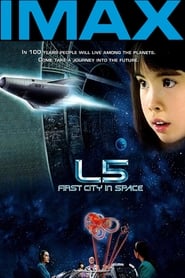
L5: First City in Space (IMAX - L5: First City in Space)
Stáhnout English titulky
Náhled titulků v jazyce English
Prvních 200 řádků.
Torch?
Torch, where are you?
Are you hiding on me?
Torch?
Near the end of the 21st century,
my mother and father and scores of others
left the Earth for a new home.
Torch!
Several years later, I was born here in L5,
the first city in space.
The garden was always my favorite place.
You're a pretty bird.
People said it reminded them of Earth.
Of course,
I had never actually been there,
but I could imagine how beautiful it must be.
Want to make a wish, Torch?
It's lovely here too, living among the stars.
Our city is the gateway to the solar system.
It's home to 10,000 people.
They came here
to follow their dreams of exploration
and expansion to new worlds.
It takes about five days to get here from Earth
on the transfer shuttle.
It's routine now, but it wasn't always so easy.
Transport data recall.
The journey began over a century ago
when our ancestors took the first small steps
away from their home planet.
They faced an enormous challenge then:
how to escape the gravity
that held them pinned to the ground.
They had to design a ship powerful enough
to lift them into space and then return them safely
through the searing heat of the atmosphere
back down to Earth.
There was no fusion power in those days.
The early technology
used more than two million pounds of fuel
to launch a small crew and a few days' supplies
into orbit.
Hey, Houston,
I wish you could see the view we see
on monitor two.
For the first time in their history,
Earth dwellers saw their home from the outside.
It's an incredible sight, isn't it?
Perhaps it was then,
as they gazed upon its fragile beauty,
they began to see
that instead of competing with one another,
they could unite
and explore the wonders of the solar system together.
The first wonder they discovered
was zero gravity.
Suddenly, people were thrust into a world
with no up or down.
They had to learn
a completely new way of living and working
inside their spaceships.
Then the Russians built a space station
called Mir.
Some early cosmonauts stayed inside this tiny outpost
for over 400 days.
The actual living space was only 30 feet long.
Imagine spending a year in such a small place.
As the millennium began,
the first cautious steps away from Earth
turned into strides.
Several different countries working together
designed a much larger space station.
The parts were made on Earth, ferried up on spacecraft,
and assembled in orbit.
It took seven years to build.
The people that lived here
were the first to really adapt to a continuous life in space.
It wasn't long before they were ready
to travel to another planet.
[ELECTRICAL CRACKLING AND MECHANICAL WHIRRING]
Finally, we reached the outer planets.
[CRACKLING AND WHIRRING CONTINUE]
We always sent robot scouts into new territory first.
They were the builders and caretakers
of our outposts.
It was the great dream that people would soon follow
and settle the outer solar system.
To do that, we would need a port in space.
It would have to be a place
with very little pull from gravity
so that ships could come and go with ease.
And so it was that L5,
a point on the moon's orbit around the Earth,
was chosen.
Then a master plan was drawn up,
a grand design for the first city in space.
Of course, people were used to Earth's gravity.
To provide something similar, the living area on L5
would be built in a mile-wide wing
which rotates once every minute.
The centrifugal force from the spin
would produce artificial gravity.
The whole city would be connected
by a continuous main street running around the outside rim.
The farms and animals would be housed
in different layers around the inner ring.
Life would depend
upon a continuously recycled supply of air and water.
The spinning outer rings would be connected
by four giant spokes
to a stationary zero-gravity hub in the center.
This was the entrance to our port
where spacecraft dock.
The entire perimeter of the structure
would be encased in 10 million tons of moon rock
to protect us from cosmic radiation.
A giant mirror would float nearby
to bathe the city in reflected light.
At last, after nearly 30 years, our city was complete.
With each transport from Earth, new citizens arrived.
We captured an asteroid
to mine its metals and fuels for our growing fleet of ships.
Our dream of settling the outer planets
was soon to be realized.
Inside the city's protective skin,
the population flourished and grew.
By the time I was seven, there were 10,000 of us here.
We modeled our neighborhood after small towns on Earth.
There were sensors everywhere which could detect
any sign of contamination or imbalance in the air supply.
Most days, my mother would come by the playground
on her way home from work.
She was a doctor
and had been one of the first people selected to come here.
Eric.
See you soon. How's your hand?
She seemed to be friends
with just about everybody.
Can you...?
Good stuff!
Her father-- my grandfather--
was a pioneer founder of L5.
Oh, Chieko!
What's this, Mom?
Well, it was supposed to be a surprise,
but you're a little too fast for me.
Do you like it?
I love it. Thank you.
You're welcome.
My father was a flight commander,
an engineer.
He'd explored almost all of the inner planets,
and now he was designing an expedition
to the Neptune system.
When we wasn't working,
you could almost always find him at home in the kitchen.
Every kitchen at L5
had a built-in hydroponic garden.
The big farms on the inner ring were hydroponic too,
though sometimes we used moon soil.
What can I do now, Nancy?
You can help me collect the cucumbers.
In many ways, it was just like Earth here.
We grew all kinds of fruits and vegetables
as they do,
but in space, we could control
the amount of sunlight and the seasons
so that everything was available all year round.
I loved to grow things.
Back then, I wanted to be a farmer.
[CHICKENS CLUCKING, GOATS BLEATING]
Here on level two,
all of the farms fit into only 150 acres.
We raised the usual animals, but not very many cows.
They took up too much space.
Hi, Alice. Hi, Andy.
Come on.
Good girl.
Hi, duckies.
Of course,
I visited Earth farms on virtual trips,
but still, I often wondered what it would really be like
to lie in a field and watch the clouds roll by.
I knew all about Earth's giant oceans and rivers,
but it was hard to imagine so much water.
Every drop of ours had to be imported and recycled.
L5 was a world of perfect harmony and balance.
Then everything changed.
I've been doing some calculations...
It began one day
when I went to visit my grandfather at his lab.
I was surprised to see my father there too.
The amount of fuel it would take
to lift the water...
I'll never forget what I heard.
Our life-support systems had reached their limit.
Unless more water could be found soon,
there wouldn't be enough to sustain us all.
I have something to show you, Mori.
My grandfather was L5's senior scientist.
L5: First City in Space subtitles in other languages
More English subtitles for L5: First City in Space
- L5 First City in Space 1996 BD · 14 downloads · 2021-11-29
Komentáře
No comments yet. Be the first to leave one.