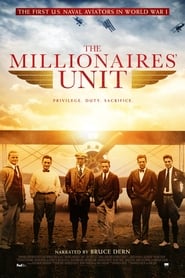
The Millionaires' Unit
Stáhnout English titulky
Informace o verzi
Tagy
Náhled titulků v jazyce English
Prvních 200 řádků.
We made a sort of compact
that if war came, we should go into aviation.
That was the life.
It is certainly great up there,
and you own the world when you get up alone
and can do whatever you want.
Have you ever had your wildest dreams come true?
In the summer of 1916, two college juniors from Yale
started an air militia in preparation
for America and entering World War I.
They were there first.
They were there in the beginning and everything that follows
flows from their early efforts.
As sons of some of the wealthiest and most prominent
families in the country, their exploits
were noticed by the press who dubbed them The Millionaires
Unit.
This was a group well-educated,
affluent young men who voluntarily took up
the challenge.
They didn't have to.
The men of the Yale Flying Club
had a sense of duty, honor, country.
They felt they were privileged and had an obligation to lead.
They determined to learn
to fly when aviation was still in its infancy,
and they aimed to convince the Navy of their fortitude
and resolve.
Through their initiative, these daring young aviators
became the first to fly for the United States in World War I.
Some of them making the ultimate sacrifice.
The gates of honor
opened to us, those lucky ones of us who are over here.
We need not fear that we're not prepared to die for no matter
what we have been in the last glorious moments,
we can die not as the ordinary man,
but fighting for the ideals we hold so sacred.
We were still pretty young
as I was 18, my brother, 16.
We went to Alaska and had some very good mountain
sheep and caribou hunting.
When we went into the interior by pack train,
the world was at peace.
We met on the trail one day a prospector,
and he told us the world was at war.
He was a little mixed up about who was fighting who,
but he knew there was a war on.
When we heard about that, we decided
to cut short our trip short and go home, which we did.
It was quite a shocking experience
to have it come at you that way.
There was just peace and then war, as far as we knew.
Frederick Trubee Davison.
Most of America was as unawares as Trubee Davison
of the tensions that threw Europe
into the most cataclysmic event yet known to mankind.
Trickling across the Atlantic came
news of the horrors of the first war of the Industrial Age,
fought with new technologies.
The machine gun, the tank, the airplane.
World War I would mark the end of the Age of Empire
and the destruction of decades of peaceful productivity
and cultural exchange.
The United States would eventually
be drawn in to the great war across the ocean, spearheaded
by the new field of naval aviation.
The courage and enterprise shown by these pioneer pilots
forever changed the character of the Navy
and the ways in which wars would be fought
and peace would be won.
A small group of college students
affected a large part of that change.
They were known as the First Yale Unit.
They formed the founding squadron of the Naval Air
Reserve, and in the years that followed
they helped lead military aviation through two world
wars, the Cold War, and played major roles in America's
ascendancy as the dominant power on the world
stage in the 20th century.
The sinking of the British liner Lusitania by a German u-boat,
taking the lives of 128 Americans,
was a shocking reminder to the United States
of the war on the other side of the Atlantic.
For young Frederick Trubee Davison,
it was a harbinger of what would consume his life
for the next four years--
stopping the German u-boat.
In the summer of 1915, after his freshman year
at Yale University, he accompanied
his father, Henry P. Davison, on an eye opening trip to Europe.
H.P. Davidson was the senior partner
of JP Morgan and Company.
As the most powerful bank in America,
Morgan and Company was in the unique position
to lead the sales of securities that
helped finance the British and French war effort.
This business trip entails some high stakes bargaining
as America was officially neutral when the war started,
and President Woodrow Wilson was up for re-election.
That was, indeed, in 1916.
He ran on a platform of, with the slogan,
he kept us out of war.
And he intended to continue to keep the US out of war.
So Trubee joined his father
on one of those trips, in part to see how his father was
working and to learn the ropes.
The young man accompanied his father
on a whirlwind of meetings and dinners
with the British prime minister and other senior officials.
He couldn't help but start thinking
that there was no way that Americans
would be able to ride it out.
That they would get involved and be drawn into the war.
Trubee saw an opportunity
where a young man could help with the war effort
and gain some experience.
He spent the rest of the summer driving ambulances
from the Paris train stations to the American hospital
and got a good hard look at the effects of war.
When Trubee Davidson
was returning after that summer of ambulance driving,
he was on a ship with Robert Bacon, one of the organizers
and financiers of the squadron of the aviators called
the Escadrille Lafayette.
And he discussed that effort to create an all-American Air
Force with the French.
And that implanted the idea in Trubee's mind
that maybe what he'd like to do is create his own little Air
Force in the event that the US should get into the war.
FREDERICK TRUBEE In 1915, I
at least saw enough of the fellows over there
to know that if we ever got into the war, where I personally
wanted to be was in the air service.
That put the bug in my Bonnet.
When I was back to college in the fall,
I picked up Bob Lovett and poured it in his ear.
We made a sort of compact that if war came,
we should go into aviation.
That was the life.
Perhaps the epitome of the Yale gentleman
was Trubee's classmate, Robert Lovett.
Composed and aloof, Lovett was voted
as the most brilliant, hardest working, and most thorough
gentleman at Yale.
But while Trubee had been driving ambulances
near the front, Bob had spent the summer
driving sports cars and motorcycles in the Swiss Alps.
When I look back
and I read about my grandfather and his Yale years,
it paints a picture of a very different man than I knew.
To read that he was the head of the prom,
that he was involved in the acting program at Yale,
these were surprising to me because these would indicate
to me that my grandfather was an extrovert and charming,
lively fellow who went out for a good time,
and this was not the grandfather I knew.
After their eventful summers,
both Trubee and Bob returned to Yale for their sophomore year,
and each set about to prove they had sand, grit, and spirit that
made them popular on campus.
I think there's
a certain amount of truth to the statement
that Yale was heavily social before the First World War.
Everybody at Yale wanted to be in a club,
wanted to be in a team, wanted to be
in one kind of organization or another.
And Trubee Davidson was one of the kind of people that
thrived at a place like Yale.
While still reflecting on his experience
with the victims of trench warfare,
Trubee found it difficult to focus on school,
and his thoughts turned repeatedly to aviation.
At the beginning of the war, airplanes
were still seen as the dominion of aristocrats
and wealthy sportsmen looking for adventure.
As aerial combat evolved, there was
romance in the idea of warrior knights of the air.
Jousting one on one.
A romance completely lacking in the trenches
of mechanized warfare.
But Trubee and his generation of friends
were also motivated by a sense of duty.
The idea that of those to whom much is given, much
is expected.
If the United States was going to war, they want to take part
and they wanted to fly.
They were highfalutin.
They aimed beyond their human capacity
to fulfill as any good rule should.
And they were based a lot on ethics and religion.
What a man did and did not do.
And it formed a kind of a behavioral code,
far more than it does now.
Yale had a obligatorily chapel attendance
every day of the week except Saturday.
This is a time when what has become almost
the Yale anthem became popular.
It's called "Bright College Years."
And the final lines in that are, so
let us strive that ever we may let
Komentáře
No comments yet. Be the first to leave one.