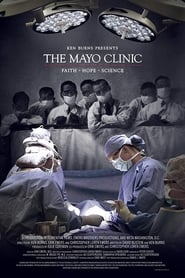
The Mayo Clinic, Faith, Hope and Science
Stáhnout English titulky
Informace o verzi
Tagy
Náhled titulků v jazyce English
Prvních 200 řádků.
Man: "The sum total of medical knowledge is now
"so great and wide-spreading that it would be futile
"for any one man to assume that he has even a good
"working knowledge of any large part of the whole.
"The very necessities of the case are driving practitioners
"into cooperation.
"The best interest of the patient is the only interest
"to be considered, and in order that the sick may have
"the benefit of advancing knowledge, union of forces
is necessary."
Will Mayo.
Narrator: On the early evening of August 21, 1883,
Will and Charlie Mayo, the young sons of a local doctor
in Rochester, Minnesota, were practicing eye surgery
on a sheep's head at a slaughterhouse
when the butchers urged them to go home immediately.
A powerful storm was coming.
One of the worst tornadoes in Minnesota history tore through
the northern end of Rochester.
Dr. William Worrall Mayo and his two sons treated scores
of the wounded in homes, offices, hotels,
even a dance hall.
Amidst the chaos, the elder Dr. Mayo asked to see
Mother Alfred of the nearby Sisters of St. Francis.
It was summer, vacation time at the convent school
she oversaw.
The students' rooms were empty, he said;
could they use the beds for the injured.
She agreed.
Afterwards, Mother Alfred told Dr. Mayo that she had received
a vision from God instructing her to build a hospital
in Rochester with Dr. Mayo as its director.
It would become, she believed, "world-renowned for its
medical arts."
Within a few years, Mother Alfred's vision--what people
would call "the miracle in the cornfield"--came true.
In one of the most unlikely of partnerships, and in one
of the most unlikely of places, the Mayos
and the Sisters of St. Francis
would end up creating what many believe is
the greatest medical center in the world.
Woman: I think that there is a reason so many people come
to Mayo Clinic and have been for so many years.
It has such a long history and such a good reputation.
Mayo was the right place to go and my parents
could see that, too.
When I first came, the history was powerful to me.
We read the description of how it was built after
the tornado.
There was a sense of support in the history and in
the beliefs that those nuns had had that carries on today,
not even in a religious sense, but just you feel supported by
that faith and hope.
Yeah.
Let me have that valve.
Man: I was a child growing up in the Midwest,
and the Mayo Clinic was a secular temple.
It was something that we could all be proud of even if we had
no association with it.
And it was there in Rochester, Minnesota, like it had
risen up out of the earth in some way.
Narrator: When William Worrall Mayo and his sons began
practicing medicine together in Rochester, Minnesota, a small
town 90 miles southeast of Minneapolis, there were only
a handful of doctors in the whole county.
That 3-person practice has grown into an organization
employing more than 64,000 people, with campuses
in Florida and Arizona and affiliates all over the world.
For 150 years, the Mayo Clinic has been confronting age-old
questions about our commitment to taking care of each other,
about the role of money and profit in medicine,
and about the very nature of healing itself.
Man: Imagine for a minute that you've been told that
the doctors don't know what's wrong with you
or can't help you.
And then imagine if you will that you contact Mayo Clinic
and Mayo Clinic says "We can help you."
Imagine what that does for that patient in terms of hope
and inspiration and opportunity going forward
for healing.
That's what this place is about.
Narrator: Each year, more than a million patients arrive
at the Mayo Clinic from all 50 states and 150 countries.
During any given 24-hour period, there will be as
many as 14,000 patients,
9,000 examinations and 300 surgeries,
5,000 lab specimens will be evaluated,
4,600 diagnostic procedures will be conducted,
with 230 radiologists able to read
the results and report back within 90 minutes.
In an age when most doctors operate independently and are
financially rewarded for ordering a battery of tests
and procedures, every physician at the Mayo Clinic
is on salary, creating a culture that thrives
on collaboration.
Dr. Mayo had a simple philosophy he tried to impart
to his sons: "The needs of the patient come first."
They wouldn't treat diseases.
They would treat people,
and they would do it with the Sisters of St. Francis.
Man: Medicine is a science,
but how we interact is layered with all kinds of other issues--
all of which have to do with health.
And so if they don't have faith in the caregivers,
if that patient doesn't have hope, we're gonna have a lot
of trouble, you know, even attempting to make them better.
Faith, hope, and science-- those three things are
absolutely critical.
Man: "My own religion has been to do all the good I could
to my fellow man, and as little harm as possible."
William Worrall Mayo.
Narrator: One day in 1846, a 27-year-old aspiring doctor
named William Worrall Mayo went down to the docks
in Liverpool, England and got on a ship headed to America.
He had been born in 1819 to a middle-class family
near Manchester.
His father was a cabinetmaker who died when his son was
7 years old, leaving his wife with 6 children to feed.
At 14, W.W., as he would be known,
became a tailor's apprentice, where he gained experience
with a needle and thread that would prove invaluable.
He was small, just 5'4", wiry, and formal, with memorably
piercing blue-gray eyes.
One of his grandsons would describe him as "snap-tempered,"
"strange, ferocious, striving, and restless."
He had studied with the famous chemist John Dalton,
who promoted the theory that all matter is
composed of atoms.
Dalton was also a Quaker, and he instilled in W.W. Mayo
a commitment to the scientific method, to hard work, and to
social justice.
When W.W. arrived in America, his first job was as a chemist
at Bellevue Hospital in New York City, where he saw the
full range of human suffering.
Man: Hospitals were places where the perception was,
that's where you go to die.
There really were almost no rules or regulations.
They weren't sterile places.
And there really weren't doctors, as we perceive
of them today.
There were no standards, in terms of education
for individuals that claimed they were doctors.
And also, there were a lot of quacks that toured the country
proclaiming cures for this disease or that disease.
Narrator: Determined to be a real doctor, W.W. enrolled
at the Indiana Medical College.
After graduating in 1850, he married Louise Abigail Wright,
a 25-year-old strong-willed woman, who would become
his first assistant.
They moved to Lafayette, Indiana, where he opened
a practice in a small drugstore.
When W.W. contracted malaria, he left the mosquito-infested
marshes of Indiana, telling Louise he was going to
keep going, "until I get well or die."
By the time he arrived in St. Paul, Minnesota, he was well.
But wherever he traveled, there were either
too many doctors or not enough patients.
So for the next 10 years, he worked as a surveyor,
riverboat pilot, newspaper publisher, and veterinarian.
The Civil War brought Mayo's travels to an end.
At age 43, he was appointed examining surgeon
for a regional enrollment board on the edge
of the frontier in Rochester, Minnesota.
When Louise and their children caught up with him
in January of 1864, she told him, "No more.
We're not moving again."
Although two of their children died in infancy, they would
eventually have two daughters and two sons, Will and Charlie,
whom they would raise "in medicine,"
the boys remembered, "like farm boys on a farm."
While W.W. Mayo was trying to determine
who was fit to fight for the Union Army,
thousands of other doctors were
practicing on the battlefield a medicine that was
almost medieval.
Most of them had never seen a bullet wound, let alone
performed surgery.
Many sharpened their scalpels on their boots, carried
surgical tools in their pockets, and used their own saliva
to wet the silk used for sutures.
After the war, Mayo began to build a practice in Rochester,
and his reputation grew.
He usually saw patients at his downtown office,
but in an emergency, he thought nothing of taking off
late at night in the middle of a snowstorm and driving his
horse and buggy at breakneck speeds to get to a patient's
log or sod home miles away.
He'd quickly determine the best place to operate,
then proceed to deliver a baby, set the bone of a farmer,
or amputate a leg ravaged by gangrene.
If the patient was poor, W.W. wouldn't charge him.
He also immersed himself in the latest medical journals,
and began contributing his own articles as his
expertise increased.
Mayo made several return trips to Bellevue Hospital, where he
attended lectures, observed operations and autopsies,
and marveled at its ambulance corps,
the first in New York City.
But he was most impressed with an imported German microscope
that cost $600, a fortune.
Komentáře
No comments yet. Be the first to leave one.