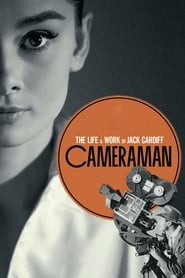
Cameraman: The Life and Work of Jack Cardiff
Stáhnout English titulky
Informace o verzi
Tagy
Náhled titulků v jazyce English
Prvních 200 řádků.
Good evening.
For those of us here tonight that are 70 years old or younger,
Jack Cardiff was shooting film before we were born.
I don't do many interviews.
But when I was invited to speak about Jack Cardiff, my friend,
I couldn't resist,
because Jack Cardiff is a...an amazing guy.
Every time I saw certain names,
and one of the names that kept cropping up was Cardiff.
Every time I saw these names, I knew I was in for something very special.
And I began to have a very strong affinity towards British cinema,
because of my recognition of Cardiff's name, actually.
The way a movie is photographed creates a mood,
and creates the mood of the movie,
so that the audience is prepared for the kind of movie it's going to be.
Cinematography is central to film.
Motion pictures is... is the art form of the 20th century,
and you can't do them without the camera.
Going over to Bogie, he's dead.
She's dead, she's dead, she's dead. She's alive.
I'm just alive.
It's fantastic, isn't it?
- (lnterviewer) You've outlivedthem all. - Yeah.
Incredible.
I don't know. Do you think it's a tragic industry to be in sometimes?
No, I don't think so, I think it's a nonsensical thing...job to be in,
because it's full of, um...
full of hypocrisy, hyperbole.
Just about everything you can think of.
At this moment your room is still not ready.
- Thank you. - Your name?
If anybody said, "Who is that guy? "
because I don't think anybody really knows who I am,
I'd say, "Well, I used to be a stand-in for Frank Sinatra."
- That was made 50 years ago. - Cinquante ans.
How are you?
Pleased to meet you.
- Nice to see you. - Hello.
Come up a bit on this one,
and they're putting on a narrow one on the number four.
How oldare you now?
A couple of weeks ago, I was 91.
- Andyou're still working? - Yes, well, not for long.
Another ten years, and I'll have to take it easy, I think.
- Can you put it on now? - Yes, sir.
Where you are now with the smoke. That's it.
- When didyou begin, Jack? - In this business?
Er...well, I started in 1 9...
1 91 8.
As a kid actor. That's a long way back, isn't it?
And that's myself when I was about five years of age.
- You'dalready been in a movie. - Yes, I had.
Do you remember, as a child, the fiirst fiilm you acted in?
Very, very fuzzily. I know that it was called "My Son, My Son".
I was four years of age, and it was a silent picture, of course.
The director used to shout the instructions through the megaphone.
"Now smile a bit, look over to her. You love her. Come on, you do this."
That was...that was easy, you know.
In between stage shows,
my mother and father would work as extras sometimes.
The standard rate of pay in those days, the extras got one guinea a day.
And there was something like, I don't know, 1 50 or 200 extras.
They were paid at the end of the day by filing past a little booth.
After a while, they realised what they could do,
they'd get to the end of the queue and they'd change hats,
or put on a different coat,
and they'd go by and they'd take another guinea.
They were making a fortune until they were found out.
The queue was filing by for hours collecting guineas.
I had a different home every week.
I went to about 300 schools in my youth and learnt practically nothing.
So where didyou pick up allyour skills?
I read a pornographic book by Frank Harris.
But in between the porn, there was all these great names he mentioned.
He'd met all these great writers and painters and musicians.
And I went out to Foyles
and bought all the books he mentioned in his book, and I read the lot.
That started it, and I kept on reading ever since.
So you learned in between bits ofipornography?
Yes.
The first job I had was really a kind of runner boy. I was...
The director had some kind of flatulence problem.
He was... he had to be given Vichy water.
I had to hand him fresh, cold Vichy water at any time of the day,
so I had to sort of have it all ready.
That was a silent picture.
And then the next picture was the beginning of sound.
Hitchcock was in the next stage.
When sound films first came out, they had to be, obviously, synchronised,
and to do that we had clappers.
which was just two pieces of wood that did that,
and then you'd put the sound against the picture as it closed.
And the first clappers, they thought it was such an important function,
that they gave it to the director,
and he would solemnly announce the scene
and then clap and sit down and say, "Action."
It was considered a very vital thing.
But after a while, he found it was a bit of a bore doing that,
so they put the job with the young clapper boy, as he was called.
He was a number boy, and he became a clapper boy, and I used to do that.
4 take 1.
While I was at B&D Studios, I was working on British quota pictures,
which had to be completed in two to three weeks.
I was then operating the camera, and you couldn't make any mistakes
cos they'd never do another take, there wasn't time or money.
Korda brought over a lot of very good people
and, I think, was instrumental in founding the sort of British school, if you like.
I mean, he gave people the opportunity to learn from masters of their craft.
Run, run, Orlando.
A lot of fascinating stars were coming over, and big directors,
and, what was most important, very good top Hollywood cameramen.
What are you waiting for?
Dietrich was a big sensation, of course,
and she...she used to put gold dust in her hair.
She knew about lighting, she'd worked with Josef von Sternberg.
She would have been a great cameraman,
and she knew that that lighting had to be so high,
45 degrees, to make a shadow under the nose,
and most cameramen over the years have done the same sort of lighting.
She had a slightly turned-up nose. Like Marilyn Monroe, in fact.
So to straighten it out she had this white line down here,
and then inside here, inside the eyes, she put this white.
See this white inside. It must've been painful to do this.
She looked gorgeous. But she was in command of the lighting.
She used to have a full-length mirror by the side of the camera.
She'd look in the mirror and say, "Harry, the back light could get a bit hotter,
"and how about the kicker light? "
She used to comment on it,
and Harry would whisper to me, "Goddamn it, she's always right."
- Have you had luck so far? - Wonderful luck.
And the most wonderful of all was to meet you.
- Do you think so? - Yes, I do think so.
Even if tomorrow means the end of us...
...as it may do.
What about this one?
We had this scene in the bath,
and she came on the set,
and we thought she was going to be in a swimming costume,
which was the usual thing.
When she took off her dressing gown, she was stark naked.
Within half an hour of doing these shots in the bath, the place was crowded.
There was about 1 6 electricians on the spot rail
trying to look technical, holding lamps and things.
The ground, which was a paper floor, was getting wetter and wetter.
And as she got out, she slipped on the soapy water, and fell with a crash,
and the towels missed her completely, east and west in the air,
and there was the great Marlene floundering about on the floor,
stark naked.
He started very early in colour.
Started about when they started doing colour, I believe.
It's a different medium, really.
You light in a different way, which, of course, is the cameraman.
The Technicolor people had come over
to choose one young operator to be trained in Technicolor,
and they came out shaking
because the technical questions were absolutely...very, very tough.
So, when it came to my turn, I said right away,
"I'm afraid on the technical side, I'm zero,"
and there was a shocked silence,
and they said, "How are you going to get on in the film business? "
I study painting and light and lighting buildings and so on,
and they asked me, "Which side of the face did Rembrandt light? "
I took a chance and said, "This side, and it'd be reversed in an etching,"
and then I talked about Pieter de Hooch and his interiors
and the camera obscura and that stuff,
and the next day I learnt that I had been chosen.
Light comes through the front, obviously, through the lens,
and there's a prism here, which is the soul of the Technicolor camera.
Twenty-five per cent of the light comes straight through the prism
on to the one film in this gate here.
That's the green record.
And then the other...rest of the light, 75 per cent of the light,
comes through and is reflected on to a bipack.
This is a bipack of the blue and the red records.
And, of course, the magazine holds three films.
Of course, these things free the sprockets. They do nothing except that.
But I used to put on this big act and say, "l think I'll put a bit more green here,
"a little less blue there,"
and they believed it, they thought I was creating colour with the camera.
The whole camera department were American
and Jack was the only one on the camera crew who was English.
And he was the camera operator on it at Denham.
- Here they come. - (Cheering)
Donnerhill still in rather a pocket on Wings Of The Morning.
It was a fascinating new world,
because I was into the lmpressionists at that time,
and I was mad about the lmpressionist painters,
and I thought, "Well, this is it."
The surface of anything you look at is absorbing some colour rays
and is reflecting the rest.
What it reflects strikes the eye and that's how we get our impression of colour.
Colour is light and light is colour.
He always liked to experiment.
He liked to apply certain things which he felt he'd learnt from painting
to cinematography.
As you see, I've always collected a lot of interesting paintings and drawings.
I learnt a lot about painting... Well, I'm still learning, let's face it.
And the main idea is I copied some painters, like I liked that Boucher.
I couldn't afford to buy the real one and so I copied it,
and that's the way to learn.
Komentáře
No comments yet. Be the first to leave one.