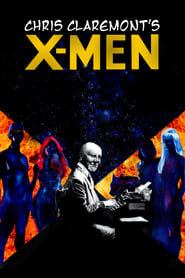
Chris Claremont's X-Men
Stáhnout English titulky
Informace o verzi
Tagy
Náhled titulků v jazyce English
Prvních 200 řádků.
- X-Men is unique in comics history.
Unlike Superman, Batman, Spider-Man,
and most other popular superheroes,
which were defined by many creators over decades,
the X-Men's wild success
is due almost entirely to one writer, Chris Claremont.
- I was born in London, abducted by pirates at a young age,
transported across the pond to this strange new world.
My father wanted to explore medicine over here.
My mother wanted better food.
It was five years after the war.
She was tired of rationing.
Went to school for the first time,
dressed as I would be going to school back home,
shorts and a proper shirt and a proper sleeveless sweater
and knee socks and shoes and a blazer, and, uh,
didn't last the day,
and never did it again.
- Chris grew up in a military family
and they moved around quite a bit.
- When you're moving every couple of years,
by the time you settle in and establish relationships,
especially when you're a kid,
boom, you're up and out, moving across the country.
and you gotta do it all over again.
That's a hard thing to get used to,
and after a while, you just stop trusting,
because, well, I'm not gonna make friends,
because if I make friends, we'll just move again.
- Chris's experiences feeling like a little bit
of an outsider had influence on his work on the X-Men.
He probably would not have found
a whole lot to identify with in the comics of, say,
the 50s or maybe even the early 60s.
- Comics was something I did when I went to get a haircut.
You know, sitting around waiting for a barber,
didn't want to read Ladies' Home Journal.
So if there were comics there, you read, I read comics.
- Chris Claremont, when he went to college,
he went to college for theater, he wanted to be an actor.
And what do actors do?
They sit and they think about character.
How do you make a character well-rounded?
What is a character's back story?
How do you present it so that
it's not a flat, two-dimensional thing on the stage,
but is something living and real
that the audience can relate to.
And I believe that it's that training,
in how to create a character,
that led him to create these amazing characters.
- As a university student,
Chris was tasked with finding an internship,
a task which took him into the world of comics.
- My parents had a friend, Al Jaffee,
the artist from Mad magazine,
and I thought it'd be cool to work as a volunteer for Mad,
because from all accounts, Mad was cool.
Al evidently called up my parents and said,
"There is no way in hell I'm gonna take your son
into the office."
"Do you have any idea what we do in there?"
"You'll never speak to me again."
But Al said, "I know Stan Lee."
"If he's interested,
I can see about getting him a job at Marvel."
And I said, "Cool," and the minute I said,
"Since it's school, I'll work for free,"
I was in.
- While Marvel comics of the 60s
may seem dated now, at the time, they were hailed
for a realism and relatability previously unseen in comics.
- The challenges that the Marvel heroes would come across
were more down-to-earth,
and because they were more down-to-earth,
they made the super-heroics part of things
a little more accessible.
It wasn't that Spidey would defeat Doc Ock,
it was, will he get the test in on time?
Will he work things out with Gwen Stacy?
Everybody was flawed, which made the Marvel characters
that much more accessible and interesting
from a dramatic side of things, and more fun to play with,
and, as far as the X-Men were concerned,
no one really knew from one issue to the next,
were they respectable, were they hated, were they loved,
were they what?
They'd save the world and nobody would say thank you.
X-Men was created
by Stan Lee and Jack Kirby in 1963.
They introduced the basic premise of mutants
fighting for a world that hates and fears them,
and some of the series' notable characters,
but the book was not considered a major achievement
next to more successful Marvel titles,
like Fantastic Four, Spider-Man, or The Avengers.
- It was one of the very few books Jack and Stan created
that wasn't at least doing solidly in the marketplace.
They left the book early.
The X-Men, back in the 60s,
was a commercially failure, ultimately.
It got canceled.
But it was always a book that had loyal readers.
It was always an intelligent book,
even though it was sort of a second,
even third-string book.
- And there was talk for a number of years
about possibly reviving the book
as a group of international heroes,
based on the fact that a lot of Marvel books
sold very well in various other, foreign countries,
and they thought if they could heroes from those countries
in this book, it would increase the sales even more.
- Editor Len Wein and artist Dave Cockrum
were tasked with creating an all-new, all-different team
of international X-Men.
- Dave Cockrum was already a fan favorite
from his work on Legion of Superheroes.
- And he showed me his sketchbooks from the Navy.
- Dave had a note, well, a notebook,
he had a dozen notebooks
filled with sketches of characters he did.
- You'd ask him for a costume design,
he'd come in with 40 pages of artwork.
- So it's where we found Nightcrawler,
and Colossus, Thunderbird, all came from that.
- Giant-size X-Men number one
was released in May 1975,
the first new X-Men story in five years.
It was successful enough to justify continuing the series.
- It was supposed to be a quarterly,
because Marvel wasn't sure it would sell.
After Dave had started working on the second issue,
the editorial decision came down
to make the book a bi-monthly.
- And X-Men, I really didn't intend to give up, initially.
- But he didn't have time to do a bi-monthly X-Men.
- And when I said, "Gee, I don't know,
should I give up the X-Men, should I keep it?"
Chris just sort of sat there and went,
"I'll take it, I'll take it, me, over here."
- So he asked if I was interested.
And I said, "Hell yes!"
- In his early issues,
Claremont began to develop this new cast of characters
and started laying the groundwork for decades of storylines.
- What I had was what almost no one has had since then,
a mainstream series that was fundamentally a tabula rasa.
We had a half-dozen characters, all of whom are brand new.
It was a chance to get in on the sub-level
and define the characters from the get-go.
- His dialogue had more sophistication to it
than a lot of other writers.
It had more of an edge.
He also was delving more deeply into character
in ways that a lot of other comics writers of the time
were not doing.
- You take these seven people, five of whom were immigrants,
and you throw 'em into a world that, ideally,
is unlike anything they know.
You had a wall down the middle of Europe.
So for Peter Rasputin to come
from the Ust-Ordynsky Collective to New York
to work with the X-Men, was making a valid and,
in its own small way, revolutionary, statement.
- Chris and Dave Cockrum and, later, John Byrne
were the ones who really sort of helped
define these characters.
How do we define Nightcrawler?
Nightcrawler should be scary, but no.
We're tired of demons who look like demons
acting like demons.
Why can't they be cool?
Why can't they be normal people?
Why don't we make the most outrageous-looking of the team
the most cheerfully rational and generous of them all?
- Wolverine came along when I was doing the Hulk.
The idea of making him a mutant
was simply because I knew there was talk
of somebody doing this international book.
I said, "Well, okay, so I'll give 'em a Canadian hero."
- Len had envisioned him as a kid, he was 19, 20 years old,
and that the claws were part of the costume, not the body.
And the problem is, he didn't look like a kid.
And especially in the first issue,
he's presented as an officer, so we figured,
let's go the other direction.
Why not try him as being older?
But then, if he's older and he's got a healing factor,
how old are we talking about?
And then, the third thing was, well,
wouldn't it be cool
if the claws actually came out of his body,
if they were a part of him?
And the first reaction was, "Oh, that's disgusting."
"Oh, man, that's creepy."
Oh, they are gonna love this.
The reality for me, from the very beginning, was,
every time he pops his claws, he is slashing open his hand,
so there's blood and there's pain.
Komentáře
No comments yet. Be the first to leave one.