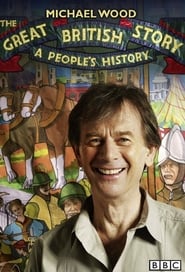
The Great British Story: A People's History
Stáhnout English titulky
Informace o verzi
Tagy
Náhled titulků v jazyce English
Prvních 200 řádků.
The story of the British is one of the most astonishing tales in history.
It's a tale of struggle and war ...
... but also of huge achievement .
From small beginnings, Britain became a great empire, the workshop of the world.
And the real makers of our history were the British people themselves.
Resilient and creative, they built our society,
they won our rights and freedoms .
Today, we're many nations and countless tribes.
But we are still British .
And what unites us all is our history .
The Great British Story .
It was the Romans who first named us, and, in a sense, defined us.
"How lucky you are, you Britons," wrote one Roman,
"more blessed than any other land,
endowed by nature with every benefit of soil and climate.
Your winters are not too cold, your summers are not too hot.
And to make life even sweeter,
your days are long and your nights are short,
so that while to us Italians the sun may appear to go down,
in Britain it just seems to go past. "
Good to see you. How are you? You're looking suitably attired for the occasion.
In the life of nations, just as in people's lives,
anniversaries and celebrations are good times to look back.
I was a big fan of Princess Diana and I love William.
I think his mum would be really proud of him.
Good moments to reflect on what has made us.
For our history gives meaning and value to our present.
It tells us where we've come from, who we are,
maybe even gives a clue to where we're going.
And ours is an extraordinary story .
This is the story of the people of Britain over 1,500 years.
The Welsh, Scots, English...
Irish too have played a great role in the story of Britain.
Hey!
But it's also the story of the people who've come here to settle over the centuries.
From the Anglo-Saxons and the Vikings,
to the peoples of Asia and the Indian subcontinent, Africa and the Caribbean,
who've come in the last few decades to help build modern British society.
This small island off the shore of Europe
has played a role in the history of the world out of all proportion to its size.
From the deep past, to the continuing present, this is our story.
Oh Happy Day!
And the story will take us right across the British Isles.
From Merseyside to Skye,
from the Black Country to Cardiff and Antrim .
But our tale begins in East Anglia in the little town of Long Melford, in Suffolk.
Over the next few months,
the people here, along with a host of other communities across the UK,
will be sharing their knowledge, their documents, photos and memories.
- Look at these lovely seals on the bottom. - Yeah, yeah.
Unique sources which will help build our story .
He used to say that he had relatives...
The gardening club, probably Melford Hall there.
That is so wonderful, isn't it?
- These are amazing social documents, actually. - Oh, yes.
But first, they're going to put their spades into the soil on a communal dig,
led by Carenza Lewis and her team from Cambridge University.
One-metre-square test pits in as many different places as possible.
What we're hoping to find first of all is clues to the history of the community
before the documents begin .
I think it's worth trying it here, don't you?
So what brought us here to Long Melford in Suffolk?
Well, it's a classic English small town with very deep historical roots.
The people of Melford have lived through the Industrial Revolution,
civil wars, the Black Death .
Like most places in Britain, their history as a community goes back a very long way.
But don't think this is just local history .
For at the grass roots you can also find the national story.
We started yesterday, and then when we finished, we filled the hole in.
We're site number 17, there's number 8 there.
With 50 test pits, we soon began to expose the layers of Melford's past.
Bits of clay pipe.
Where you are now is about 250-300 years ago.
Ooh!
Victorian china, Tudor jugs ...
- Your classic milk jug ware almost. - Oh, right.
There was Anglo-Saxon tableware .
So we've got this greyware right the way through the last half of the pit.
The three trays there and that tray at the back are all medieval.
And then we made an exciting discovery .
It's a road. I'm almost certain it's a road.
I'm beginning to wonder if it might be the original Roman road.
We looked at it on a map
and we were able to plot a line all the way through from the school
and we now feel that that's where the direction is
and we thought we'd put our pit here and it looks like we've struck gold.
Rome at the centre!
I shall probably head off East and you head off West, and I'll join you in a minute.
If you want to understand the British story,
you have to start with the Romans .
It's almost like a London Tube map or a GPS.
It was they who brought civilisation to Britain for the first time.
Athens.
I'm heading into Iraq, Mesopotamia.
This copy of a 4th-Century Roman map shows our place in their world.
Hadrian's Wall.
Here I am reaching the very end of the Roman world, the Pillars of Hercules,
the Straits of Gibraltar.
From the Atlantic Ocean in the West ...
Mountains of Southern India.
... to India, 7,000 miles to the East .
Elephanti nascuntur.
The place where elephants come from. Isn't that fantastic?
This marks the moment we Britons became part of global civilisation.
Europe, Africa and Asia.
And alter orbis.
Right. It is the Roman's new world, effectively.
What were they looking for? What were the riches of Britain that attracted them?
The sources mention things like hides and dogs.
They know there's a bit of precious metal over here,
but the riches they're really looking for are the riches of glory, of conquest.
New land, new revenues. There's a new place to tax,
a new people to extract money from, which is what empires are often about.
But as much as anything else, it's about an individual emperor, in this case Claudius,
who's the emperor, the Roman Emperor, that begins the definitive conquest of Britain,
showing he's a real Roman Emperor by taking a new piece of the world and making it Roman.
Brilliant!
Lovely little Samian Ware bowl.
Everywhere we dug in Long Melford,
we found evidence for the Britons adopting Roman lifestyles.
More and more and more Roman.
Oh, right, now that, that is really interesting.
That is a bit of hypocaust flue tile.
It's the Roman central heating system.
We Britons then enjoyed a standard of living that we didn't get back until the 17th Century.
Yes, it could be, actually.
The Emperor Vespasian.
Under the Romans, the population thrived and grew to maybe four million people.
That's quite an impressive pile of pottery, isn't it?
We can probably say there's probably Romans in the vicinity somewhere.
So over the four Roman centuries,
the ideals of Roman civilisation became ingrained in us.
And not just in the Southeast .
Here at Caerleon in South Wales,
there was a huge military and civil complex
with all the amenities of Roman civilisation .
Markets, baths, sports arenas .
And more than that .
Local government, law, civic order .
And a huge dig here is uncovering new evidence
about Roman Britain's second-biggest port .
A miserable day when I woke up, pouring with rain,
but it's not dampened the enthusiasm of the archaeologists.
What they're finding here is nothing less than the Roman roots of South Wales.
It's a part of Roman Britain which is almost forgotten about in some sense.
People think of Wales as an upland country,
as our Iron Age culture continuing through,
but the Southeast, really we should view it as part of the West Country.
It's more in keeping with Somerset and Dorset and Gloucestershire.
It's highly Romanised, we have villas,
we've got Roman towns, Roman fortresses, Roman roads.
It's a fascinating part of the country.
A dig on this scale can only happen with an army of volunteers.
It's exciting starting a new project.
Yeah. A lot of people aren't aware the Roman heritage in South Wales is so rich.
Yeah, we didn't know the site was so big, I don't think.
I think it was just amphitheatre and then it stops
and a humpy-bumpy field.
I enjoyed the pot washing best of all.
You have these big white trays
and then this beautiful Samian Ware glowing in my hands after a good wash,
all over the white trays.
Really fantastic feeling and holding and touching,
and thinking, "Who held this last?"
The thrill of finding something is quite... gets us up.
- And the mud is good. - The mud is good? Are you serious?
- What do you mean? - Mud's brilliant!
You get to be five years old again.
The Caerleon dig is guided by a huge geophysical survey.
We know from the geophys there should be four walls going this way through this section.
- Right. - Where's the wall?
It shows the plaster underneath and the paint's been taken off but there's some red there.
So Caerleon Isca was a big military town and port.
This is, like, revolutionary.
- A whole new area of Roman... - There's always something new to find.
Yeah, it's just so diverse.
Next door was the civil capital at Caerwent - Venta -
which gave its name to modern Gwent,
the whole conurbation a predecessor to today's capital, Cardiff.
Britain very quickly becomes part of this international Roman world of wealth and style.
It's a thought that's hard for us to encompass
but, in the Roman period, if you're living in Britain, and if you're living in Syria,
you're part of the same world.
So don't imagine the Romans in Britain as Italians in togas.
The Britons were the Romans .
And theirs was a cosmopolitan and multicultural world, a bit like ours.
Up on Tyneside, near Hadrian's Wall, stood the Roman fort of Arbeia.
The fort of the Arabs .
And excavations here have found evidence of Roman Britons
from an amazing variety of backgrounds and cultures.
Victoris natione maurum.
He's a Moor from North Africa. He's a black man.
Don't forget, there were black people in Britain before there were English.
20 years old, a freed man of Numerianus.
He's a cavalry officer for a Spanish regiment up here on Hadrian's Wall.
And Numerianus says,
"Piantissime prosequtus est."
He devotedly conducted the funeral of his former slave.
Very intimate relationship between the two men.
Gay, perhaps?
More English subtitles for The Great British Story: A People's History
- The Great British Story S01E04 Most Releases · 39 downloads · 2020-01-18
- The Great British Story S01E07 Industry & Empire Most Releases · 41 downloads · 2020-01-18
- The Great British Story: A Peoples' History Complete (8 Episodes) Most Releases · 43 downloads · 2020-01-18
- The Great British Story S01E02 Tribes To Nations Most Releases · 33 downloads · 2020-01-18
- The Great British Story S01E08 Modern Britain Most Releases · 39 downloads · 2020-01-18
- The Great British Story S01E06 The Age Of Revolution Most Releases · 44 downloads · 2020-01-18
- The Great British Story S01E03 The Norman Yoke Most Releases · 34 downloads · 2020-01-18
- The Great British Story S01E05 Lost Worlds & New Worlds Most Releases · 40 downloads · 2020-01-18
Komentáře
No comments yet. Be the first to leave one.