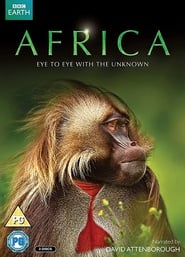
Africa: The Greatest Show On Earth
Stáhnout English titulky
Informace o verzi
Tagy
Náhled titulků v jazyce English
Prvních 200 řádků.
Africa.
The world's greatest wilderness.
The only place on Earth to see the full majesty of nature.
There's so much more here than we ever imagined.
I'm standing where the equator
cuts right across the middle of the continent.
To the north of me, there's an immense desert
the size of the United States of America.
To the west, a vast rainforest the size of India.
And behind me, for thousands of miles,
the most fertile savannahs in the world.
From the roof of Africa...
...to the deepest jungle.
Rarely seen places, and untold stories.
There's nowhere in the world where wildlife puts on a greater show.
This is the last place on Earth
where you can come eye to eye
with the greatest animals that walk our planet.
This is Africa.
Our journey starts in the far south west,
in the oldest and strangest corner of the continent.
Here, the thirsty land is covered
with thousands upon thousands of circles.
We still don't know their origins.
Poisonous plants, foraging insects
and even magnetism have all been suggested, but each ruled out.
The circles don't move, and their shape never varies.
They're unchanging, much like this part of Africa itself.
Ancient and arid, it almost never rains on this land,
yet there is water here, hidden away.
To survive here, life must use every trick in the book.
Winter. Dawn temperatures can fall well below freezing.
And that's a problem for this drongo.
It's too cold for his normal prey, flying insects.
But he has a plan. The drongo is the Kalahari's greatest trickster.
And these are his victims.
A family of meerkats, desert specialists.
After warming up in the morning sun,
the meerkats begin their search for breakfast.
The drongo can now begin his tricks.
But he must first win the confidence of his victims.
He spots an eagle on the hunt, and sounds a warning.
CHIRRUPING
One that sends the meerkats gratefully scurrying to safety.
Danger over.
And now, he has their trust.
He sounds another warning.
CHIRRUPING
But this time, it's a false alarm.
Thank you very much!
The meerkats fell for it.
This all seems too easy. He tries the same trick again.
CHIRRUPING
BARKING
But the meerkats aren't stupid - they'll only fall for it once.
The juicy scorpion won't be for him.
Then, suddenly, the sound of a sentry's warning.
No meerkat can ignore that. Sentries never lie.
But the sentry sees no danger.
Guess who?
Of course, it's the drongo.
He's learnt to mimic the meerkats' own warning call.
And now, he can enjoy his prize.
A gang of meerkats, outsmarted by a bird.
The drongo is only deceitful in the hardest winter months.
For the rest of the year, he provides honest protection.
So, in the long run, the meerkat family profit as well as the drongo.
CHIRRUPING
It's a much harder life,
if you haven't yet learned the tricks of your trade.
This young leopard is just a year old,
and at a critical point in his life.
His mother has battled to raise her two cubs,
but finding enough food for them is now beyond her.
From today, he'll have to fend for himself.
Kalahari means "land of great thirst".
Prey is scarce. Of all the leopards in Africa,
these have to be the most resourceful.
A big warthog.
Potential prey,
but armed and dangerous.
His mother tried to tackle one, but it nearly killed her.
He spots something more promising.
A steenbok, that's more like it.
He won't strike unless he can get to within just four metres,
and without making the slightest sound.
ANXIOUS YAPPING
A jackal barks an alarm.
But the steenbok still has no idea it's being stalked.
The nearer he gets, the quieter he must be.
He's blown it.
A good opportunity like that won't come around very often.
Hungry and thirsty, he heads back home,
and spots a kill stashed in a tree, almost certainly by his own mother.
And, like any teenager, he thinks nothing of raiding her larder.
Booby trapped.
It's not really his day, is it?
Some young leopards grow up to be brilliant opportunists.
But even they find life hard here in the Kalahari.
These bizarre little birds are baby ostriches.
They're just a few days old.
In time, they'll become superb desert survivors.
But in the Kalahari, these early days are perilous.
Like leopards and meerkats, adult ostriches can extract
all the moisture they require from their food.
The chicks, however,
won't survive much more than another day without water.
But there's none in sight.
How can their parents conjure up water out here?
The youngsters follow their parents,
as they head out onto a featureless wasteland.
It seems like a suicidal journey.
The Etosha salt pan.
Here, water is more often a mirage than reality.
It's now well over 40 degrees centigrade.
Their father shades his chicks from the midday sun.
Another mirage?
No. The ostrich family is not alone out here.
Surrounded by miles of sun-baked mud,
sweet, fresh water wells up from deep below ground...
like a miracle.
Although the ostrich parents have guided their chicks to water,
there's still a problem - traffic.
Heavy traffic.
These tiny, fragile birds could easily be trampled under foot.
The water is tantalisingly close.
Where prey gathers, predators are never far behind.
The brawling lions have unwittingly done the young ostriches a favour.
The waterhole is now clear.
Sometimes, you need a bit of luck in life.
Their first-ever drink...
and just in time.
Their father's done his job.
A black rhinoceros, the Kalahari's most cantankerous resident.
They don't like company,
and they certainly don't like sharing a waterhole with lions.
Fortunately - for everyone else, that is...
they only visit twice a week.
The Kalahari is the black rhino's last stronghold.
And here, under the cover of darkness,
at one secret and very special waterhole,
rhino abandon their normally solitary life,
and come from miles around to meet under the stars.
Using the latest starlight camera,
we can reveal for the first time the rhino's true character.
This young female seems nervous.
She senses other rhinos close by.
A mother appears from the shadows with her calf.
Tentatively, they greet one another.
They may be ill-tempered by day,
but now they become gentle and affectionate.
More and more arrive.
We had no idea that rhinos met to socialise
and build friendships like this.
The young female has an admirer.
But she doesn't seem keen on him.
She's excited about something.
Or someone.
Here comes a really big male.
This time, she's much more welcoming.
Who would have thought that rhino could be so flirtatious?
The first male tries to come between them.
Somehow or other, he's got a pair of antelope horns stuck on his nose.
It looks as if she's been won over by his eccentric style.
He leads her off, away from the party.
He may have style...
but he's turning out to be something of a disappointment.
GRUNTING
A girl can only put up with so much.
The only way she can get rid of him is to pretend she's asleep.
To see so many rhino in one place is a revelation.
And that's the power water has here - the power to bring together
the greatest gathering of rhinos anywhere on Earth.
Spitzkoppe.
An ancient volcano, that towers above a plateau
that is two billion years old.
This land has remained unchanged
for longer than any other part of Africa.
Animals here have had a long time to find inventive solutions
to the challenge of finding water.
Out on the open plains, life must await the chance arrival of rain.
THUNDER RUMBLES
When it does fall, it has an extraordinary effect.
Each sporadic downpour may only last minutes,
but it can bring life, and in spectacular numbers.
Red-billed quelea.
SHRILL CHORUS
They're the most numerous bird in the world.
In all, more than a billion live here in the Kalahari.
No-one knows quite how,
but they seem to have an extraordinary ability to locate
the fall of rain, and then instantly exploit the bonanza that follows.
These nomads now have just five weeks to find food,
build a nest and raise a brood.
But they're not alone.
The rains have also created a plague.
These are armoured ground crickets.
Giant insects, with voracious appetites... for meat.
With the quelea parents away feeding,
their chicks are defenceless.
Africa: The Greatest Show On Earth subtitles in other languages
More English subtitles for Africa: The Greatest Show On Earth
- Africa 2013 BluRay 720p DTS x264-CHD · 58 downloads · 2023-09-18
- David Attenboroughs Africa S01E05 HDTV x264-C4TV · 77 downloads · 2019-09-24
- David Attenboroughs Africa S01E03 HDTV x264-FTP · 68 downloads · 2019-09-24
- David Attenboroughs Africa S01E02 HDTV x264-FTP · 87 downloads · 2019-09-24
- Africa 2013 Part6 BRRip XviD MP3-RARBG · 73 downloads · 2017-01-26
- Africa 2013 Part5 BRRip Xvid MP3-RARBG · 72 downloads · 2017-01-26
- Africa 2013 Part1 BRRip XviD MP3-RARBG · 70 downloads · 2017-01-26
- Africa 2013 Part2 BRRip XviD MP3-RARBG · 75 downloads · 2017-01-26
Komentáře
No comments yet. Be the first to leave one.