Náhled titulků v jazyce English
Prvních 200 řádků.
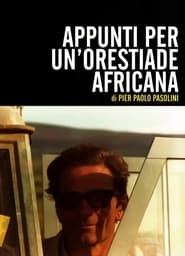
NOTES FOR AN AFRICAN ORESTEIA
With the participation of a group of African students of the University of Rome
I am looking through the camera at my reflection
in the window of a shop in an African city.
I have come to film, but to film what?
Not a documentary or a film.
I have come to film notes for a film.
This film would be the Oresteia by Aeschylus,
filmed in the Africa of today, in modern Africa.
I chose, for Aeschylus' Oresteia,
an African nation which seemed typical to me.
A socialist nation, with philo-Chinese Tendencies, as you can see.
But this choice is not yet definitive,
because as well as the attraction to China,
there is another, no less fascinating attraction: America.
Or to put it better, neocapitalism.
You all know the story of Aeschylus' Oresteia.
I'll sum it up briefly, and give only the facts.
We are in Argos,
the city ruled by Agamemnon, who is about to return from war in Troy.
His wife Clytemnestra awaits him, but she loves another man, Aegisthus,
and she awaits him with the sole intention of killing him.
Agamemnon returns to his city exhausted and destroyed,
and Clytemnestra tricks him and murders him.
Cassandra, the slave that Agamemnon brought back from Troy,
had warned him in vain about this murder.
Agamemnon and Clytemnestra had two children' Orestes and Electra.
Electra witnessed the crime, but Orestes was far from home.
But when he grows into a young man and returns to Argos,
he meets Electra in secret by the grave of their father Agamemnon,
and together they decide to take revenge.
Orestes goes in disguise to the Court in Argos,
and, thanks to a trick,
ferociously murders his mother, Clytemnestra.
But as soon as he has murdered his mother, the Furies appear to him,
the Erinyes, the goddesses of ancestral terror.
Orestes flees, but he is protected by the god Apollo.
And Apollo tells him to turn to the goddess Athena,
the goddess of democracy and reason -
that is to say, the goddess of the new city of Athens.
The goddess Athena decides to help Orestes,
but not to help him, so to say, from above, as a goddess.
She wants to help by making men judge him, and sets up the first human law court.
This human court of law, of democracy and reason, acquits Orestes.
And the Furies are transformed by the goddess Athena
from goddesses of ancestral terror
into, let's call them goddesses of the irrational,
which endures alongside the rational democracy
of the new state.
I started out by looking for the characters.
Throughout Tanzania and Uganda, l photographed dozens of people.
This could be an Agamemnon.
So could this one.
The old Agamemnon who returns exhausted from the Trojan war.
Another variant for Agamemnon, more mythical as you can see.
This is a Masai.
This could be Pylades, Orestes' loyal and honest friend,
who is always by his side,
and who only pronounces a few words in the whole tragedy, these ones:
And what will be the words of your god,
the sacred words, the integrity of oaths?
lt is better to have men as your enemies than gods.
This sinister black veil
could be hiding the face of Clytemnestra.
This could be - l won't say Cassandra, she was young and beautiful.
But it could be one of Cassandra's magic gestures.
Electra.
Electra is the most difficult character to find in today's Africa.
Young African women seem to be deprived
of those feelings of hardness, pride and hatred which drove Electra.
And they smile, they seem only to know how to laugh, accept life as a celebration,
with their beautiful, bright headscarves: red, yellow, blue, purple.
Orestes.
l would like my film of the Oresteia in Africa
to have essentially working class characters.
So l would like the chorus to be of huge importance.
ln Greek tragedies, the chorus is static and speaks as one.
Here however l would like to set it in real, realistic situations, in daily life.
Here we are by Lake Victoria, where l started looking for the chorus.
A hut on the shores of Lake Victoria.
And the objects you see are the only objects
owned by its inhabitants.
There's nothing else.
Here is the inside of the hut.
The mother with her little boy.
With the next-door neighbours.
And over there the father, captured by the indiscretion of the camera.
Here however we are on a ferry, to cross an arm of Lake Victoria.
Full of farmers,
on their way to the market of course. The workers.
Here is the other shore of Lake Victoria, which we are drawing close to.
Directed towards the centre of Africa, towards Kigoma,
on Lake Tanganyika, right opposite Congo.
As well as for characters, l also looked for locations of course.
Just like the characters, the locations should be realistic, true.
Here we are on the road to Kigoma,
to the centre of Africa.
This village is called Kazulu.
lt's still close to prehistory,
these houses have only recently been built.
There was only a simple market here up to a few years ago.
And this boy, another possible member of the chorus,
takes us to the market.
Here it is, poor and abandoned,
underneath the violence of the sun.
And here is another, modest small town,
where there was once nothing but a deserted space in the savannah or forest
where farmers from surrounding villages gathered for the market.
This, in fact, is another market.
l'll repeat the nature of my film: it must be profoundly working class.
These must be the protagonists, here, this woman fetching water from a well.
This baby.
This elegant young man.
The members of the chorus will chat around the petrol-pump attendants,
their clients, the curious children, the tailors.
The tailors and their clients have big discussions.
They talk of powerful people, they discuss politics.
Big debates are had at the hairdresser's
like everywhere else in the world.
This however is the market of a city - the city of Kigoma,
on the edges of the small city.
Other characters: slightly thuggish young men.
Inquisitive children.
Here however is what we might call an ancient-style market,
just like what many markets in the savannah must have been like,
and where farmers would go now and again to exchange their goods.
This people, captured in their day-to-day business,
and their humble daily lives,
should be the protagonists of my film, the African Oresteia.
lt is they who, because they are so realistic, so true,
carry inside them that mythical, sacred moment,
which will make them say sentences like this one:
God, if this is your name, if you want me to invoke you with this name,
l have weighed everything up.
l know nobody but you
who can truly free me from the nightmare weighing down on my heart.
Of course, l will not neglect the factories in the modern side of Africa.
This is a factory city, of a factory near Dar es Salaam.
A factory city which looks like every other factory city in the world.
With girls, some of whom still belong to the ancient world,
archaic peasants let's call them.
Whereas others are already modern, advanced - like this one for example.
And as well as the factories, l will not neglect the schools.
This school is very modern, as you can see.
lt's near Kigoma.
lt's called Livingstone, because it's near the place where Livingstone met Stanley.
Desacralising Africa.
Marking the start of the new era of modern Africa.
The boys are working.
According to modern pedagogical methods, study should be combined with work.
From fields to reading.
Here is a classroom full of zealous and respectful students.
African students, presented with knowledge which still seems to them like a gift,
are obedient, passive and humble.
So, you have seen some travel notes
which have helped me block some scenes, define some characters
for my film of the Oresteia.
First of all, l would like to tell you why l decided
to set the Oresteia in today's Africa.
This is the essential, profound reason:
l feel l can see analogies between
the Oresteia and Africa today.
Above all in terms of the transformation
of the Erinyes into Eumenides.
lt seems to me that African tribal civilisation
resembles Greek archaic civilisation.
And the discovery of democracy made by Orestes,
which he then takes to his country -
Argos in the tragedy, Africa in our film -
is, in a way, the discovery of democracy which Africa has made in recent years.
So the first two questions l want to ask you are these:
do you think l could set this film in Africa today, in 1970,
or would it be more fitting to backdate the film,
and set it in 1960 Africa,
during the period when most African states gained independence?
l think - in my opinion,
this film would be very valuable
if it was set in the 1960s.
Because today Africa is becoming modern
and is starting to resemble Europe.
lt's losing some of its typically African character.
Do you agree with him?
Africa isn't a nation, it's a continent.
Yes, but what l'm asking you is, firstly,
when do you think it should be set, 60s or 70s,
and in what place? For example, where in Africa would you imagine it?
But l haven't traveled around Africa.
Where are you from?
Ethiopia.
And you only know Ethiopia?
Yes, but it's not that... "Africa" ' when you say "Africa",
it goes from the Mediterranean to the furthest point.
From the Atlantic Ocean to the lndian Ocean.
So you can't say "Africa" .
On the subject of this film, l would like to remind its author
that you shouldn't make too much of the issue of tribalism in Africa.
Because Europeans generally made too much of tribalism
to justify their crimes.
So if we talk about Africa,
we're talking about a race, not tribes,
Komentáře
No comments yet. Be the first to leave one.