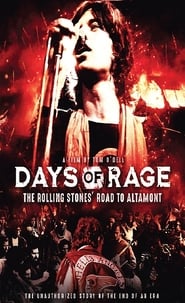
Days of Rage: the Rolling Stones' Road to Altamont
Stáhnout English titulky
Informace o verzi
Tagy
Náhled titulků v jazyce English
Prvních 200 řádků.
In February 1964
The Beatles brought optimism to America.
Only four months later The Rolling Stones arrived.
They made themselves an antithesis, really,
of what the Beatles were in terms of image.
The Beatles may want to hold your hand,
but The Stones want to come and burn your town.
Rebellious, dangerous, druggy,
sexy, that is The Stones.
But as peace and love spread from California,
The Stones tougher vision seemed out of place.
The Stones are hardened.
They never fully bit on all the idealism of the '60s.
"We can transform things by smoking pot."
It was just not realistic.
In a sense, The Stones' vision was truer.
And then, within months of
The Summer of Love, the whole world changed.
By '68 the darkness that was associated with The Stones
definitely chimed with what was happening
on the streets of Chicago, and Paris, and London.
Blood was running in the streets.
The temperatures were rising, rising really fast.
It was as if this is their time.
This film traces The Stones through this
turbulent era, all the way to the Altamont Festival in 1969,
the concert that brought the decade to a shocking end.
Much as there was an element of The Stones
that loved chaos, and loved disorder, they had no idea
what they'd gotten into at Altamont.
This didn't turn out like that.
You'd see real ugliness,
savagery right in front of your eyes.
The Hell's Angels were horrible.
It's like a car crash.
You can't do anything about it, you're just in it.
Things just went from bad to worse,
and there's no controlling it.
It was probably, one of the worst days of my life, ever.
October 17, 1969.
After a prolonged break from live performance,
The Rolling Stones touched down in Los Angeles to begin
preparations for the biggest concert tour of their career.
Due to play at 16 arenas across the country,
for the booming youth culture, The Stones' return
to the American stage was hugely anticipated.
It was looked forward to as a huge event,
a big event, and a lot was expected of it.
People wanted to hear what The Stones had to say.
The Rolling Stones hadn't played
in America for three years or so.
Things had changed radically in that three years.
When The Rolling Stones before were playing,
girls would literally wet themselves and scream
the house down, and the show might last 20 minutes
before all 10,000 people rushed the stage.
So The Rolling Stones were confronted with something which,
at first, completely kind of freaked them out.
Which was audiences that sat there and wanted to listen.
Announced as the greatest rock and roll band
in the world, despite a changed environment,
The Stones' seminal performances became the stuff of legend.
Everybody was on fire, you'd get the energy from a group,
and you'd get an energy from the fans.
I'd love the fact that I could go and watch them
every night, and it would be a little different each time.
But it was great, the shows were spectacular.
The boys knew how to perform.
In 1969 The Stones were incredible, they were brilliant.
I mean those shows were raucous.
The Stones were the biggest rock and roll band on the road.
The Beatles had pulled back, Dylan had pulled back.
But The Stones were out there in 1969.
And coming to America in 1969 was no joke.
The Stones were in the thick of whatever was
racketing around in America at that time.
America in '69 is in a state of some turmoil.
We'd moved on from The Summer of Love in '67.
Obviously things have got a lot darker,
partly because of the Vietnam War protests.
We've had the assassination of Martin Luther King,
and Kennedy, so there's a much darker mood abroad.
There's still that air of hippy optimism. '69 is,
in some ways, the high water mark of that,
rather than The Summer of Love in '67,
because this is the summer of Woodstock.
Held in August 1969,
with nearly half a million in attendance,
the Woodstock Festival was a momentous four day
free concert that stood as a testament
to the growing strength of the youth culture.
In November, late in their tour, The Stones announced
their own free concert on the West Coast.
Originally to be held at San Francisco's Golden Gate Park,
this event would eventually take place
at a remote racetrack called Altamont.
Altamont was intended to be an expression of optimism,
of the strengths of the counterculture,
an event at which all the tribes could could come together.
So, on the surface, when it's first announced,
this is huge news and and it's celebratory news.
The mythology of free concerts were
at the absolute height in 1969.
The whole phrase free concert was just redolent
with all these ethics, and images, and ideas
that were floating around the counterculture at the time.
It could have been fantastic, everybody assumed
that they were looking at a mini Woodstock
in San Francisco's Golden Gate Park.
That's not what it turned out to be.
The event itself would prove disastrous,
a tipping point where the countercultures dream
of peaceful solidarity tragically fell apart.
And the violence and chaos that The Stones
came face to face with during this concert
was a far cry from the seemingly calm America
they had first encountered less than 10 years beforehand.
And the band's own development across this decade
interweaved with the changing currents
of America's youth culture during the same period.
America, 1962, a nation energized by a period
of political growth of prosperity.
Consumer culture was thriving.
Advances in technology were transforming everyday life.
And many felt that this was the dawn of a new golden age.
The American dream alive and kicking once more.
Yet an ever present threat of war
cast a shadow over this spirit of optimism.
And beneath the confident surface,
tensions were developing.
America in the early '60s is a strange place in many ways.
In terms of popular culture, it's rather bland and anodyne.
At the same time, politically you've got
Camelot and the court of JFK.
And there's a certain optimism there that
we've broken with the immediate post-war generation,
and this is the start of a more youthful,
more energetic, more forward looking political life,
soured to an extent by the Cold War,
soured by the Bay of Pigs, and the situation in Cuba.
Almost half of the population in
the United States is under 25 years old.
And there was this sense of an inherited
world that had a lot of problems.
For the younger generation, growing up with the Cold War
and the threat of nuclear annihilation,
all the material prosperity in the world
didn't really go to their concerns.
Things like community, or things like social justice,
or spirituality, none of those things could
be addressed by a roaring economy itself.
And in November 1963,
the equilibrium of the nation was shattered.
President John F. Kennedy, for many a symbol
of optimism and rejuvenation, was assassinated in Dallas.
The event stunned America,
its youth in particular traumatized
by the violence and chaos it seemed to represent.
But early the following year, a voice of hope emerged.
And it was emanating from distant shores.
The Beatles arrived within a couple of months
of Kennedy's assassination, so they walked
into a nation that was grieving,
grieving really badly, and was in a state of shock.
And they appeared on that Ed Sullivan.
And immediately they put smiles on people's faces.
It sounds glib and bland, but that's really what they did.
It was medicine, what the Beatles did.
You can't stress enough
just how important their arrival was.
And the sudden stateside success
of this revolutionary four piece opened the door for dozens
of other British bands to have a go at breaking America.
Following in the footsteps of Liverpudlians,
Gerry and the Pacemakers, The Searchers and Billy Kramer,
in June 1964 a London group arrived
with a very different image and sound.
Unlike their fellow countrymen,
The Rolling Stones weren't about optimism.
There wasn't a sense of "the latest band from England."
That was the thing, it was the British Invasion.
And every week it was The Searchers,
and The Dave Clark Five, and Herman's Hermits,
and all this business.
The Stones were something totally different.
It just felt entirely different.
No one else was really trying to do what
The Stones were doing, they were into the blues.
They were into black music, and they imitated it.
But they imitated it very well,
and they got something of the essence.
They weren't just playing on the surface.
But The Stones', singer Mick Jagger,
guitarists Keith Richards and Brian Jones,
bassist Bill Wyman, and drummer Charlie Watts,
found that their appeal was limited.
And their first US tour proved a disappointment.
When The Rolling Stones first came to
the United States in 1964, they were not
greeted with tremendous acclaim, initially.
More English subtitles for Days of Rage: the Rolling Stones' Road to Altamont
- Days Of Rage The Rolling Stones Road To Altamont 2020 WEB H264-RBB · 21 downloads · 2022-03-25
Komentáře
No comments yet. Be the first to leave one.