Informace o verzi
Tagy
Náhled titulků v jazyce English
Prvních 200 řádků.
This story began in the elevator of a Paris apartment house,
between the 3rd and 2nd floors, to be precise.
I'm claustrophobic, and for two hours,
there I was stuck in an elevator with a companion in misfortune.
So we got acquainted.
Ines, was the widow
of the famous filmmaker Henri-Georges Clouzot.
A cult figure,
one of the greatest directors in film history.
She talked about her husband, dead 30 years ago now,
and the masterpieces that always thrilled me.
L'Assassin habite au 21, Le Corbeau,
Quai des Orfevres, The Wages of Fear, Diabolique...
She also evoked her husband's lasting regret,
Inferno, in 1964.
A huge budget, an ill-fated production,
a film that he'd given pride of place,
and which no one would ever see.
She told me about those forgotten cans of film,
the dramatic story of that shoot.
These 185 cans of film are all that remain of Inferno.
13 hours of exposed film.
The origins of a film that sought to revolutionize the cinema.
185 cans of picture negative,
unseen for more than half a century.
No soundtrack left.
These cans, these images tell us
the story of Inferno.
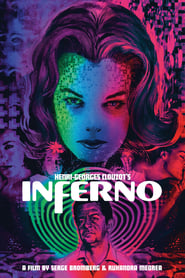
Henri-Georges Clouzot's Inferno.
It can't be!
It all started with insomnia.
I had this idea,
which was to dramatize
the feeling of anxiety that I have every night
and which keeps me awake.
So I wrote a 50-page treatment.
Well, I quickly realized,
after having finished these 50 pages, sadly,
that it was fairly easy to convey to an audience
that a character could have ten obsessions,
but you can't share these obsessions in two hours,
because they took ten years to poison this person.
There's a pathological side to this film.
A semi-pathological side.
The main character...
for a period I can't define
because it would take too long on television...
is in a pathological state.
But there are plenty of moments when he's normal.
Are you personally interested by what's morbid and pathological?
Not particularly.
The starting point is you, isn't it?
I don't think I'm a pathological case.
I had been one, but I'm not anymore.
- You had been? - I had depression, yes.
Real!
I'm not alluding to a particular starlet's depression.
I tell you... nothing.
Don't think. Forget.
Earlier,
I was about to leave for Clermont with her.
Don't think. Forget.
We're still here.
Like before.
Like before... what?
Inferno is the story of a man, Marcel Prieur,
and his wife, Odette.
Just married, they take over a small hotel
in the Cantal department by the Garabit Viaduct.
The script starts here.
A happy opening. Images of happiness.
The film starts now,
and as it says in the script,
it starts...
badly.
I arrived at the Colombe d'Or
where Clouzot was living at the time.
He gave me the script, some 300 pages.
He said, "Read it and we'll discuss it." It was late afternoon.
An hour later he calls me and says, "Well?"
I say, "I've barely started."
He phoned me twice that evening.
I said, "No, tomorrow morning. I haven't had time to take notes."
We met the next morning.
I asked him a question about a specific thing.
He re-read the scene to answer my question.
It was a powerful moment as it lasted a very long time.
It was ten lines.
But he took a long time, puffing on his pipe,
reading and re-reading,
as if trying to see exactly what he wanted to do and how.
It's an image that will forever stay in my mind.
Clouzot had lived at the Colombe d'Or for ten years.
This inn, far from the din of Paris in St. Paul de Vence,
had become a Mecca of French art.
Here you could meet anybody who mattered.
Painters, actors, writers and musicians.
Since filming Picasso,
he had become a painting aficionado.
Depression and the tragic death of his first wife Vera,
were far behind now.
In 1963, he married Ines,
finished the script for Inferno,
on which he'd worked for years,
and shared the opening lines with other hotel regulars:
Serge Reggiani.
Yves Montand, Simone Signoret,
and her daughter, who would have a small part, Catherine Allegret.
I feel like I'd always known Clouzot.
As Mom and Montand were always there, me at times, and Clouzot,
it was part of life at the Colombe d'Or.
He must have thought no one had ever depicted jealousy
as it should have been.
He cut deep into the pain of jealousy.
Someone with so many fantasies... It's an illness.
It reaches the point of neurosis.
It's virtually the neurosis he depicted... beyond the drama of jealousy.
The feeling I had when reading the script
was something
physical,
much more physical than intellectual.
I remember the story perfectly,
but what remains weren't scenes
where you say, "This is terrific. What vision!" etc.
That's not it. It's a kind
of experience you have when you read through this script.
The anxiety and neurosis felt by Marcel, by Reggiani,
is so strong that you're caught up
by something physiologically nerve-wracking.
You can't breathe.
Clouzot and Romy Schneider.
Filmed together for the first time.
Can 5 and following
contain the first exposed images.
First moments of shared enthusiasm: the costume tryouts.
In 1955, Romy had become Sissi.
Now at age 26, she was this young star
who had already worked with Welles, De Sica, Siodmak and Visconti.
For the general public, she was still the innocent Sissi.
For Clouzot, she would be the sensual, alluring Odette,
object of her husband's gaze and obsessive jealousy.
It was a pretty amazing story, written, I think,
for Romy Schneider alone.
Romy at the time was one of the major French actresses,
despite her Austrian origins.
Romy's co-star, Serge Reggiani, would be Marcel Prieur.
He was 42 and had already worked with Clouzot
15 years earlier in Manon.
The two men knew each other well and met often at the Colombe d'Or.
There were many contenders for the part,
but Clouzot fought with the producers...
He wanted Serge Reggiani.
People said he had a head like a carved chestnut.
So he was perfect for the role of a man
who becomes totally paranoid and jealous.
He easily filled the bill.
Among the hotel regulars, Clouzot cast Jean-Claude Bercq
as Martineau, the mechanic from the next village.
Beefcake, showoff and womanizer.
Did he seduce Odette? Is he the only one?
Alongside Mario David,
the mischievous Dany Carrel
would play carefree Marylou, the best friend, the village hairdresser.
In the story Clouzot imagined, she is both angel and devil.
She introduces the feelings of seduction
and doubt.
In the cinema of the time, Clouzot was one of the greats.
One of those French directors who could
get the actors and the funding he wanted
to do as he wanted.
It was a big film,
in terms of budget and as an undertaking as a whole.
It was the talk of the town.
The fact, too, that he had American backing.
That added to the gossip.
Clouzot hadn't worked in four years.
His last film, La Verite, with Brigitte Bardot,
had won a prize at Venice.
Four long years of waiting.
As the new film seemed out of the ordinary,
the cameras of the only TV channel of the time,
went to the Hotel Georges V, where Clouzot was headquartered.
He rounded up his usual team of long-time collaborators.
I met a Clouzot quite different
from the one I'd known when making Quai des Orfevres.
To begin with,
he took a suite at the Hotel Georges V to prepare a film,
when in the old days, he'd easily settle for a drafting office at the studio,
or, as on Quai des Orfevres,
my brother's apartment on Rue des Bourdonnais.
It was casual and easygoing.
But this time, it was a bit Hollywoodian.
9 am.
In a palace hotel, the Clouzot factory is gearing up.
With an engineer's precision,
Clouzot begins the preparation of his new film, Inferno,
which will co-star Romy Schneider and Serge Reggiani.
His hero's obsessive jealousy has been charted on color-coded cards
depending on the hero's moods, the action in time and space.
Madness conceived as an equation.
Henri-Georges Clouzot's Inferno subtitles in other languages
More English subtitles for Henri-Georges Clouzot's Inferno
- Lenfer Henri Georges Clouzot · 42 downloads · 2011-02-16
Komentáře
No comments yet. Be the first to leave one.