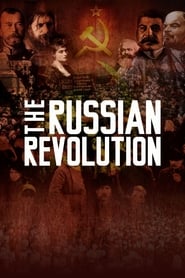
The Russian Revolution
Stáhnout English titulky
Informace o verzi
Tagy
Náhled titulků v jazyce English
Prvních 200 řádků.
It's been a century since the Russian Revolution
and the formation of the world's first communist state.
But how did it happen?
How could the mighty Romanov dynasty, that lasted for 300 years,
fall to a ragtag group of revolutionaries,
who brought with them Joseph Stalin and a brutal reign of terror?
Lenin understood it wasn't your numbers that mattered,
it wasn't your popular support that mattered,
you just paralyzed the country by occupying the key points,
and then you take over.
Revolutions don't happen from the dispossessed and the starving,
they happen from the middle class, and it's always been true.
But at the heart of the Russian Revolution
lay a very personal battle
between Lenin's Ulyanov family and the royal family,
who were determined to retain autocratic rule.
The tsarina used to say that Russia likes to feel the whip.
There was always the feeling that the tsars
had the divine right of kings,
they had a sort of God-given obligation to rule themselves and the autocrats.
So, there wasn't really space for democracy.
The disaster that's happened to Russia since
is substantially down to mistakes made by Nicholas II.
He is utterly, utterly useless.
He was a man who shouldn't have been tsar.
He wasn't suited to the onerous task of monarch.
The errors made by the tsar would bring an empire to its knees.
But no one could have predicted that Vladimir Lenin
would be the man to seize control in the chaos.
Lenin understood that power is constrict in certain knots,
that you take over a railway junction,
you take over a telephone exchange, and you've already got a city.
Lenin was in a tradition
of Russian leadership, and was a very strong part of it.
He had a profound effect on Russia that we are really still feeling now.
1917 in a sense recasts the ideological map of Europe.
As the century progresses, the ideological map of the world.
March the 13th, 1881, Saint Petersburg.
The tsar, Alexander II, is on his way to his army's military roll call.
He's traveling in a bulletproof carriage, gifted to him by Napoleon III.
It had proved necessary as the tsar had faced numerous assassination attempts
during his reign.
Many people wanted
to get rid of the tsar and his government.
But the fact that in middle of the 19th century you had two inventions...
...the revolver and high-explosive dynamite,
both of which were widespread in Russia,
which enabled quite amateurish people to get together
and organize an assassination.
This is really a kind of sustained terrorist campaign.
There are multiple attempts on the life of the tsar,
attempts to blow up his carriage.
One terrorist, over a period of months, working as a carpenter
in the Winter Palace, manages to plant a body of explosives,
which very, very nearly kill Alexander II.
I mean, 11 people are killed, about 56 are injured.
It's sort of those moments where he was in the wrong room at the right moment,
as it were, and the explosion just missed him.
But this time, the tsar would not be so fortunate.
Alexander's legs are shredded, his stomach cut open by shrapnel.
His dying body is carried to the Winter Palace,
where his family, the Romanovs,
who have ruled Russia for nearly three centuries,
are horrified to lay their eyes upon him.
He only lasted 90 minutes,
and the bomber himself, also, lasted 90 minutes.
His legs were blown off, too.
The assassination of Alexander II, it's kind of Russia's 9/11.
I've read newspaper reports that come out in the days after the assassination,
and they are astonishingly graphic about the physical damage
inflicted on Alexander's body.
They sort of start talking about the shattered legs
and the tendons hanging out and stuff.
What they're describing is this wound
that has been inflicted on the body of the state,
you know, so, the king's two bodies clearly there.
The group responsible
for this attack is Narodnaya Volya, the People's Will.
The conspirators would be hanged for their crimes,
but the movement would continue,
and it would soon attract the attentions of one Aleksandr Ulyanov,
eldest son of the Ulyanov family and elder brother to Lenin,
the man who would eventually eliminate the Romanovs completely.
But in 1881, the People's Will's predictions
do not come to pass.
There is no great revolution following the death of Tsar Alexander II.
He's succeeded by his son, Alexander III,
who, upon viewing his dying father,
vows to never let the same fate befall him.
Despite the enormous unrest, Russian autocratic rule would continue.
Alexander III considered Alexander II way too lenient.
I mean, he'd liberated the serfs.
So, Alexander III decided to come down hard on Russia,
and he was anyway a very sort of forceful character
who used to bend forks in knots at the table.
And he apparently was able to walk through doors without opening them.
He was a huge man.
And undermined his son, unfortunately, by calling him girly
when the tsar was a child,
and I don't know that the tsar, Nicholas,
ever emerged from that repression from his father
and that sort of undermining.
Alexander III has a very bad press.
People say stagnation, reaction, and all that is true.
On the other hand, there were some good things about Alexander III.
He never declared war on anybody, unlike Alexander II,
who's extremely aggressive,
made war on the Turkish Empire, on the Chinese.
He also listened to his ministers. He may have been a reactionary,
but he appointed some very competent ministers,
and, in his reign, Russia railways became one of the best service in Europe,
Russian post office, too.
He was a boring man and he liked the bottle,
but there were things to be said for him.
It seems sort of counterintuitive,
but Russia was actually a fantastically dynamic society
in lots of ways in this period. Really from its defeat in the Crimean War
in the 1850s, it understands that it has to industrialize
if it is to remain competitive on the international stage.
So, the defeat in the Crimea at the hands of the French and the British
laid bare the fact that Russia was an undeveloped state.
Its peasant armies were no match for the Western powers,
and so, if Russia wants to remain in the game, it needs to industrialize.
Russia was modernizing at an extraordinary rate,
but its political system remained deeply autocratic,
unlike almost all other European nations of the era.
Because of the conditions of Russia at the time,
normal, middle-class families
weren't allowed any form of political expression at all.
That was the main problem.
So, any normal, middle-class family,
the son would have entered the revolutionary,
the radical political sect.
There was a wave of repression against Russian radicals,
oppositionists, and so on.
Some of these people are clearly dangerous.
Some of these people have plotted to kill the tsar,
members of the Imperial Family, or, you know, regional governors and so on.
There's a general paradox that a dictatorship,
as long as it's strict and severe, is safe.
The moment it starts to liberalize,
it gives an inch and the people take a yard.
Once the people detect a weakness,
or a division, then the whole thing starts to fall apart.
One such person who got caught up in this radical world
was Aleksandr Ulyanov, known to his family as Sasha.
He was the eldest Ulyanov son, and elder brother to Vladimir Lenin.
The Ulyanov family was not a typical family.
There was a very small caste of civil servants in Russia,
and the father was a schools inspector.
And he'd reached a position
in the civil service that gave him the rank of a noble.
That was a very, very small percentage of people in Russia.
But they weren't that rich.
Lenin's elder brother, like Lenin himself,
brilliant intellectually, covered in gold medals from school and university,
and he joined a student group, and they decided to make a bomb,
and attempted to kill Alexander III.
The plan is to assassinate Alexander II's heir, Alexander III,
when Alexander III is going to be attending a ceremony
to commemorate the assassination of his father.
And Aleksandr Ulyanov, he's the kind of, you know, master bomb maker.
The People's Will
was more of a mystic than an ideological association.
The idea if we bring down the very top,
they'll all be so terrified that the system will disintegrate
and they'll be a sort of peasant uprising out of which a new order will arise,
but they had begun to read Marx. The trouble with reading Marx, of course,
is Marx predicted the last place there'd be a revolution would be Russia.
So, it was still that romantic idea of kill the tsar
and everything will naturally reform.
A bomb that's packed with pieces of metal
that have been dipped in strychnine to inflict maximum number of fatalities.
I mean, that's worth remembering. But the plan is undone by the Okhrana,
and they have wind of the attempt on the tsar's life,
and the terrorists are arrested and rounded up within a matter of days.
Of course they were sentenced to death.
Alexander III very generously said,
"Those that repent, I will reprieve. Those that don't repent, I will hang."
Sasha said, "That would be going against my principles to ask for a reprieve."
His mother begged him to.
The hanging of Sasha, that is often seen as what motivated Lenin.
Often these things are personal, not political.
When his brother was arrested, his mother rushed to the city.
Vladimir, the future Lenin, tried to organize transport
to get her to the nearest train station, and he traced around bourgeois Simbirsk
to try and get someone who would go with his mother.
Absolutely all of them refused,
and that changed his entire perspective about bourgeois liberals
and the other middle class, and it was-- That was overnight.
And from then on, he just abused the liberals,
and the way the family were snubbed because of this
changed him as much as any other politics.
Sasha Ulyanov was hanged on the 20th of May, 1887.
Lenin entered the underground revolutionary movements
following the path laid out by his brother,
and just like Sasha, Lenin would be tracked
by the secret police of the Russian Empire, the Okhrana.
Every country had a spy organization, of course,
but Russia was the first one that had an entire massive organization
More English subtitles for The Russian Revolution
- The Russian Revolution 2017 720p WEB-DL x265-HDETG · 18 downloads · 2021-04-07
- The Russian Revolution 2017 1080p NF WEB-DL DD+2 0 x264-monkee · 20 downloads · 2017-09-11
Komentáře
No comments yet. Be the first to leave one.