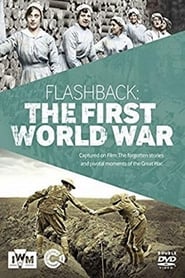
Flashback: The First World War
Download English undertekster
Udgivelsesinfo
Tags
Forhåndsvisning af English undertekster
De første 200 linjer.
Think of the First World War and you think of trenches.
There was mobility elsewhere, in the East and Africa,
but the war on the Western Front was bogged down.
The challenge on both sides was to find new ideas, new weapons,
new spirit among the men.
Only then could they break out - and win.
In September 1914,
the Allies had stopped the German drive into France at the Marne.
The Germans pulled back to high ground and dug in.
The Allies followed suit.
The result, 500 miles of trench and fortification,
stretching from the Channel to Switzerland,
allowing ground to be held with fewer men, freeing troops for other fronts.
Breaking the deadlock meant taking the offensive
but it was much easier to defend trenches than attack them.
For all their blood and mud and horror, trenches saved lives.
They were places of fear and bad smells,
where walls might be shored up with limbs and corpses,
but they were the safest places to be in a battlefield swept by machine-gun fire,
devastated by shelling.
The greater danger came when you left them.
The popular image of First World War soldiers is lions led by donkeys
but the generals knew that battles couldn't be won from behind a trench wall.
Sooner or later, the men would have to go over the top,
and that meant heavy casualties.
The generals weren't so much callous as realistic.
And there were more good generals than bad.
Rather than sitting out the war in chateaux miles behind the lines,
71 German generals were killed in action, 55 French, 78 British.
The generals' response to the deadlock was to challenge it.
To find dynamic ways to beat it.
In 1916, both sides looked for a place to break through,
where an attack could be concentrated and supplied.
The Germans thought they'd found it at Verdun.
A town and mighty fortress on a salient -
a tongue of France sticking out into the German lines.
Verdun looked secure,
with its huge walls,
its giant circle of 19 forts, with their outer ring of defences.
But the French had now downgraded Verdun's status,
removing many of its guns to needier sites.
For the French garrison, it was becoming known as a cushy sector.
We have almost nothing to worry about.
We often play cards and sometimes we have to drop them
and pick up our rifles. But it's usually a false alarm.
So we go back to our suits and our cards,
our minds completely on the game again.
But parliamentary deputy Emile Driant, now a frontline colonel,
realised how vulnerable Verdun really was.
He warned the French government.
We are doing everything, day and night,
to make our front line inviolable,
but there is one thing about which we can do nothing -
the shortage of hands.
If our front line is broken by a massive attack,
our second line won't hold.
Lack of workers, and also barbed wire.
But Driant was ignored.
On Monday 21st February 1916,
a clear, still winter's day,
over 100,000 German soldiers drew breath,
and prepared to go over the top.
They had surprise on their side.
Above them, they had air superiority.
No Allied planes had spotted their preparations.
Behind them, their own German artillery opened fire.
And in front of them, in the French lines,
Corporal Marc Stephane could hardly believe what was happening.
We were swept by a storm, a hurricane, a tempest,
growing ever stronger, with hail like cobblestones,
with the destructive force of an express train.
And we're underneath it, do you follow?
Underneath it.
The Germans fired a million shells that day.
When a shell bursts a few metres away, there's a terrible jolt,
and then an indescribable chaos of smoke, earth, stones, of branches,
and too often - alas! - of limbs, flesh, a rain of blood.
By three o'clock in the afternoon,
the section of the wood which we occupied and which,
in the morning, was completely covered with bushes,
looked like the timber yard of a saw mill.
A little later, I'd lost most of my men.
The Germans were evolving new solutions to the problems of attack.
They delegated command forward to the men at the sharp end,
training them to advance in small groups,
zigzagging and crouching, equipped with fearsome new weapons -
light mortars, grenades, flame-throwers.
They called these units "storm troopers".
We moved forward from our position.
That's where I saw the most refined weapon of modern technology
or human bestiality.
There was a spurt of flame...
HUGE EXPLOSION
..which flooded the attacking enemy with burning oil.
Verdun was one of the defining battles of the 20th century.
Among the attacking Germans was a young Lieutenant Paulus
who, as a general in the Second World War,
would command the siege of Stalingrad.
25-year-old Charles de Gaulle was also there,
France's future leader, wounded and captured defending Verdun.
On the second day of the attack, at his HQ,
Colonel Driant received absolution from his chaplain
and wrote a note to his wife.
The hour is near. I feel very calm.
In our wood, the front trenches will be taken in a few minutes,
my poor battalions spared until now.
He sent a message to his divisional commander.
We shall hold out against the Boche,
although their bombardment is infernal.
Driant ordered a retreat out of the woods.
Then one of his men was hit.
As Driant started to dress the wound, he too was shot.
I clearly saw the colonel throw up his arms and shout, "Oh, my God!"
Then he half-turned and collapsed.
When I could get over to him, there was no sign of life.
Blood was flowing from a head wound and from his mouth.
He had the colour of a dead man.
Three days later, the Germans captured Douaumont,
Verdun's key fort.
Germany was jubilant.
Church bells rang out, a national holiday was declared.
In France, Driant's heroic sacrifice
helped spark the flame of national defiance.
Verdun was to be held at any cost.
The survival of France herself was at stake.
"They shall not pass," declared General Philippe Petain,
Verdun's new commander.
He rotated his troops.
Three quarters of the French army at one time or another defended Verdun,
a national effort that ensured whole units
were not totally destroyed in the battle.
Petain was genuinely concerned for the lives of his men.
A quarter of a century later,
he led country into surrender and collaboration with Hitler
rather than repeat the blood bath of Verdun.
Route Nationale 93.
An ordinary French road, but it saved its country's life.
Night and day, supplies for Verdun rolled along the Voie Sacree,
the Sacred Way, as well as by rail.
Events on another front also helped the French at Verdun.
At the end of 1915, the Allies - Britain, France, Italy and Russia -
had agreed a plan for 1916, to pull Germany in different directions.
Now the deal paid off.
A successful Russian offensive forced Germany
to switch troops from France to the Eastern Front.
From June, the initiative at Verdun passed to the French.
And Germany's technical advantages were short-lived.
Throughout the war, new ideas were quickly picked up by the other side.
All our inventions seem to turn like evil spirits against us,
like a monster destroying itself.
Amid these terrible scenes of destruction,
the idea of ever returning home seems indescribably glorious.
Please look after yourself and our home,
your soul and your body and all that is mine.
Franz Marc was killed later that day.
Finally, on 24th October 1916,
the French recaptured Fort Douaumont.
Verdun was saved.
At last the time has come,
and we set off to conquer the enemy positions.
They don't offer any resistance.
And the few men who are still alive
come out of their holes crying "Kamarad".
The battlefield of Verdun has a different atmosphere
from any other I was ever on.
Its horrors are also greater.
But there's a feeling of intense satisfaction.
It was at Verdun that the French people found themselves again,
and emerged from the clouds which have hung over them
since their defeat by the Germans in 1870.
France had learned a string of lessons at Verdun,
about artillery, new weapons, logistics and manpower.
But at a cost of over a third of a million casualties.
German casualties were nearly as high,
but Germany, fighting alone in the West and with weak allies on other fronts,
could not endure losses on this scale.
She would not launch another major offensive on the Western Front
until 1918.
One can look for miles and see no human beings.
But in those miles of country lurk, it seems, thousands of men,
planning against each other perpetually some new device of death.
Never showing themselves,
they launch at each other bullet, bomb, aerial torpedo and shell.
Unlike previous wars, the fighting on the Western Front was unceasing.
Somewhere down the line, there was always a gun firing, a man falling.
But for the troops of both sides,
life was not always unrelenting warfare.
During 1916, the average British soldier spent 100 days at the front.
For the remainder, he was in reserve, on work detail, resting or on leave.
And over the 500-mile front, some sectors were easier than others.
Even busy ones had their lulls.
One day, British General Lord Edward Gleichen visited the front line.
When going round the trenches,
I asked a man whether he had had any shots at the Germans.
He responded that there was an elderly gentleman with a bald head
and long beard who often showed over the parapet.
"Well, why didn't you shoot him?"
"Shoot him?" said the man.
"Why, Lord bless you, sir, 'e's never done me no harm."
A shocking example of "live and let live".
Flashback: The First World War subtitles in other languages
More English subtitles for Flashback: The First World War
- BBC The First World War 10of10 War Without End 720p HDTV x264 AAC MVGroup Forum eng · 53 downloads · 2019-02-07
- BBC The First World War 09of10 Germanys Last Gamble 720p HDTV x264 AAC MVGroup Forum eng · 46 downloads · 2019-02-07
- BBC The First World War 08of10 Revolution 720p HDTV x264 AAC MVGroup Forum eng · 45 downloads · 2019-02-07
- BBC The First World War 07of10 Blockade 720p HDTV x264 AAC MVGroup Forum eng · 54 downloads · 2019-02-07
- BBC The First World War 05of10 Shackled to a Corpse 720p HDTV x264 AAC MVGroup Forum eng · 39 downloads · 2019-02-07
- BBC The First World War 04of10 Jihad 720p HDTV x264 AAC MVGroup Forum eng · 40 downloads · 2019-02-07
- BBC The First World War 03of10 Global War 720p HDTV x264 AAC MVGroup Forum eng · 32 downloads · 2019-02-07
- BBC The First World War 02of10 Under the Eagle 720p HDTV x264 AAC MVGroup Forum eng · 27 downloads · 2019-02-07
Kommentarer
No comments yet. Be the first to leave one.