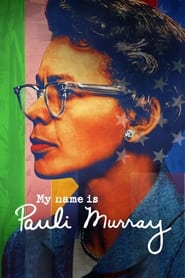
My Name Is Pauli Murray
Download English undertekster
Udgivelsesinfo
Tags
Forhåndsvisning af English undertekster
De første 200 linjer.
Mm-hmm.
-(dog barks) -Lie down.
Sit down. Lie down.
-Lie down. -(others laugh off screen)
My name is Pauli Murray,
and my field of concentration has been human rights.
My whole personal history has been a struggle
to meet standards of excellence
in a society which has been dominated by the ideas
that Blacks were inherently inferior to whites
and women were inherently inferior to men.
Pauli Murray was a person
way ahead of the times,
saying and doing things that others were not,
until much later.
Pauli had the nerve
to confront discrimination
at a time when there was great risk in doing so.
Incident after incident piling up
meant that sooner or later, I would either go berserk
or I would find a way to protest.
Pauli was the writer,
the lawyer, the priest,
the poet.
-(typewriter keys clacking) -(Pauli reading):
Pauli has been so critical
to so many of the rights and freedoms that we all enjoy.
Pauli Murray was not just
an amazing lawyer or a badass feminist,
but also a queer, nonbinary person.
And most of the time, my students are like,
"Why don't we know about Pauli Murray?"
How can one person be so pivotal
and yet their name is just one that we never learn?
(respirator whooshes rhythmically)
My great-aunt Pauli
called me and said...
she wasn't gonna make it through the night.
She said, "You've got things here
that you'll need to do for me."
And she died a couple hours later.
I found out I was the executrix of her estate,
so I had to gather her belongings.
File cabinets lined the rooms,
and then the bookcases sat on top.
Boxes, folders, letters to the government.
She saved everything.
Pauli's will was very clear
she wanted her papers to be at Schlesinger Library,
one of the places where women's historical papers
are housed.
Aunt Pauli did not share a lot about her life with me.
I knew she was a priest. I knew she had been a lawyer.
But she never, ever mentioned any of her accomplishments.
I went and read what I hadn't read,
and then I realized, "Oh, my God."
"Petersburg, bus incident, March 1940."
I did not start out to-- deliberately contest
the Virginia segregation statutes.
As so often happened in those early days,
an incident would arise
where there was just nothing you could do but fight back.
My friend and I were traveling from New York
down to Durham to visit my two aunts for Easter.
My friend's name was Adelene McBean.
Mac, we used to call her.
MARGHRETTA McBEAN: For my mother, it was
her first introduction to what was a pretty common situation
in many parts of the South.
When you crossed the Mason-Dixon Line,
you were expected to move to the back.
The bus was the quintessence
of the segregation evil, the intimacy of the bus interior
permitted the public humiliation of Black people
to be carried out in the presence of
the privileged white spectators who witnessed our shame
in silence or indifference.
McBEAN: When they got to Virginia,
the Black people got up and moved to the back,
and then more white people came on.
The bus driver insisted
that we move, and the next seat had this broken seat,
and we refused to sit on that.
McBEAN: The bus driver said he wasn't gonna drive anymore
until she moved back.
And the police came in and arrested us.
Mac and I were hungry and cold but were afraid to go to sleep
because the mattresses were alive with bedbugs.
When I protested, the surly night jailor shouted,
"If you don't shut up, I'll shut your ass in the dungeon.
"Time them rats get through with you,
you'll wish you'd kept your damn mouth shut."
The reality set in.
The reality set in, and, uh,
I think it was very scary.
Pauli reached out
to the NAACP, hoping that
they could get a ruling that declared, um,
segregated seating unconstitutional.
Mac and I did a report,
a summary, of the case, the facts.
After we were released on bond,
we were invited to meet with NAACP lawyers
Thurgood Marshall, Judge William H. Hastie
and Dr. Leon A. Ransom.
It was my first exposure
to a team of able civil rights lawyers in action,
and I sat enthralled for several hours.
What they were fighting for was the right of Black people
to easily assimilate into the whole of American life.
But the judge knows that this is becoming a big deal,
and so, ultimately, they get outmaneuvered.
-(gallery chattering) -(gavel banging)
The judge drops the segregation statute here that's at play
and just says, "Y'all were disturbing the peace."
So they are not able to reframe legal precedent.
They serve a small sentence, uh, and they're let go.
At the time, I felt only
the bitter disappointment of a personal defeat.
But I began to sense
that we were a small part of a teamwork effort
which envisioned the ultimate overthrow
of all segregation law.
The thought was stupefying.
So, today,
we have this really cool opportunity
to learn about Dr. Anna Pauline Murray.
Pauli Murray is just so spectacular that I literally
cannot cover all her firsts and all her dopeness.
Think about if you're a Black person in the 20th century
and you're trying to make the argument
that your humanity should be respected.
And you live in a world where people already don't like you
because you're Black.
I want to give you a little sense of-of
what informed Murray's life.
PAULI (over recorder): This is chapter one,
page one... (clears throat)
of an autobiography in manuscript.
In a study published in 1910, the year of my birth,
Dr. Howard W. Odum,
a sociologist then working at Columbia University,
asserted that "the races have different abilities
and potentialities." Close quote.
And that those who wish to help the Negro should, quote,
"not expect too much of him.
"He has little conception of the meaning of virtue,
"truth, honor, manhood, integrity.
"The best education for the Negro child
"would lead him toward the unquestioning acceptance
"of the fact that he is a different race
from the white, and properly so." Close quote.
-(children shouting playfully) -I can remember this today,
and I-I can see that old school building.
It was a rickety old wooden building.
No swings.
You know, nothing to play with when you went out.
And of course, the white kids' school...
sitting in a lawn,
surrounded by a fence,
it was the contrast between the treatment we got
and the treatment the white kids got.
And you sense those things. You feel them.
I come from a very proud people.
They were stubborn. They swam against the stream.
This is the house.
This is Pauli Murray's homeplace.
When she came to this house, she was three years old,
and she came as a result of a tragedy.
Her mother died of a cerebral hemorrhage,
and eventually her father was committed
to a mental hospital.
Even though she was born in Baltimore,
this was really her home.
When I came to Durham,
the household included Aunt Pauline and Aunt Sallie
and my Fitzgerald grandparents.
The Fitzgeralds are very well known in Durham
and pretty prestigious with the Black community.
The family going back was mixed with Cherokee, Irish,
African American.
It was a family where there were some members
who looked so white that they passed,
and Pauli was somewhere in between.
There was prejudice based on complexion
from the white community
and from the Black community.
And so they were an entity all to themselves.
Pauli was the joy of the house.
Aunt Pauline didn't have any children, so she doted on her.
Aunt Pauline taught in the local public schools,
and when I was around four,
she decided to bring me with her every day.
I was permitted to sit with the older children
and to look on while they recited.
Toward the end of the school year,
Aunt Pauline was surprised when she heard me say,
"I can read, Aunt Pauline."
I seized the book of the child next to me
and began to read out loud.
My Name Is Pauli Murray subtitles in other languages
More English subtitles for My Name Is Pauli Murray
- My Name Is Pauli Murray 2021 1080p WEBRip x264 AAC5 1-[YTS MX] · 20 downloads · 2021-10-03
- My Name Is Pauli Murray 2021 720p WEBRip x264 AAC-[YTS MX] · 17 downloads · 2021-10-03
Kommentarer
No comments yet. Be the first to leave one.