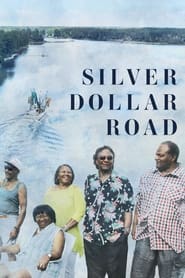
Silver Dollar Road
Download English undertekster
Udgivelsesinfo
Tags
Forhåndsvisning af English undertekster
De første 157 linjer.
- (insects chirping) - (water lapping)
My daddy, the day before he died, he told me,
he said, "Gertrude, I won't be with you all long."
He said, "And whatever you do, don't let the white man have my land."
- (birds chirping) - (water lapping)
Grandma, I just want to say we love you.
It's been a blessing to have you here for 95 years,
and we hope to have you many, many more.
- I got to speak for the grandkids, for all you grandkids. - Yeah.
The only thing I can say is, we lived the best life
- in Merrimon, all because of Grandma. - Yes. Amen.
I can't speak enough on how I thank my Lord and Savior
for being from Merrimon, from the bottom, from Silver Dollar Road.
We didn't have a whole bunch of money, but we have plenty of love.
We have plenty of family. Look at the people that turned out.
You are our queen.
You are the mother and the father.
Mother, you have been a true example of what a single mother can do and be
if she set that goal.
Mother, you worked so hard in your 95 years of life,
preparing flowers and vegetables for Fridays.
Five o'clock in the evenings, you was in the fields.
When the alarm went off on Saturday mornings,
you was up at 4:00 to go to that home extensions in Morehead City.
When I was a little girl and growing up here on Silver Dollar Road,
I like thinking about those days 'cause it was so innocent.
It was so magical.
You just felt free.
You felt happy, and you felt love.
It was like a village, you know.
You was free to roam and play,
and you had the water.
And going to the water, for me, was magical.
My uncles drank, and they were always...
When they got together, they would talk about...
it was a mermaid to the water,
and, at a certain time, you would hear the mermaid singing.
And she would come up and she would shake her hair and go back down in the water,
and we would sit and we would listen.
And we knew Uncle Melvin lied, you know.
Ain't no mermaid out there and stuff.
But, as a little girl, it was just so magical.
I lived in New Orleans,
and we would come down every summer.
And it was almost like two weeks
before we knew it was time to go back to New Orleans,
the depression would sit in.
Oh, we'd cry 'cause we didn't want that Friday to come
when Mom and Dad was coming to get us.
We didn't want to go.
It was just the nostalgia of just having that freedom.
We walked around in our bare feet
from this aunt's house to that aunt's house to cousins' houses.
And, "Can you take us swimming today?
'Cause Grandma said we can't go down unless we have an adult."
We had our own beach.
My uncles would bring their boats to the pier,
and we'd run up, help them offload shrimp and fish and crabs.
And it was a good time- music, dancing, barbecues,
concerts or local churches just putting on gospel concerts
and baptisms in the water.
Being in the sun, the sand,
being stung by sting rays and running out.
: And putting sand on you, just trying to get the stinging off.
And it was just amazing.
It was amazing.
I did go to the market with Grandma to help out.
Grandma was very well respected.
And she had a lot of clientele when it came down
to the produce and the seafood that she sold.
Technically, she was probably considered
one of the richest Black women in the community,
because their property...
was so, um, valuable.
And not valuable to us from a monetary standpoint
but valuable to us because of the history,
you know, and the beauty of it.
We're, uh, at the cemetery next to, uh,
our family church, Reels, uh, Chapel.
This is, uh, what I refer to as "cemetery number three."
Number one is, um...
It's about 200 yards to my left.
And, uh, that was the one that's kind of described in old documentation
as "the first Black cemetery."
The second cemetery is at an elevated site.
This, uh, gravestone here, this is Elijah Reels,
the first owner of the property.
Him and Suddie Anne acquired the property in, uh, November 1911.
He, uh, he was born in 1866,
and that was during slavery time.
("Working Man Blues" by Floyd Council playing)
Elijah Reels was my great-great-grandfather.
He farmed the property, had a family upon the property.
And unfortunately, in 1939,
he lost the property due to back taxes.
His son, Mitchell Reels, then purchased the property
in 1944 at the courthouse doors due to back taxes.
Unfortunately in 1970, Mitchell died without a living will,
and the property then became the heirs of Mitchell Reels.
And that's when all our legal problems started.
Heirs' property is property that has been left to an onslaught of family members.
So there was a document that was conveyed
that my grandmother and her siblings did, in fact,
own the 65 acres after a court proceeding.
So it was ruled that the 65 acres did belong to the Mitchell Reels' heirs.
Oh, the night that Mitchell died-can I just call him Papa? -
it was a pretty night out.
Someone came to the house and told my mother Papa had sent for her.
Then my mother went to his house.
He was saying he needed to go to the hospital,
'cause he was sick,
and he was sick that he didn't know if he would be coming back home.
And it was some things he wanted to discuss with her and wanted her to do.
I remember my mother precisely asking him,
"Well, Papa, why would you want...
me to do these things when you have sons?"
He said, "Because I know you will make sure they happen.
I know I can depend on you."
He said, "You stick with your mother, with this land."
'Cause he knew Mother was the strongest one.
And she did-- He knew she would do what she got to do
to hold... (stammers) to hold on to this land.
("Walkin' Night and Day" by Big Boy Henry playing)
I have all the memories, all the memories.
Because it's no place on this property
that I haven't been.
I know where every inch of it is at.
Because this was my travel when I was growing up.
- (birds chirping) - (insects trilling)
My heart is really into this land.
Whenever I had a break during the military,
I would always come back down here for peace and quiet.
I can go down to the Adams Creek there
and sit there and reflect
not only my past, as growing up
down here, but, uh, anything that I had on my mind.
You know, I-I'd look out on the water and say,
"Hey," I'd tell myself,
"It could be worse."
From that point, Shedrick, which is Mitchell's brother,
intervenes with a deed from New Jersey.
He comes back down, has it registered in our court-- local court-
registered deeds as a personal property that he currently owns,
unbeknown to the family.
And shortly thereafter, we start finding out that
there's word of the property being sold to someone else
that the family had no knowledge of.
So during that time frame, my grandmother,
who's made the administrator of the property,
is brought into the fold.
And she's then in charge of getting someone to represent the family,
um, to show that this property, in fact, is Mitchell Reels' heirs' property
and not Shedrick's property.
- (birds squawking) - (water lapping, waves crashing)
So, the 13.25 acres was the property that was in dispute.
That was the part of the property that the developers wanted,
prime real estate, already developed, waterfront property.
Silver Dollar Road subtitles in other languages
More English subtitles for Silver Dollar Road
- Silver Dollar Road 2023 WEBRip AMZN · 16 downloads · 2023-10-20
- Silver Dollar Road 2023 WEBRip-AMZN · 23 downloads · 2023-10-20
Kommentarer
No comments yet. Be the first to leave one.