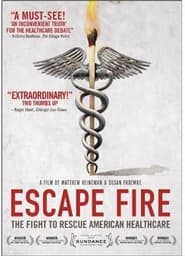
Escape Fire: The Fight to Rescue American Healthcare
Download English undertekster
Udgivelsesinfo
Tags
Forhåndsvisning af English undertekster
De første 200 linjer.
In 1949, a forest fire broke out in man gulch, Montana.
Smoke jumpers were parachuted in,
a team of 15, headed by a foreman named wag dodge.
The fire exploded.
It was moving over 600 feet a minute,
faster than most people could ever run
and so 15 firefighters were trapped.
Wag dodge had an idea.
He knew that they would lose the race
back to the top of the Ridge,
so he suddenly stopped,
he lit a match and he lit a fire at his own feet
and the fire spread around him.
I imagine the other smoke jumpers thought the guy was crazy,
but his idea was this... if I burn the fuel around me,
then when the fire comes and overtakes me, I'm safe.
I'll be in what came to be known as an escape fire.
He tried to get the other smoke jumpers to join him and nobody did.
The fire overtook the crew,
killing 13 men and burning 3,200 acres.
Wag dodge survived nearly unharmed in his escape fire.
It's just tragic to think of the answer being there,
but just in the moment not able to see it.
That's how imbedded people get in the status quo.
They can't recognize an invention when it's among them
and they can't give up their old habits.
We're in man gulch.
Healthcare, it's headed for really, really bad trouble.
The answers among us, can we please stop
and think and make sense of the situation
and get our way out of it? It's the same challenge.
We have had enough!
What do we want?!
Healthcare!
- When do we want it?! - Now!
All I hear is how we're gonna get more people access
to the present system and how we're gonna pay for it
and to me that's not the only issue.
The present system doesn't work and it's gonna take us down.
We need a whole new kind of medicine.
Healthcare reform was a good place to start,
but it will do little to address the root problems.
We don't have a healthcare system in this country.
We have a disease management system.
People often think it has to be a new drug or a new laser
or something really high tech and expensive
to be powerful and they have a hard time believing
that these simple choices that we make in our lives each day
can make such a powerful difference.
We're in the grip of a very big industry
and it doesn't want to stop making money.
At the executive level, what's most important
is meeting wall street's expectations and they have to.
These for profit companies,
by law, have to serve the shareholders.
You almost forget that what you're doing is providing healthcare.
The healthcare system is unsustainable.
We're spending almost twice as much in America
as any other country on earth.
We're really mortgaging the future.
Not just the health of healthcare,
we're talking about the health of the nation.
Mommy, what are you going to do?
I gotta go to work.
What are you gonna do at work?
What I do every day, buddy.
I love you.
I love you, too!
Bye.
Bye!
In a community health center like where I work,
you see chronic illness,
people that aren't able to afford their medications,
lots of psychiatric illnesses,
but the government pays you
based on how many patients you see.
I think we have about 25 patients for today for Dr. Martin.
I think 5 or 6 of them are on the waiting list.
If they're an easy 15 minute,
I'm sure we can probably squeeze them into the schedule.
Hello, Mr. fields?
I need to listen to you.
All right. Who's next?
- Hello. - Hi.
How are you?
Well, first of all,
my son's in the air force
and he's going to be 21 on Sunday.
Mm-hmm. And he's not here.
Where's he at?
- Germany. - Yeah?
And you're missing him?
I am.
And I moved out from my boyfriend in December
and I work 6 days a week,
5:30 to 7:30 and I'm tired.
Whoa. Yeah.
So, it sounds like you're feeling really overwhelmed right now.
Sorry.
Don't be sorry.
Did you have anything in mind when you came in here today?
I was on Celexa for a while and that seemed to help.
So, you were thinking about medication?
If you can think of anything else.
I'm a little bit wishy washy on the medication
because medication is not the problem.
- It's not. - Yeah.
The problem in your life is that you've got
too many things going on and you're overtired.
Instead of basing things on outcomes,
on how good of a job we're doing,
the government sets the reimbursement completely
on the number of patients that we see.
It doesn't matter how complicated they are,
how much time that we spend on them.
It's just a number... one, 2, 3, 4, 5.
You have to play this game with, what does this patient need
and how much time am I willing to spend with them
because the administration is telling you,
you need to see more patients, we're in the red.
And if you try and buck the system, someone says,
what can we do to get your productivity up?
I'm not interested in getting my productivity up.
I'm interested in helping patients.
In the era of for profit medicine,
the time allowed for patient visits has shrunk to a point
where you've got 7 minutes with a patient.
Can you feel this?
Yes.
Barely?
- Yeah. - Ok.
Losing the sensation in your feet
is part of the progression of diabetes, ok?
It could get worse.
People talk about 2-minute doctors...
Hmm.
Literally, 30 patients an hour.
Things could move in that direction here.
And this is not the choice of the doctor.
As a primary care physician, we're supposed to be the people
that are making sure the patients don't get sick
and that they have everything that they need
to maintain health...
But we end up being this revolving door.
People come in and you try and fix one thing
and they come back for the same thing over and over and over.
You just never get to the bottom
of what's causing all of these problems that they're having.
Michelle?
Tell me what happened.
I just tried to cut my arm off.
What were you trying to do?
I just wanted to just end it and...I'm tired of it.
I'm so tired of it.
- Are you taking your medication? - Yes.
A great deal of what's done in conventional medicine
is to put band-aids on things or to suppress symptoms.
Have you cut yourself before?
When I was a kid...
- You used to cut? - Mm-hmm.
Lexapro is the only thing you're on right now?
Mm-hmm.
This is a problem with a lot of our suppressive treatments.
They may keep the disease process going
and they may strengthen it over time.
It's much better to try to work at a deeper level.
I'm gonna make a phone call and try to get some wheels in motion
so that we can get you the help that you need, ok?
Ok, so, we need the crisis counselor then.
Yes, this is Dr. Martin over at LA clinica.
I need to speak with the crisis worker.
There's no crisis worker at lunch time?
I have an acutely suicidal patient
in my office that I need help with.
She's still taking her Lexapro,
but it's obviously not, uh...Not doing the job.
Where I'm at right now, patients are in desperate need of care
and the way that the system is set up, you can't be effective.
I became a doctor because I care about patients
and working here, I can't help them.
To feel that way when you come home...
Is...Demoralizing.
There has to be a different way of doing things,
so I decided to leave.
It's hard to say good-bye to the patients.
I took care of them and I was responsible for them
and just worrying about if somebody else is gonna do
for them what they need.
I want to give to people
and I want to help people
and I wasn't able to find that here.
I'm gonna go look for it.
The history of how the American health care system grew
is not one of order,
it's one of sort of haphazard chaos.
Everybody's doing what makes sense to them individually.
We pay hospitals to be full, so they try to be full.
We pay doctors to see patients, so they see a lot of patients.
We create a public expectation that more is better,
which isn't actually true, so people seek more.
More English subtitles for Escape Fire: The Fight to Rescue American Healthcare
- Escape Fire The Fight to Rescue American Healthcare 2012 WEBDL-1080p-NOGROUP en hi · 12 downloads · 2025-10-29
Kommentarer
No comments yet. Be the first to leave one.