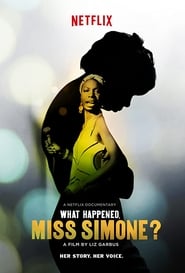
What Happened, Miss Simone?
Download English undertekster
Udgivelsesinfo
Tags
Forhåndsvisning af English undertekster
De første 200 linjer.
Tremendous pleasure and honor to welcome
the incredible, unique, and fantastic, one and only Nina Simone.
Hello.
Hi! We're ready.
One, two, three.
I haven't seen you for many years, since 1968.
I have decided that I will do no more jazz festivals.
That decision has not changed.
I will sing for you,
or we will do and share with you a few moments,
after which I shall graduate to a higher class, I hope,
and I hope you will come with me.
We will start from the beginning,
which was about a little girl,
and her name was Blue.
What's "free" to you, Nina?
- What's "free" to me? - Yeah.
Same thing it is to you. You tell me.
No, no, you tell me.
I don't know.
It's just a feeling.
It's just a feeling.
It's like, "How do you tell somebody how it feels to be in love?"
How are you going to tell anybody who has not been in love
how it feels to be in love?
You cannot do it to save your life.
You can describe things but you can't tell them,
but you know it when it happens.
That's what I mean by "free."
I've had a couple of times onstage when I really felt free,
and that's something else.
That's really something else!
Like, all... all... Like... like...
I'll tell you what freedom is to me, no fear.
I mean, really, no fear.
If I could have that
half of my life, no fear.
My mother was one of the greatest entertainers of all time,
hands down...
but she paid a huge price.
People seem to think that when she went out on stage,
that was when she became Nina Simone.
My mother was Nina Simone 24/7...
and that's where it became a problem.
When she was performing, she was brilliant, she was loved.
She was also a revolutionary.
She found a purpose for the stage,
a place from which she could use her voice to speak out for her people.
But when the show ended, everybody else went home.
She was alone and she was still fighting...
but she was fighting her own demons...
full of anger and rage.
She couldn't live with herself...
and everything fell apart.
Good evening. Our guest tonight is Nina Simone.
Probably the foremost blues singer, jazz singer, singer of all songs
in the United States today.
Nina, are you happy with the kind of work you are doing?
What makes me the happiest,
is when I'm performing and there are people out there
who feel with me and I know I touched them.
But to be completely honest,
the whole thing seems so much like a dream.
I never thought I was gonna stay in show business.
When I first got into show business,
I wasn't a blues singer and I wasn't even a jazz singer.
I was a classical pianist.
I studied to become
the first black classical pianist in America,
and that's all that was on my mind.
That's what I was prepared to be.
I was born Eunice Waymon, which is my real name, by the way,
in a town called Tryon, North Carolina.
I started to play the piano when I was three or four.
My mother was a preacher
and she took me with her on her revivals,
and I started to play the piano in church.
Revival meetings were some of the most exciting times
that I've ever had.
The music was so intense,
you just sort of went out of yourself.
I felt it tremendously.
I was leading it.
When I was seven, the choir of our church gave a program at the local theater,
and I was on that program...
And I played some song, I don't remember what it was,
and these two women, two white women, in the audience heard me.
One of them was the woman that my mother worked for,
and the other one was a music teacher, Mrs. Mazzanovich,
and they decided right then and there to give me lessons.
And so, for five years after that,
I studied piano, classical piano, with this teacher.
I crossed the railroad tracks every weekend to get to Mrs. Mazzanovich.
And, you know, railroad tracks in the South
are supposed to be dividing the blacks from the whites.
Well, it really did.
I was so scared.
Mrs. Mazzanovich frightened me.
It was her being white, in the sense that I had never seen.
She was alien to me.
Her white hair, the combs in it, her pleasantness...
I loved that.
And she started me on Bach.
And this Bach, I liked him.
Mrs. Mazzanovich had it in her mind
that I was gonna be one of the world's greatest concert pianists.
So it was all very disciplined classical music.
Bach, Beethoven, Debussy, Brahms, you name it.
Then Mrs. Mazzanovich got a fund together, "Eunice Waymon Fund,"
and I gave lots of recitals,
and they would take up collection
to further my education after I had left her.
Mommy took to all of the training like a fish to water,
but it was a double-edged sword.
She had a very lonely life
because she was practicing seven, eight hours a day.
When I first started to take lessons,
I became terribly aware
of how isolated I was from the other children,
and how isolated I was
from the white community and the negro community.
I felt it, all the time, even when the kids used to play with me.
They always wanted me just to play the piano for them to dance.
I wasn't asked too much to do anything else.
That was very hard.
Part of that isolation, of course, was the thing about color.
I was a black girl, and I knew about it, and I lived in it.
I lived in the South for 17 years.
My mom rarely referred to Jim Crow and segregation
and a lot of the racial issues that were going on at that stage in her life.
But she did tell me about times when she was told her nose was too big,
her lips were too full and her skin was too dark.
And after she was told that, they probably told her,
"There's only certain things you'll be good for in your life."
What I knew, I knew.
But we weren't allowed to mention anything racial in our house.
I wasn't consciously dealing with race.
That wasn't consciously on my mind at all...
until years later.
After I graduated from high school,
the money that had been saved from the Eunice Waymon Fund
sent me to New York to Juilliard for a year and a half.
And then I applied for a scholarship to Curtis Institute of Music in Philadelphia.
I was playing Czerny and Liszt and Rachmaninoff and Bach.
I knew I was good enough, but they turned me down,
and it took me about six months to realize it was because I was black.
I never really got over that jolt of racism at the time.
Then the money ran out
and the reality hit me that I had to go to work.
My parents had moved the whole family to Philadelphia to be near me,
and my family is very poor, so I had to work.
What else was there for me to do?
So, I got myself a job in Atlantic City for a summer.
It was a very crummy bar
and I used to go in in evening gowns. I didn't know any better.
And I played everything that I could think of.
Pop songs, classical, spirituals, all kinds of things.
It was very strange.
And I had never sung before,
and the owner came in the second night
and told me if I wanted to keep the job, I had to sing.
So, $90 was more money than I had ever heard of in my life,
so I said, "Well, I'll sing," and ever since then, I've been singing.
Eunice Waymon was playing in the bars to support her family
and to have money to continue her classical piano training.
But since she didn't want her mother to know that
she was playing "the devil's music" in bars,
she changed her name.
Eunice Waymon became Nina Simone.
She named herself "Niña," meaning "little one,"
and she had a boyfriend who called her "Niña,"
and "Simone" came from the French actress Simone Signoret.
I didn't want my mother to find out.
I knew she would hate it.
So I, kind of, kept it from her for a long, long time.
Was it lonely for a young girl
entertaining in these strange bars?
Extremely. Extremely lonely.
Working peculiar hours, I imagine.
12:00 midnight to 7:00 in the morning.
It ruined your social life, uh...
Never had much of one.
- Why'd you keep on with it? - Couldn't help it.
I have to play and I needed money.
It was always a matter of necessity from day to day what I'm going to do.
I didn't even know I was going to stay in show business.
I never thought about a choice.
From the beginning, I felt there was something eating at her.
You know, "What's eating at you, Nina?"
And, um...
gradually that got stronger.
The first time I played with Nina,
it was the summer of 1957 at a restaurant in New Hope, Pennsylvania.
She didn't look at me.
Said nothing, as though I wasn't... I wasn't even there,
and started in on a song.
She never told me what key she was going to be in.
She just started playing, and I knew exactly where I was going to go with it.
It was like we had a telepathic relationship.
Before you knew it, we were just weaving in and out.
What Happened, Miss Simone? subtitles in other languages
More English subtitles for What Happened, Miss Simone?
- What Happened Miss Simone 2015 WEBRip Netflix · 18 downloads · 2022-07-20
- What Happened Miss Simone 2015 WEBRip iTunes · 21 downloads · 2022-05-02
- What Happened Miss Simone 2015 BDRip x264-VoMiT · 32 downloads · 2016-09-02
- What Happened Miss Simone 2015 BDRip x264-VoMiT · 28 downloads · 2016-09-02
- What Happened Miss Simone 2015 720p WEBRip 750MB MkvCage · 23 downloads · 2016-03-23
- What Happened Miss Simone WEBRip x264-[eSc] · 28 downloads · 2015-08-26
- What Happened Miss Simone 720p NF WEBRip DD 5 1 x264-NTb · 17 downloads · 2015-08-26
Kommentarer
No comments yet. Be the first to leave one.