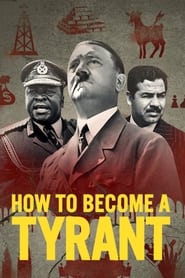
How to Become a Tyrant
Download English undertekster
Udgivelsesinfo
Tags
Download English Subtitle Files for Mobile (6)
Forhåndsvisning af English undertekster
De første 200 linjer.
Absolute power.
Come on. You know you want it.
You just don't know how to get it.
But I do.
There's a playbook.
A series of tactics that history's most infamous tyrants used
to achieve unimaginable power.
Each in his own unique way.
Now, there is one small catch.
This path does involve making some unpleasant choices.
But nobody said ruling was easy.
Care to look inside?
- Sieg! - Heil!
When I say the word "tyrant," what comes to mind?
No. Too simple.
Tyranny is government for people who want results.
When you look at human history, freedom is not the norm.
We love being ruled.
When you're living in a difficult time, there's an appeal to someone who comes up,
finds their moment, and says, "I alone can fix it all."
History's most successful tyrants do just that,
transforming their societies from top to bottom.
By following their path step by step,
you can too!
There's a playbook for tyranny.
If you want to be a tyrant, you just have to do those few things.
That's it.
But before you can do anything, you need to break out from the crowd
and grab the reins of power.
That's where our story begins,
with the failed landscape artist
who reinvented himself into the most powerful man on Earth.
- Sieg! - Heil!
Here he is. Adolf Hitler.
Just one month after becoming Germany's absolute ruler.
So, how exactly did Adolf Hitler become Adolf Hitler?
And what lessons can you take from him on your rise to power?
Hitler in his twenties was a disenchanted, broke,
friendless, failed artist.
I interviewed someone who had met Hitler,
and she said, "I found him remarkably unimpressive."
"He seemed very weedy. He had a clammy handshake."
How is it that this man ends up having this charismatic hold
all over this incredibly large country in the middle Europe in the 20th century?
It's actually quite simple.
If you want to rule,
you first have to believe that you can.
Tyrants do have
a kind of megalomaniacal confidence in their own abilities.
They have to have that.
They often see themselves as liberators.
They are frequently convinced
that only they can save the world
and make the world a better place.
In other words, they're special.
And as you'll see, Hitler wasn't the only one who felt that way.
Roll the film.
According to North Korean legend, at the moment of Kim Jong-Il's birth,
a new glowing star lit up the sky,
a double rainbow appeared, and winter turned into spring.
Saddam Hussein claimed that he was anointed by God
to rule Iraq forever
and pointed to the times he escaped death as proof of his divine favor.
While Haitian dictator François Duvalier claimed
that he himself was an eternal being
whose voodoo powers caused the JFK assassination.
Who's to say they didn't?
But where might you find the source of your otherworldly belief?
Hitler claimed that he found his in a most unexpected place.
The blood-soaked trenches of World War I.
One day while on duty, he hears a strange voice with a message.
"Move."
Several of his comrades are killed immediately,
but Hitler emerges without a scratch.
Later, as the war nears its end,
Hitler and his unit fall victim to mustard gas at the Battle of Ypres.
While recovering at a nearby hospital,
a pastor gives Hitler the bad news.
World War I is over.
Germany has surrendered.
In shock, he completely loses his sight.
A case of hysterical blindness.
Then from the depths of his despair
springs a grand vision for his nation's future.
From this point forward, Hitler never doubted his special purpose.
Hitler once said famously,
"I walk with the self-assurance of a sleepwalker toward my destiny."
Once he had his mission for Germany, he was on autopilot.
Nothing would distract him from that aim.
That's the sort of confidence that any future tyrant needs to get ahead.
Although some might use a different term.
The potential dictator is usually highly narcissistic.
Believe themselves to be the center of the universe,
and everything must happen according to their will.
And this is very different from ordinary people.
Maybe that's not such a bad thing.
But before you can realize your destiny,
you still have some big challenges to overcome.
For one thing, you don't have any followers yet.
In order to launch your rise to power,
you'll need a message that stirs people's souls,
and there's one surefire place to start.
In a perfect world,
your society wouldn't need to be guided by the firm hand of a tyrant ,
but look around you. People are angry ...
... and looking for someone to blame.
You're terrorist monsters!
The genius is understanding the nature of the resentment
that already exists...
and presenting yourself as the means to overcome that,
as the means to get even with the people that you resent.
You want to get your people's attention? The playbook is clear.
Show them that their enemies are your enemies...
...and that you are the one who will take them down.
Like these guys did.
From an early age, future Libyan leader Muammar Gaddafi
gave fiery speeches against the Western-backed monarchy
he called "corrupt,"
and was received as a hero when he toppled them in a coup.
The father of North Korea, Kim Il-Sung, came to prominence reminding his people
of the humiliations they suffered
at the hands of the occupying Japanese Army.
And as Idi Amin rose to power,
he focused the Ugandan people's frustrations
on their former colonial master, Britain.
We see that they are deposed in Uganda, that the British imperialism is over.
After the First World War, Germany has got hyperinflation,
mass unemployment,
and people are taking bucketloads of money to buy a loaf of bread.
And among Germany's disillusioned masses
is 30-year-old Adolf Hitler,
who was about to take a fateful step on his path to power.
Munich 1919.
Adolf Hitler is an unemployed artist with just a few coins in his pocket
and strong opinions about where everything went wrong
and who to blame.
Hitler gets a job as an army intelligence officer.
His first assignment: observe a meeting
of an anti-Semitic right-wing group called the German Workers' Party.
Hitler's bosses expect him to lay low,
take notes, and report back to headquarters.
But Hitler was never great at taking orders.
Years of rage and frustration pour out.
He rails against the Jewish-led conspiracy holding the proud German people down.
Now before we go on, I'm going to let this guy tell you
about the conspiracy theory Hitler was selling.
Hitler says that basically,
the financiers of Wall Street and the Communists in Moscow
are all one part of the same Jewish plot.
And it seems absurd, but that's what Hitler convinces the German people.
Absurd or not, Hitler's words strike a chord.
Now a party member,
Hitler obsessively perfects his performance.
The content of his speeches was... A lot of it was hatefulness.
Of the need to cleanse Germany of Jews.
It was vendetta against Germany being humiliated.
It was national pride , that Germany needed to rise again.
Before long, Hitler is named leader of the party,
which takes on a new name.
The National Socialist German Workers' Party,
otherwise known as "the Nazis."
Hitler now has a platform to vent his outrage
and a loyal group of followers hanging on his every word.
Many Germans found that he was saying what they thought secretly
but had never been able to express.
Why does this work so well?
It's because you are giving people permission to be themselves.
Common grievance brings people together,
and it feels very good because you have solidarity,
and you have a strong leader
leading you against that minority
or that threat from the outside.
Hard to believe people would be so quick
to blame others for their misfortune, right?
Let's not try and make out that German people in the '20s
are worse people than we are today.
If you feel genuinely
that there's an enemy within,
then you would want your politicians to do something about it.
It's very easy for us to sit back
and go, "I would never, you know,
fall for the seductive charms of a tyrant like Hitler."
I promise you you would.
But to achieve absolute power,
you'll need more than a compelling message.
You also have to sell the messenger.
Let the playbook be your guide.
As a tyrant, yours will become the face of your nation,
and how you present that face
will be all up to you.
But at this early stage of your journey, the playbook offers very specific advice
on how to fashion your image.
Show your people you are one of them.
Need some examples?
Italian dictator Benito Mussolini
proudly referred to himself as a "man of the people,"
frequently playing up his humble roots as the son of a small-town blacksmith.
At the start of his reign,
Idi Amin drove himself around Uganda in an open Jeep
and was known for showing off his accordion skills in public events.
How to Become a Tyrant subtitles in other languages
More English subtitles for How to Become a Tyrant
- How to Become a Tyrant S01 COMPLETE 720p NF WEBRip x264-GalaxyTV[TGx] · 84 downloads · 2021-07-22
- How to Become a Tyrant Complete S01 720p WEBRip x265 HEVC-MeGusta · 58 downloads · 2021-07-15
- How to Become a Tyrant S01 WEBRip x264-ION10 · 22 downloads · 2021-07-09
Kommentarer
No comments yet. Be the first to leave one.