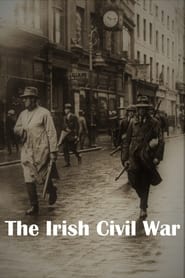
The Irish Civil War
Download English undertekster
Udgivelsesinfo
Tags
Download English Subtitle Files for Mobile (3)
Forhåndsvisning af English undertekster
De første 200 linjer.
Ireland, 1922:
After a long and turbulent struggle, Irish separatists
have forced britain to withdraw from most of the island of Ireland,
bringing centuries of colonial rule to an end.
The Irish public are ecstatic that they have stood up to Great Britain
and the country is still standing.
But at this moment of independence,
the new Irish free state descends into brutal civil war.
The Irish civil war is a war among fellow citizens,
people who recognise themselves as part of the same community
and that, I think, captures the horror of civil war
over its long history.
As the new state is engulfed by war,
few regions or communities escape.
Friends and families are torn apart.
Ashe referred to the civil war as a scar on the soul of Ireland
and it leaves spiritual wounds that fester for generations.
"Ready!"
Desperate to prove they can govern the Irish free state,
"aim!"
The new government officially executes 81 men by firing squad.
"Fire!"
The state's national army acts with impunity.
Young men dragged from their homes, their tortured bodies
left on roadsides for families to claim.
Those who resist the new state also resort to brutal tactics:
Assassinations, arson, attacks on families,
lethal ambushes of former comrades.
People were seeing people be murdered.
They've also been part of things that were going to have to live with
for the rest of their lives.
The legacy of the civil war will haunt Irish society and politics
for decades to come.
Some are so imbittered they feel like the revolution
has completely failed, they feel like they've wasted their youth.
It split the independence movement
and has mostly put an end to the dreams and hopes
that it would end in glory.
In the first decades of the 20th century
Irish revolutionaries achieved something
extraordinary and unexpected.
They then come close to destroying it.
Ireland wakes to a truce and peace.
After two and a half dark years of conflict
the Irish war of independence has been suspended.
People gather at Dublin's mansion house to Mark the moment.
When the truce was declared, everybody was delighted.
The summer of 1921 was a gorgeous summer.
It was absolutely wonderful.
And between the lifting of the curfew and the disappearance
of the auxiliaries and the black and tans off the street,
people began to think we actually had something.
As calm settles, British troops and police return to barracks.
Exhausted after years of war, some ira volunteers go home.
But others remain in the field, ready to resume the fight
against britain if necessary.
The truce allows people the opportunity
to do things long-postponed.
Parties and prayer vigils are held; People get married;
..Some play or watch their favourite sports;
..Fairs and markets spring back to life.
There was this great sense of celebration.
There was a great hope that a new future of Ireland could be achieved.
As the truce settles, the president of the Irish republic,
éamon de valera, is invited by British prime minister,
David Lloyd George, for talks in London.
Massive crowds and the world's press follow every step.
Lloyd George informs de valera that he is committed
to securing peace in Ireland.
De valera tells the prime minister that the people have mandated him
to establish an Irish republic.
The Irish Republicans thought the republic was going to
deliver a complete transformation of life.
Part of the problem of, perhaps, the excessive demonisation
of British rule was the assumption was once you cast it off
everything would be wonderful.
(Waves crashing/birds screeching)
The pursuit of independence in Ireland was inspired
by the enlightenment ideals of Liberty, fraternity and equality,
which by the late 1700s had fueled popular revolutions
in america, France and Ireland.
The Irish rebellion of 1798 was soon supressed,
but its example would encourage radical nationalists
for centuries to come.
Constitutional nationalists in Ireland, meanwhile,
including Daniel O'Connell and Charles Stewart parnell
campaigned to for the achievement of self-government by peaceful means
through the political system in London.
In 1914, the Irish parliamentary party seemed on the verge of success
when, despite intense opposition from unionists
who wished to remain in the United Kingdom,
the third home rule bill was passed by parliament in westminster.
But with the outbreak of the first world war,
Irish home rule was postponed.
Sensing betrayal and political opportunity,
in easter 1916, a small group of militant Irish separatists
staged a rebellion and unilaterally proclaimed an Irish republic.
(Cannon roaring/machinery clanking)
Britain easily quashed the rebellion.
Ready! Aim!
Fire!
But when the British executed 16 of the rebellion's leaders,
and then tried to introduce mass conscription,
the angered Irish public changed its mind.
Now popular support moved away from home rule
towards the pull of a fully independent republic
as advocated by the radical nationalist party sinn féin
and the rebels of 1916.
For a lot of these revolutionaries, the idea of the Irish republic
meant the values that were included in the 1916 proclamation,
whether that was the religious liberties, civil liberties,
equality for all; That all would be equal,
we have the question of gender equality.
This was to be a state where everybody was afforded
the same rights in the state
and where wealth was somewhat equally shared.
The national movement that builds around sinn féin
encompasses large swathes of society.
Left, right, and centre, big business and small farmers,
the catholic church, former home-rulers and the labour movement,
feminists, land agitators and radicals.
All coalesce around the common of a sovereign Irish nation.
At that moment, sinn féin is a very broad church.
It was kind of a joke, that sinn féin often...
It's informal policy was, independence first,
everything else after.
We can attend to those other economic and social issues
after independence.
When the first world war ends in 1918, a general election is held.
With its goal of an independent Irish republic,
sinn féin wins by a landslide.
Only in the north-east is the result different.
Here, unionists, many descended from the conquest planters of the 1600s,
have long rejected the idea of Irish independence.
Unionists are increasingly of the view that they might
be able to siphon off some of the northern counties,
which would remain in a union relationship with Great Britain.
Of course from the nationalist perspective,
with a substantial nationalist minority
within those six counties and with slight nationalist majorities
in Tyrone and fermanagh,
the six-county demand is anathema.
So that election is very polarising.
Ireland is pulling in different directions.
There's no doubt about that.
Bolstered by their mandate,
sinn féin tds meet in Dublin's mansion house.
Here they form an underground parliament called dáil éireann.
Without seeking permission from britain, they declare independence
and swear an oath to defend the republic.
"We the elected representatives of the ancient Irish people
ratify the establishment of the Irish republic and pledge
to make this declaration effective by every means at our command."
What goes on in Ireland from 1916-1923,
is what's going on across Europe, or even globally,
in places like Russia, places like the baltics, Finland and Poland.
But also places like Mexico, China, Mongolia.
There are revolutions and a kind of common thread
is ordinary working people,
who have been denied access to
elevated positions of social status and education, financial gain -
have been politicised.
Republics are cropping up everywhere. Monarchies are falling.
Over 20 dynasties are falling at the end of the first world war
and there's a sense of a kind of new world being made.
And there's a sense of the apocalypse arriving
for many of those on the right and many middle-class groups
who see bolshevism coming out of Russia as this real danger.
And revolution that is going to spread that across the world.
The revolutionary dáil sends a delegation
to the Paris peace conference.
Here, new nations are being formed
as the allies divide the spoils of the first world war.
But on britain's insistence, the Irish are ignored.
Now dáil éireann feels it has no choice
but to fight and to protect the Irish republic.
The period between 1918-1921 is relatively unusual
in Irish nationalism, in the sense that Irish nationalism
is usually fragmented between
different factions with different political outlooks.
But what you find from the general election up until the truce
there is a real unity brought about by the struggle for the republic.
Britain directs its overwhelming military power
against the Irish independence movement.
The Irish public mount campaigns of mass civil disobedience
while the ira and the women's republican organisation -
cumann na mban - use innovative guerilla tactics
to attack and consistently undermine British forces.
Dáil éireann sets up courts, policing and tax collection.
All in the name of the Irish republic.
The British, they had encountered conspiracies and insurrections.
But they had never encountered this consistent programme
of alternative administration
which meant that as you drove out, as you pushed out British power,
you substituted a republican structure.
That's revolutionary.
The British government responds with brutal reprisals
and punishment attacks on Irish citizens;
tactics that become difficult to defend as the world's press watches.
Sinn féin mounts a sophisticated propaganda war
Kommentarer
No comments yet. Be the first to leave one.