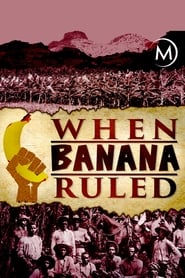
When Banana Ruled (La Loi de la banane)
Download English undertekster
Udgivelsesinfo
Tags
Forhåndsvisning af English undertekster
De første 200 linjer.
- This is the story of a fruit, a simple fruit,
available all year round all around the world.
It's the story of a fruit on which an empire was built,
one of the first modern multinationals,
the United Fruit Company.
This is the story of a fruit which altered the destiny
of Central America and gave its name to republics.
It became notorious.
It became the symbol of all that's wrong
with American capitalism.
- This is an economic and political tale,
a little story about globalization.
This is the story of a fruit, a simple fruit, the banana.
It all began in 1871, when the government in Costa Rica
asked a certain Minor Cooper Keith from New York
to construct a railway.
It was to link the Caribbean coast
to the high plateaus through the jungle.
But nothing went as planned.
The jungle was pitiless, accidents, scorpions, malaria.
4,000 men died for just 40 kilometers of railway.
And when a stock market crash dragged the world economy
into a depression, credit disappeared.
Costa Rica could no longer pay.
The railway remained unfinished.
Minor was ruined.
He did not yet know that fortune was in fact
right there at his feet, in the humid soil of the jungle,
in these unpretentious rhizomes
which he had planted to feed his workers,
in this fruit, this simple fruit of the tropics, the banana.
The simple food of Costa Rican workers,
the banana appeared at the turn of the century
in northern markets in the United States.
It was a prized delicacy,
expensive because it was rare and perishable.
Whoever managed to transport it quickly enough
before it could ripen and rot could turn it into gold,
and Minor recognized that.
Very soon, he was exporting bananas.
They saved him from ruin.
He struck an agreement with Costa Rica.
He would finish work on the railway.
In return, he asked for just two things,
the right to operate the line for his own profit,
and land, lots of it,
land for producing bananas,
trains for transporting them quickly and cheaply.
This was the start of his fortune.
In 1899, Minor joined forces with two Boston wholesalers.
He put in his plantations and his Central American railways.
His associates provided a fleet of ships
and a distribution network across the United States.
On the 30th of March 1899,
together, they founded the United Fruit Company.
- My working definition of a multinational is a company
which owns and controls assets in more than one country.
I would say it's among the first of the multinationals
in this kind of like primary commodity type of business.
And it's really taking the process of vertical integration
to quite an extreme extent, including constructing
what's gonna become one of the biggest shipping fleets
actually in the world and integrating right down
through to distribution in the United States.
So it's really quite, quite extreme at this time.
But they're pioneering in a more fundamental way
because this company is actually creating the market
for bananas as well as pioneering how to deliver
the product to their consumer.
So in 1890, nobody in the United States
really knew what a banana was basically.
By 1914, you can buy bananas
in virtually all big American towns.
- Delicious, nourishing, full of vitamins.
The United Fruit Company had a flare for promoting bananas.
Mothers of families were the target.
They published recipes, solicited pediatricians
who sang their praises.
Ah.
- Very soon, Americans could no longer
do without them.
Imported by the ton, reasonably priced,
they were accessible to everyone.
Bananas were fragile.
Tempests, flooding, and heatwaves
regularly devastated the plantations.
Bananas could become scarce.
For Minor and his associates, it was obvious.
They needed to produce more, ever more bananas
over a much larger area right across Central America.
- Today's fast white steamship
travels across the Caribbean with cargoes
more valuable than pirate's gold.
And officers in trim white uniforms pick up
their golden cargoes from a place we call Banana Land.
Banana Land,
this was the Central American nations.
Former Spanish colonies, they had won their independence
at the beginning of the 19th century.
But the United States regarded them as its private
hunting ground, a natural extension of their market.
For the United Fruit Company, this was one single territory
completely given over to the production of bananas.
The United Fruit Company kept on growing.
It needed ever more land.
In Panama and Costa Rica, Indian farmers
who had no property rights were evicted.
By cutting the price of bananas, it threatened to ruin
any small producers who refused to give up
their banana plantations.
Little by little, it took over hundreds of thousands
of hectares of Central America's best land.
It's exactly what happened
during the land reforms in Great Britain which began
in the 16th century and carried on until the 18th century.
You had poor British land workers
who were expropriated in the same way.
There's no other word for it.
The land which they cultivated
started to have fences put up around it.
And by the 18th century, they had been obliged
to give up their workforce to the factories
which were beginning to appear.
So in reality, this movement is at the origin
of contemporary industry and economy as we know them today.
It was the founding act of contemporary capitalism.
Did the United Fruit Company
introduce capitalism to Central America?
In any case, it brought in very early on
a certain vision of development and progress.
The train was at the origin
of the good fortune of Minor Cooper Keith,
the founder of the United Fruit Company.
For the young nations of Central America,
it was synonymous with modernity.
Guatemala wanted its own, but the country was in debt.
And when the price of coffee,
its primary resource, collapsed, it could no longer pay.
Their railway was abandoned.
In 1903, Guatemala turned to the one person
able to save it, Minor Cooper Keith.
Minor agreed to take over the work.
In exchange, as usual, he asked for land
for banana plantations and the right to operate
the new train for his own profit.
He also acquired control over the country's main port
as well as the telegraph lines.
And that is how in order to gain a train,
Guatemala gave away to the United Fruit Company
its infrastructures, its economy, and its future.
And thus, the company's empire grew
to the detriment of these new states in search of progress
but with no resources and in debt.
- In other words, more often than not,
the debt of the poor helps line the pockets of the rich.
Here, you had an attempt to privatize the totality
of the public sphere through the debt mechanism,
which reiterated the fundamental act of expropriation
of common property to pick the land
for the profit of a very small number.
- The banana-producing countries of the Caribbean
and Central America in this way bound themselves,
one after the other, to the company.
Each time, it obtained the right to pay little or no taxes
to the countries in which it operated,
draining their resources even more
and assuring their dependence.
Thousands of letters have been found
on a plantation in Panama, a massive internal correspondence
which illustrates the daily life of the company
and its long history of tax avoidance.
A letter from a United Fruit Company head to his manager.
Panama, October 26th, 1918.
"Dear Mr. Kyes, while having a chat with the President
"the other day, he asked me why we were so unfair to Panama
"as to pay her only one cent per bunch export taxes.
"We talked over the matter frankly at some length,
"and he finally told me, 'Don't worry,
"'you always have gotten what you want, my friend.'"
"Signed, Carson McFarland."
Republic of Panama, Presidential Offices,
December 17th, 1918.
"To Mr. McFarland, my dear friend, I have received
"the draft legislation concerning tax increases.
"I have sent it to some deputies who are friends of mine
"so they can introduce the modifications
"which you suggest and which I have accepted.
"Your friend, Belisario Porras, President of Panama."
In the case of the United Fruit,
it had these wonderful tax-free concessions and things.
But honestly, practically every Western company
all over Latin America and Asia had the same conditions.
Basically, they had the bargaining power.
They had the technological advantage and the money.
These places wanted them,
and the deal was very little taxes.
In our age, tax avoidance, or tax planning as its called
in business course, has become a central feature
of business globally, and that's a quite different situation
from when developing fragile states in the 19th century
Kommentarer
No comments yet. Be the first to leave one.