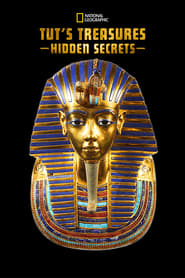
Tut's Treasures: Hidden Secrets
Download English undertekster
Udgivelsesinfo
Tags
Forhåndsvisning af English undertekster
De første 200 linjer.
Tutankhamun's spectacular treasures.
Now, for the first time since they were discovered,
all 5,398 objects are being brought together
in a new $1 billion museum.
This will be the first time many of them have been seen for a century.
Look at the horse, look at the horse, look at the horse!
Scientists have been using the latest imaging and forensic technology
to unlock long buried mysteries to reveal the man behind the mask.
So many tiny details are visible again.
And one treasure has caused more speculation over the years than any other.
Tutankhamun's death mask.
Some scholars have begun to suggest that this may not belong to him at all.
Now, who the mask was actually made for may no longer be a mystery.
The Valley of the Kings.
The sacred burial ground of ancient Egypt's pharaohs.
For centuries, archaeologists have explored these tombs.
But each one they entered was stripped bare by grave robbers in search of gold.
Every tomb, except one.
On November 26th, 1922, archaeologist Howard Carter broke into that long-forgotten
tomb to make the greatest archeological discovery of all time.
He found the breathtaking treasures of Tutankhamun.
Ever since, the world has marveled at the royal splendor of this young king's tomb.
And the most famous treasure of all is the death mask.
-Tutankhamun's mask is an icon.
And I think part of it is because it is made of solid gold and a lot of people get
wowed by that, as well as by the beauty of the craftsmanship
and also by the elegance and the expression of the face.
Crafted from 22 pounds of gold,
this priceless object is known throughout the world.
But speculation has always swirled around this 3,000-year old treasure with
some experts claiming the mask may never have been made for Tutankhamun.
Now, the opening of a major new museum offers Egyptologists a unique
opportunity to assess everything from the tomb as never before.
And the world-famous death mask has undergone the most
intensive forensic examination ever.
It will answer once and for all if this is the mask of Tutankhamun.
The Cairo Museum has been the home of the death mask ever since it was
discovered a century ago.
And to see how the mask was documented when it was first discovered,
Egyptologist Chris Naunton is stepping back in time.
Wow.
Hidden in the bowels of the museum is a 100-year-old book,
that details every single object found in Tutankhamun's tomb.
It's Howard Carter's original excavation log.
Huh. Wow. This is it.
This is the beginning of the record.
-Yeah. -And so this is the first thing he recorded.
Shrine outermost. 6064.
-Yeah. -Can I, can I turn the page?
These pages, barely turned for a century, reveal that over
5,000 objects were taken from the tomb, but only a third have ever been seen in public.
-That's the death mask. What does he say?
'Mask of mummy, beard and necklace.'
-Yes. -Wow, there it is.
The most famous archaeological object from the ancient world; mask of mummy 60672.
And now, decades after its discovery, the mask is about to start
a new chapter in life.
In a high security operation, the entire contents of Tutankhamun's tomb are
heading to a brand-new home.
15 years in the making and at a cost of $1 billion,
the massive Grand Egyptian Museum is rising up in the desert outside Cairo.
The huge array of items arriving, show how much this young pharaoh took to the
grave when he died at the age of 19.
-Ideally, once you die, you go and live forever, and therefore you need
everything that you needed in this life.
And if you're a king you had a lot of stuff. Fantastic.
This is a scepter, which maybe he would have held or maybe someone else
would have walked before him with.
There's everything from mummified food for the afterlife.
Ooh nice.
To the childhood belongings of the boy who became the head of a
powerful empire when he was only nine.
-This is some sort of a seat with a foot stool.
Little bottom of, little bottom of Tut. Aw.
He needed all of the stuff he used in daily life, but he also needed a lot of
religious, magical things that would help him go from this world to the next.
So this is why his tomb is just exploding with objects.
The most important of those magical objects was the death mask.
This golden portrait, a clear likeness of Tutankhamun, was vital.
It was how he would be recognized in the afterlife.
As the thousands of burial goods, from the sacred to the mundane,
are gathered together in the new museum, there's a chance for new information
about all these objects to be uncovered.
-Layers and layers and layers of information are coming out.
Not just because objects are being examined in detail,
but also because new technologies can be applied to them.
Scientific advances beyond the wildest dreams of Howard Carter,
are allowing the contents of the tomb to be forensically examined,
some for the first time.
And what's become clearer, is that Tutankhamun's massive royal burial
did not go according to plan.
-Perhaps things were not done exactly as they should have been.
Perhaps they were done in a hurry.
The origin of some of the most magnificent objects
in the tomb is in doubt.
And some have now even suggested that the most famous of all the
pharaoh's treasures, his death mask,
may not have originally belonged to him.
-Was the mask created for Tutankhamun or for someone else?
Could it be true,
that this iconic death mask was never intended for Tutankhamun?
It's inlaid with thousands of fragments of colored glass and semi-precious stones.
Lapis lazuli from Afghanistan fills the eyebrows...
Red carnelian from India sets off the garland...
And the eyes are formed from Turkish obsidian.
According to ancient Egyptian burial law,
this whole mask had to be ready in a startlingly short amount of time.
Little more than two months was allowed from the moment of death until
a body was sealed in its tomb.
And that has raised doubts about the mask.
-The priesthood and the craftsmen who were involved in preparing the burial equipment
would only have had 70 days, and that's the length of time it takes to prepare
the body for burial, in which to create material like this death mask.
And some people would say that 70 days is not long enough to create
an object as fine as this.
In which case, the only way it could have ended up among the burial equipment
of Tutankhamun was if it was already available.
Perhaps having been made for somebody else.
Over recent years speculation has mounted that the death mask originally
belonged to Tutankhamun's stepmother, Nefertiti.
People have wondered if craftsmen, short of time, could have rescued her mask
and replaced her face with that of Tutankhamun.
At the new Grand Egyptian Museum the sheer number of objects
arriving in its store rooms seems to add weight to this theory.
It was a huge task for the ancient Egyptians to prepare a king's tomb.
-It's just incredible to think that these things are so old, they're so fragile.
But I mean the detail on this is absolutely exquisite.
If you look at the open work in this model shrine, with the detail of a bull.
It's intimidating to be this close to it almost.
The volumes are staggering.
Hundreds of arrows, beds, sticks, even shoes.
-Ahh, beautiful, yeah. -Smalls, smallest ones we have.
-So these must have been sandals made for Tutankhamun when he was a young child.
-Mmm. Yes, yes. -How many sandals do we have all together?
How many pairs do you know?
-All we received until now about 30 pairs, yes...
-30 pairs already here. And there's still more coming.
That's amazing.
Many of these objects have never come out of storage,
they've never seen the light of day.
And it's only now therefore, that we can really get a sense of the full extent um,
of the treasures that Tutankhamun was buried with.
And it's really incredible to think I mean, every single one these items is
an exquisite work of art in its own right.
And all of these thousands of objects had to be either found
or created from scratch in just two months before being transported to the tomb.
Tutankhamun's burial site lies 400 miles south of Cairo's Grand Egyptian Museum,
in the Valley of the Kings.
Chris Naunton has come to these desert hills to see where all the treasures from
Tutankhamun's tomb were first gathered over 3,000 years ago.
They lay here until the archaeologist Howard Carter first discovered the long,
hidden entrance to the young pharaoh's tomb.
Even though I must have been here dozens of times now,
it's still a thrill to come down that descending passageway every time.
And it's difficult not to try to imagine what it must have been like for Howard Carter
coming into this tomb, finding it absolutely chock-full of this incredible assemblage
of material of the finest quality, more or less exactly as it had been left
3,000 years ago.
The tomb was so full it took Carter and his team ten years to remove
the mass of treasures and haul them across the desert back to Cairo.
But as the excavation progressed,
Carter was hampered by the size of the site.
The burial chamber was so cramped, the team could barely fit around the gilded shrines.
It was soon clear this was an unusual tomb for such a powerful ruler
of ancient Egypt.
Difficult to escape the feeling that all is not quite right here,
it's just not very big, and it's just not very complicated,
and the design is really quite simple.
There's not very much wall space at all and what there is, is only half-decorated.
It feels more here as though a space has been hastily adapted to receive
the burial of a pharaoh.
The fact that Tutankhamun's tomb is so small and badly prepared
has long puzzled Egyptologists.
And at the Grand Egyptian Museum there's evidence that Tutankhamun's burial
fell short in other ways.
The latest shipment of objects from the tomb has arrived.
It's a batch of shabtis.
Models of servants intended to serve the pharaoh after death.
There were more than 400 of these small figures,
many of which have never been displayed before.
Each one should look like Tutankhamun, bearing the same face as his death mask.
-Is funny with the googly eyes.
But they've raised questions for Egyptologist Salima Ikram.
Idea is that they should all look like Tutankhamun,
but you can clearly see a lot of variety here.
So although the paint job's similar, the faces are very different coz that one's got a
pointy nose, that one's got a differently shaped mouth.
Some faces are more delicately formed and slightly more feminine even than his,
others are a bit more robust, so there is a question as to whether some
of them might have been made for someone else.
It seems the leader of an ancient empire may have been buried with
objects never intended for him.
-You do see re-use in tomb material fairly frequently, especially in the non-royal
corpus, but it seems a bit odd to do this in a royal burial.
The conservators at the Grand Egyptian Museum are now trying to establish how
much of Tutankhamun's burial treasure originally belonged to someone else.
Existing estimates are staggering.
Over 1,000 items, a quarter of the contents of the tomb, are second hand.
-At this point it's very difficult to be precise about how many items might have been
made for someone else and re-used because it's only now that we are looking even more
Tut's Treasures: Hidden Secrets subtitles in other languages
More English subtitles for Tut's Treasures: Hidden Secrets
- Tuts Treasures Hidden Secrets S01 DSNP WEB H264-SHIIIT · 21 downloads · 2026-06-15
- Tuts Treasuresdden Secrets Series 1 3of3 Tales from the Tomb 720p HDTV x264 AAC · 32 downloads · 2019-05-04
- Tuts Treasuresdden Secrets Series 1 1of3 Treasures Rediscovered 720p HDTV x264 AAC · 41 downloads · 2019-05-02
Kommentarer
No comments yet. Be the first to leave one.