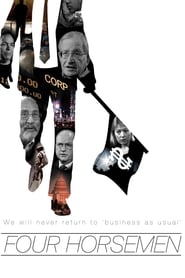
Four Horsemen
Download English undertekster
Forhåndsvisning af English undertekster
De første 200 linjer.
All experience has shown
that mankind is more disposed to suffer -
while evils are sufferable -
than to right themselves
by abolishing the forms to which they are accustomed.
American Declaration of Independence.
A Renegade Economist film
People are awfully forgiving.
They just don't understand
what has been done to them.
We are at an epochal shift.
We're at a point where
the West could tip into a complacent and quite well off redundancy
or we could play a decisive role in the future.
What the banks did was reprehensible.
That was why there was the outrage at the greed of the bankers
when we gave them money that was supposed to
help them lend to others
but they decided to use that money to pay themselves bonuses -
for what, for record losses?
We are governed by corporations today.
often by corporations that don't have very much interest
in the United States of America.
I don't know what happened man, what happened to the U.S.,
it went so far in the ditch.
You know, what... at what moment did it all go bad?
Was it Disco? Was it Donna Summer?
Is that what killed America?
We are entering The Age Of Consequence.
A rapacious financial system,
escalating organised violence,
abject poverty for billions
and the looming environmental fall-out
are all converging at a time when governments,
religion,
and mainstream economists have stalled.
War,
Conquest,
Famine
and Death -
the Four Horsemen are coming.
FOUR HORSEMEN
This is not a film that sees conspiracies.
It is not a film that mongers fear.
It is not a film that blames bankers or politicians.
It's a film that questions the systems we've created -
and suggests ways to reform them.
Over centuries, systems have been subtly modified, manipulated
and even corrupted
often to serve the interests of the few.
We have continually accepted these changes
and, because man can adjust to living under virtually any conditions,
the trait that has enabled us to survive
is the very trait that has suppressed us.
Most societies have an elite
and the elites try to stay in power.
And the way they stay in power
is not merely by controlling the means of production, to be Marxist,
i.e. controlling the money,
but by controlling the cognitive map, the way we think.
And what really matters in that respect,
is not so much what is actually said in public
but is what is left un-debated, unsaid.
For centuries gatekeepers have manipulated our cognitive map.
But in 1989 a computer scientist by the name of Tim Berners-Lee
implemented the first successful communication
between an HTTP client and server.
The World Wide Web was born.
It has since unleashed a tsunami
of instantly accessible, freely available information.
Just as Gutenberg's printing press wrestled control of the cognitive map
away from an ecclesiastical and royal elite,
today the internet is beginning to change
governments, finance and the media.
We are at the cusp of change.
But to enact it we must first understand
the things that have been left unsaid for so long.
To do that we need context
from people who speak the truth in the face of collective delusion
because to understand something is to be liberated from it.
EMPIRES
All a great power has to do to destroy itself
is persist in trying to do the impossible.
Stephen Vizinczey
At the end of World War II,
we had 50% of the world's gross domestic product,
we were making 54,000 airplanes a year, 7,000 ships, etc etc.
We were the new Rome.
And we recognized it, and devised a power management scheme
in the 1947 National Security Act to, we thought, manage it
and it worked fairly well during the Cold War.
But we haven't done anything since and I think that is another sign
of our inability to grasp the "new world", if you will.
Empires do not begin or end on a certain date.
But they do end,
and the West has not yet come to terms with its fading supremacy.
At the end of every empire - under the guise of renewal -
tribes, armies, and organisations appear
and devour the heritage of the former super power,
often from within.
In his essay 'The Fate Of Empires',
the soldier, diplomat and traveller Lieutenant-General Sir John Glubb
analysed the lifecycle of empires.
He found remarkable similarities between them all.
An empire lasts about 250 years, or ten generations,
from the early pioneers
to the final conspicuous consumers who become a burden on the state.
Six ages define the lifespan of an empire.
The Age Of Pioneers
The Age Of Conquests
The Age Of Commerce
The Age Of Affluence
The Age Of Intellect
Ending with bread and circuses in The Age Of Decadence.
There are common features to every Age Of Decadence.
An undisciplined, overextended military,
the conspicuous display of wealth,
a massive disparity between rich and poor,
a desire to live off a bloated State
and an obsession with sex.
But perhaps the most notorious trait of all
is the debasement of the currency.
Purchasing power of $1
The United States and Great Britain
both began on a gold or silver standard,
long since abandoned.
Rome was no different.
So it started on a principle that was very sound
and it was on a silver standard.
But as it corrupted further and further and further
the Roman denarius got to the point where it was basically a copper coin
and they learnt how to plate and it was washed in silver
and in circulation the plating came off.
And at the end all the senators
that really did at one time represent the people
only were interested in representing
how much wealth they could steal at the top.
Great empire wealth always dazzles
but beneath the surface the unbridled desire
for money, power and material possessions
means that duty and public service
are replaced by leaders and citizens
who scramble for the spoils.
Historically
all the signs of the demise of the empire
are beginning to develop, some are more trenchant that others.
This current financial and economic crisis,
that sort of thing, always accompanies the demise of empire.
The people of Rome
were constantly being distracted by the gladiatorial events
and the politicians knew that they did this.
Whenever there was unrest among the people
they had a huge event going on
and they created a new event with lots and lots of gladiators.
And every day, we‘re doing that.
That is a common trait of declining empires.
And so today, in the U.S. for example,
you find a tremendous emphasis on all kinds of television programmes
that distract people from what's really is going on.
Sports is a big part of that, as it was in gladiator times.
In essence, we've been lulled into a lethargy
and we've accepted it.
Just as our sports stars today earn vast sums,
so did Roman charioteers.
In the 2nd century one by the name of Gaius Appuleius Diocles
amassed a fortune of 35 million sesterces in prize money
equivalent to several billion dollars today.
Strangely, perhaps, there is another profession
that is disproportionately hallowed as an empire declines.
The Romans, the Ottomans and the Spanish
all made celebrities of their chefs.
And this again is typifying the end of an empire,
where things were so great we have this last oomph of momentum,
that we used to be great, and we felt great,
and we don't feel it anymore.
So everyone is out searching for it.
Well, maybe it's in the best food or the best clothes
or the best music or the best movies
or a reality TV show or another magazine.
But you can never get enough of what you don't need.
What you need is a strong moral conviction
that is pervasive throughout the society... and integrity reigns.
There is a vast apathy.
There is a vast amoralism, even a political nature to it,
that is to say there are vast numbers of people who don't give a damn.
And so there is this - natural, I suppose - entropy,
any living organism which an empire is of course,
over time dies.
The question is: How does it die?
Does it die in a violent cascade of events?
Or does it die over a long period of time?
The Baby-Boomer Generation were born into this Age of Decadence.
Perhaps unwittingly they've broken the unspoken intergenerational contract.
Through unfettered consumerism, spiraling house prices,
and a desire for eternal youth,
the Baby-Boomers have squandered future generations' inheritance.
My generation, the generation right after my generation,
I think we forgot that little phrase in the preamble to our Constitution
which says "and our posterity."
All of a sudden it became "us". Period.
Four Horsemen subtitles in other languages
More English subtitles for Four Horsemen
- Four Horsemen · 53 downloads · 2015-11-10
- Four Horsemen 25 000 FPS · 56 downloads · 2015-08-12
Kommentarer
No comments yet. Be the first to leave one.