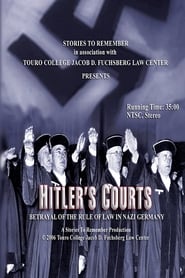
Hitlers Courts - Betrayal of the rule of Law in Nazi Germany
Download English Untertitel
Release Info
Tags
English Untertitel-Vorschau
Die ersten 197 Zeilen.
- They had the strong conviction that this was right,
and they were here at the right place,
celebrating this party, and celebrating these politics.
I mean, I as a child grew up in Germany.
And I saw what happened sometimes, you know,
when they had these mass rallies.
And when I saw Hitler's speeches.
- 10,000 German lawyers and judges took an oath
of personal loyalty to the Fuhrer.
- In Nazi arguments, the law is the will of the Fuhrer.
- Because he brings the hope, the glory, the pride.
And then it all went horribly wrong.
In 1933, less than a month
after being elected Chancellor,
Adolf Hitler used the pretext of a fire
in the Reichstag building to suspend constitutional law.
And place unlimited judicial authority
in the hands of the government.
It was a cataclysmic event.
I mean, think in terms of our Capitol burning
down.
The Reichstag was their Congress.
And the Reichstag couldn't meet.
And when the Reichstag is not in session,
the Chancellor has emergency powers.
So here you have Adolf Hitler given these
enormous emergency powers to do almost anything
that would be contrary to a democratic society.
The German legal system
in 1933 was a very sophisticated legal system.
This was not primitive law.
It was really seen, German legal science,
was really seen as the height
of what the law was supposed to be
about.
After the burning of the Reichstag,
which was more than a symbolic act
in destroying the parliament,
10,000 lawyers took an oath.
Not surprising, I've taken an oath as a lawyer
to defend the Constitution of the United States.
But 10,000 German lawyers and judges
took an oath of personal loyalty to the Fuhrer,
which is the antithesis
of what we think of as the rule of law.
So the Nazis coming to power realized
that the law was a very powerful instrument.
In order to get the German public to follow
and to acquiesce in those early steps.
- The principal procedure governing German law
during the Third Reich
was something called the Fuhrerprinzip.
And the idea was that Hitler had absolute discretion
to make any ruling whatsoever in the interest of the state.
And that there were lesser or subordinate Fuhrers
who also followed the Fuhrerprinzip,
and also themselves had wide discretion,
limited only by what the Fuhrer
above them had told them to do.
Over the next 12 years,
the Nazi party continued its subversion
of constitutional safeguards until Germany's courts
amounted to nothing more than tools
for the implementation of National Socialism.
Early in their subversion of law, Nazi officials
established special courts to deal with anyone
the party deemed an enemy of the Reich.
In these courts, there was no pre-trial investigation.
Judges determined arbitrarily what evidence
to consider, and there was no right of appeal.
- Now, this is the time when the judiciary could have
and should have stood up and said, wait a moment
we have rules and laws here,
this is our nation that is being corrupted.
And the Chancellor said, this is only temporary
because of the terror that's been visited upon Germany.
- Once he succeeded in concentrating
legal authority into his own hands,
Hitler then had the tools for eliminating all those
he deemed to be enemies of the Reich.
Primary among these were Jews and other minorities.
Before the Nazi era, Jewish lawyers constituted
a large percentage of Germany's legal community.
With Hitler's rise to power, Jews were
no longer allowed to practice law.
Eventually most lost their lives as well.
One who survived, Max Friedlaender,
was a distinguished legal ethicist.
After his escape from Germany, he wrote memoirs
that offer a vivid portrait of life before,
during and after the Nazi era.
On January 30th, 1933,
I was in Berlin
for a meeting of the Board of Directors
of the German Bar Association
when a telephone call informed us
that Adolf Hitler had become Chancellor.
But it was only later, after the Nazis had swept aside
all legal barriers to their reign of terror,
that we would come to understand
the full implications of this event.
The German Bar Association soon met its final fate.
All votes on resolutions were held
under the supervision of the SA,
and I would not have advised anyone
to cast a dissenting vote.
In a similar manner, the regional Bar Associations
and the Bavarian Lawyers' Association disappeared.
On April 7th, 1933, the German government enacted
a law forbidding attorneys of non-Aryan descent
from representing Aryan clients.
If anyone dared do so, their names were published
in the press, their businesses were boycotted,
and soon it even became grounds for divorce.
When the Nazis first came to power,
they ended up promulgating a number of laws
that incrementally deprived Jews
and other persecuted minorities of civil rights.
These incremental steps that we're talking
about that results in the Final Solution
were all legal steps.
And you can trace this.
You can trace the Holocaust as a legal event.
Genocide, the extermination
of whole categories of human beings,
was a foremost instrument of the Nazi doctrine.
We shall show that these deeds of men in uniform
were the methodical execution of long-range plans
to destroy ethnic, national political and religious groups
which stood condemned in the Nazi mind.
If you begin with the assumption
that you are a member of a superior race,
and that others who have a different color
or a different religion,
or a different ideology
are inferior, then it begins to follow
that the superior one should dominate the inferior one,
or eventually eliminate him as well.
- Doctrines of so-called criminal types
were implemented that allowed Hitler's courts
the further liberty of condemning enemies of the state
not based on what they had done,
but on the sole basis of who they were.
The enemy, which we regard this enemy,
has to be pursued, not because he has done something wrong
in our eyes, in the eyes of the state leadership,
but because he is different.
It was a principle of the National Socialist Constitution
that race is a very, very important point,
and that everybody has to be treated according to his race.
This was official state doctrine.
You couldn't act openly against the state doctrine.
- Perhaps future generations will read
about the books that were burned, forbidden, boycotted,
often not even for their content,
but because of their author's race.
I was leafing through a recent
Nazi commentary on laws governing attorneys.
And I found sentences lifted verbatim
from one of my own books.
Roland Friesler, Undersecretary in the Prussian
Ministry of Justice, wrote a review.
He said, "For decades, the German Bar had to accept
"the shameful fact that the law governing
"its conduct was commented on by Jews.
"Now at last a German commentary has appeared."
It was a truly new way of fighting
Jewish intellectual property.
You just brand it as inferior, then copy it,
and now praise it as an Aryan creation.
- In 1934, the People's Court was established
to try those accused of political offenses.
Eventually, the court came under the presidency
of Roland Freisler, a Nazi of such extreme sentiments
that he shocked even his fellow Nazi judges.
Freisler was one of an echelon of senior German jurists
who paved the way for the betrayal
of the rule of law in the 1930s.
Carl Schmitt, Hitler's legal theorist,
a wealthy and ambitious conservative
who described the Fuhrer as Germany's guardian of justice.
Erwin Bumke, the man who drafted Hitler's emergency laws.
These and other senior officials of Hitler's courts
empowered police to disband organizations,
seize assets, make arrests,
and determine on their own initiative
what constituted a threat to the state.
The Nuremberg laws reflected Nazi
preoccupation with racial purity,
an idea concocted from vague elements
of religion, citizenship and heredity.
Since the laws defined Jews as racially impure,
marriage between Jews and non-Jews would defile
the race and was now prohibited.
Resourceful judges found other applications
for the Nuremberg laws, by arguing for example
that because Jews were no longer considered full
Kommentare
No comments yet. Be the first to leave one.