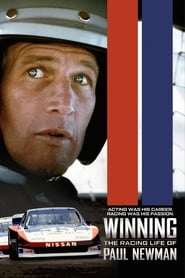
Winning: The Racing Life of Paul Newman
Download English Untertitel
Release Info
Tags
English Untertitel-Vorschau
Die ersten 200 Zeilen.
You see, it was the Oscars.
People vote. They say, "him," or, "her."
Don't hand me any of that crap.
In this, it isn't, "we vote, and it's him and her."
You either cross the finish line first,
and it's either him or her.
How do people in show business regard his racing?
I'm not sure they know he races.
Technically, I mean, he was really a good driver.
He wanted to be looked at as a driver,
Not as an academy award winner,
but as a man who was involved
with his heart and soul in racing.
He loved the big cars.
He loved the horsepower. That was his thing.
He just wanted to go fast.
Racing became his passion, and he went for it.
Paul Newman is going to be the "C" production
1979 national champ.
The margin of victory...
6.3 seconds between first and second.
I was born in January of 1924.
My brother came along 1 year, 3 days, and 10 hours later.
We grew up in a suburb of Cleveland, shaker heights.
We were very close.
If somebody was picking on my brother, I'd be there.
And I can remember Paul stepping in on a couple
of occasions or more.
Most of our friends had the use of cars before Paul and I did.
Dad never felt that that was an essential thing,
even when we went to college,
we were in the service,
came back out of the service.
Did we have our own car? No.
And there is the checkered flag for 500 winner Mario Andretti.
I met Paul Newman in 1967.
It was Bridgehampton, Long Island... Can-Am race.
I was driving this car that was called "the honker,"
and on race morning,
there's a big "Paul Newman" on front of the car.
I saw Paul Newman is sponsoring.
All of a sudden, there's Paul Newman and Joanne,
and I was totally starstruck.
Immediately, I invited him to go in the cockpit,
and he was very taken with all the gadgets and everything.
And then I took him for a ride.
And Bridgehampton is one of those elevation tracks
and narrow, blind corners.
And, I mean, it's really easy, sort of,
to impress somebody quickly.
And I noticed that, you know, he was sort of white-knuckling.
I, quite honestly, think that captured his imagination.
In 1968, I was cast with Paul to do this film, "Winning."
All I want from you is to come in first.
Both of us?
They wanted to have us be able to drive on the tracks
with cameras mounted on the cars
so it looked like we were really involved.
He's in trouble.
He seems to be out of gas and heads for the pits.
And in order to do that, we both had to be race drivers.
We had to learn how to drive automobiles.
So we were sent
to the Bob Bondurant School of Driving.
I'm Bob Bondurant here at Sears Point International Raceway
and the Bondurant School.
Well, the studio called me and said they were gonna
make this really good movie... racing movie.
So Paul and Robert came down to the school.
I said, "so, Paul, how come you wanted to do this movie?"
He said, "I had two other movies
I could make a lot more money on,
but I always wanted to see if I could drive a race car."
When he heard about the Bondurant school,
He was eager to jump into it.
You know, one of the greatest rewards
about having my own driving school is being able to teach
other people how to learn to drive better.
I think it was always inside him somewhere, you know?
When he got involved in something,
he really turned it over.
He really investigated it.
He looked at every aspect of it.
And every aspect, I think, that he looked at in the world
of racing was something that attracted him.
And I took Paul with me and teach how to do an oval,
taught him the line,
and then he went a little quicker and quicker and quicker.
And he learned real well.
He listened really well.
He stayed out particularly late.
He kept going.
You know, I'd get out of the car
and be happy to get out of the car,
but Paul, he really loved it.
Got the look of eagles in his eyes.
I could see it. I could see him starting.
And when he came out of that picture,
that was a permanent lifetime passion of his,
and it never diminished.
"Winning" was just completed when we did "Butch Cassidy."
Listen, I don't mean to be a sore loser, but,
When it's done, if I'm dead, kill him.
Love to.
I first met him in a way
that probably made indelible our friendship,
or at least my devotion to him,
because they were casting the film,
"Butch Cassidy and the Sundance Kid."
He was already cast.
He was a well-known name.
I was being approached to play Butch Cassidy.
The original title of the film was
"the Sundance Kid and Butch Cassidy"
'cause Paul was gonna play Sundance.
The studio said no, I wasn't enough of a name.
It seemed to center on the fact of Paul's approval.
I had never met him, so we went to meet him.
And after that meeting, Paul just said, "I'll go with it.
I'll go with Redford."
Well, that ought to do it.
In the course of making the film,
we discovered that we had a lot in common,
and we developed a friendship that was
not unlike the two characters in the film.
I'll jump first.
No.
- Then you jump first. - No, I said.
What's the matter with you?!
I can't swim!
Why, you crazy, the fall will probably kill ya.
Ohhhhhhh!
Oh, shi-I-I-I-I-I-I-t!
He would drive souped-up cars...
Volkswagen all jacked up...
But there were no racing cars involved.
I had racing cars because I'd been a lover of racing
since I was about 15.
When Paul and I met, by that time,
I had acquired a very special racing car called a Porsche 904.
It was built for Sebring.
So that was the car I had when we made "Butch Cassidy."
I knew of his love of cars
And so forth, so I said, "you want to drive it?"
He took it to hand right away,
and it was pretty clear
that he had a natural ability with the car.
When we saw each other again, he was racing.
He had gone to this school, graduated.
You started the whole thing, Bondurant,
Whether you know it or not.
I mean, I remember with some trepidation
the first time I went from a two-liter Datsun sedan
into a formula Vee.
And it was right out of the box,
and no one had checked camber or anything,
and the car just lurched from one side of
the corner to the other, and I thought, "boy,
if this is a racer,
I don't want to have an awful lot to do with it."
He went on to the racing world.
That's what he really wanted to do.
You could tell that this was a big, big thing in his life.
The studios didn't want him doing that.
If something happened to him,
it would involve a great financial problem.
He meant so much to a movie.
I mean, if you get Paul Newman to do a picture, I mean,
that was hundreds of millions of dollars in profits for them.
And I dreamed about this game, fat man.
I dreamed about this game every night on the road.
I mean, they think of Paul. "Geez,
what is he doing in a racer. Is he crazy?
Let him do it for a couple of times,
then we'll take him out of it."
You know, that's their attitude.
In 1971, I was at Lime Rock on a Tuesday testing,
and it was not unusual for Jim Haynes,
who owned the track, to say, "would you take so and so
from the Hartford courant, the Norwalk hour,
The Stamford advocate," one of the newspapers,
"around for a couple laps?"
So I said, "sure. Send him over."
It was Paul, in blue jeans and sunglasses, and his son.
I didn't recognize him.
He didn't look like a plastic, Hollywood guy to me.
So I took them both around for a couple laps,
and somebody said, "that was Paul Newman, wasn't it?"
I said, "it was Paul something or other."
Well, and there was a place called Bob Sharp Datsun.
So, that was sort of one of those legendary places.
"Bob Sharp?" You know, I'd go visit him.
I'd go, "my God, that's Bob Sharp."
I'd watch it like the Beatles were performing there,
and that's who he raced for.
He was 48 years old when he started racing,
when most people are retiring.
Hi. I'm Sam Posey.
I used to drive cars like this for a living.
It's been 17 years now since I started racing.
Winning: The Racing Life of Paul Newman subtitles in other languages
More English subtitles for Winning: The Racing Life of Paul Newman
- Winning Racing Life of Paul Newman 2015 HDRip Released · 40 downloads · 2016-02-03
Kommentare
No comments yet. Be the first to leave one.