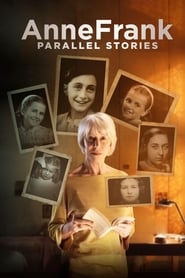
#AnneFrank. Parallel Stories
Download English Untertitel
Release Info
Tags
English Untertitel-Vorschau
Die ersten 194 Zeilen.
[loudspeaker announcement in German]
On Saturday, July the 15th, 1944, Anne writes,
"Dearest Kitty,
it is utterly impossible for me to build my life
on a foundation of chaos, suffering and death.
I see the world being slowly transformed into a wilderness.
I hear the approaching thunder
that one day will destroy us too.
I feel the suffering of millions.
And yet, when I look up at the sky,
I somehow feel that everything will change for the better,
that this cruelty too will end,
that peace and tranquillity will return once more.
In the meantime, I must hold on to my ideals.
Perhaps the day will come
when I'll be able to realize them.
Yours, Anne Marie Frank."
When this picture was taken,
Anne, a Jewish girl of almost 13,
was unaware of what she was going to be faced with.
She did not know that she would be spending
two years of her life in hiding in this house in Amsterdam,
hardly able to see the sky or breath the air,
deprived of her freedom.
She will hide here, together with her family,
to escape from the Nazis.
Here, she will be scared, but she will live, grow,
and write a diary
to an imaginary friend by the name of Kitty.
Wednesday, April the 5th, 1944.
"My dearest Kitty,
I need to have something besides a husband and children
to devote myself to.
I don't want to have lived in vain like most people.
I want to be useful,
or bring enjoyment to all people,
even those I've never met.
I want to go on living, even after my death."
On August the 4th, 1944,
she is arrested and deported.
She disappeared,
along with one million and a half
other kids and teens like her.
Anne knew this evil.
Nobody can ever forget it,
because it keeps on digging within the survivors.
Even within those children,
who, unlike Anne, are still alive,
and are now the last witnesses of the Shoah.
I'm visualizing
the gates being fully opened,
the noise of those iron gates,
and endless queues of people
marching in to take a shower, and never coming out,
which is what happened to us later.
We heard the noise of batons.
We heard the smashing of batons.
They would hit us and we were told,
"You enter through the door and exit from the chimney."
Cattle wagons remind me
of when we stood in them. We travelled in them.
Those memories are always with me.
The colours I see if I close my eyes
are the white of the snow, and the white of the corpses.
Flames from the chimney, snow,
cold...
and loneliness.
An officer of the SS,
together with some Dutch policemen,
climbed up the shelter's stairs.
They discovered the secret behind the thin barrier
that for two years
had protected Anne's underground life,
shared with father Otto, mother Edith, sister Margot,
Auguste and Hermann van Pels,
their 16 year old son, Peter,
and Fritz Pfeffer.
It is still unknown
whether they had all been betrayed.
They just had time to grab what they could in a hurry
before being taken away.
Anne's diary was left on the floor.
- -
She was still free when on her 13th birthday
Anne had received a diary as a birthday present,
a light blue shirt, a puzzle, a pot of cream, some flowers,
and two peonies.
It was June the 12th, 1942.
Anne started to write her diary and decided to give it a name.
Saturday, June the 20th, 1942.
"To enhance the image of this long-awaited friend
in my imagination,
I don't want to jot down the facts in this diary
the way most people would do,
but I want the diary to be my friend,
and I'm going to call this friend Kitty."
Kitty is a mirror,
a double, a cure for the soul.
She is her comfort, outburst and consolation.
A way of saying
that the price you pay for the evil you went through
won't be too high.
That everything can be told to an imaginary friend,
the first reader of the many that Anne dreams
of having one day,
when everything is going to be over.
In Bergen-Belsen,
there was no time to say goodbye.
The mark of the camp was typhus,
and the epidemic was spread by lice,
and ended up making people dumb and ghastly,
waiting for their end.
At first, Anne and Margot with their parents were sent
to the Westerbork transit camp in Eastern Holland.
When they arrived, more than 100,000 Jews
had already been deported.
The Franks' final destination was Auschwitz in Poland.
Later on, the two sisters ended up in Bergen-Belsen in Germany,
where they died of typhus in February 1945.
Margot first, followed by Anne.
The SS guards in Bergen-Belsen
were just a little older than the two Frank sisters.
They were young girls who became torturers,
and the most ferocious was Irma Grese.
She would later be sentenced to death
in a trial against a group of SS officers,
held by the same British forces who freed the camp
on April the 15th, 1945.
The Germans who lived near the camps
were forced by the soldiers who liberated the camps
to enter and watch
what they had always pretended not to know.
The SS guards in Bergen-Belsen
were forced by the British soldiers
to pick up their victims' corpses
with their bare hands,
and throw them in the common graves.
Here 23,200 people are buried.
No one knows where the two sisters are buried.
They ended up, like other victims,
in common graves.
What remains of them is their names on a black stone.
When you went on the train to Auschwitz,
for six or seven days,
sat in their own urine and faeces.
No food to eat, in darkness,
and in stink and in smell,
so by the time they arrived in Auschwitz,
they look like garbage,
and we have no problem with garbage
with throwing it out.
If they look like shit,
we have no problem flushing it down the toilet.
If Anne had survived, she would be 90 now.
Maybe her gaze and her face would be similar
to those of these women,
who are still proud of having survived and having made it.
I do not feel hatred.
Actually, I learned to love people.
But I hate the Nazis.
I shall never forgive them
for what they have done to the children
who were sent to the gas chambers.
BORN NOVEMBER TH 16TH, 1939 DEPORTED MAY THE 3RD, 1944
My children are my revenge against the Nazis,
and my grandchildren and great-grandchildren
are my way of taking the mickey out of them.
For many, these memories were made of secrets,
long silences, or half words
needed to protect those who came after
from memories that were perhaps too savage.
And yet those memories were passed on
to their children, grandchildren,
great-grandchildren,
as if each generation needed to find a new voice.
It was very difficult for me, as a little girl,
to understand something that happened to so many people,
my grandparents included.
And then we were told the story of Anne Frank,
and suddenly, there was this little girl
who I could see myself through her,
and suddenly the story became too real, I think,
and I just got too scared.
Arianna's tragedy,
who survived four concentration camps,
has now become a permanent mark on Lorenzo's forearm.
I decided to get her tattoo on me
after reading her book.
I felt very, very close to the story,
and also physically connected
to what happened to my grandmother.
And the voices of her family members
who disappeared in the camps
are now to be found in Francesca's music.
#AnneFrank. Parallel Stories subtitles in other languages
More English subtitles for #AnneFrank. Parallel Stories
- Anne Frank Parallel Stories 2019 Webrip · 24 downloads · 2022-11-15
- Anne Frank Parallel Stories 2019 720p WEBRip x264 AAC-[YTS MX] · 22 downloads · 2021-02-22
- AnneFrank Parallel Stories 2019 WEBRip x264-ION10 · 20 downloads · 2020-09-12
Kommentare
No comments yet. Be the first to leave one.