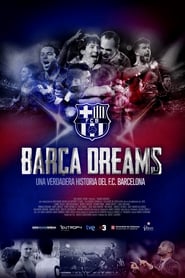
Barça Dreams (Barça Dreams)
Download English Untertitel
Release Info
Tags
Download English Subtitle Files for Mobile (2)
English Untertitel-Vorschau
Die ersten 200 Zeilen.
When I came here my dream was to play in the first squad
and I never imagined
I would experience everything that followed,
but I'm happy about all that's happened to me.
I had to live in Barcelona
I ended up going through it all
because God wanted it
and I'm grateful.
Managing to stay for a long time in a club like this
is extremely difficult.
I had the enthusiasm, conviction and confidence
that I wanted to succeed at Barça,
whatever the cost.
Seeing my name as one of the world's best players
or being nominated Footballer of the Year
was unthinkable when I began at 16, 17 or 18.
We've overcome every barrier and dream one could have.
WE ARE BARÇA
He was a true sportsman.
He's a fan of all sports and plays them all.
He met other people
in places that were very important then,
the few gyms that existed in Barcelona.
People who were crazy about sport used to meet there.
They were looked upon as somewhat eccentric.
When Gamper announced he wanted to set up Barça,
twelve people responded to his call,
the club's founders.
He initially wanted to be the team's captain and play,
and later join the board, but not to be president.
He wanted to participate from a distance.
And if the club had problems,
he took over and got it back on track again.
He'd collect signatures or money
to keep the club afloat.
He still believed in amateur sport.
However he had founded a club that was growing bigger
and to move in higher places,
this step became inevitable,
as it was the direction football was heading to.
Those who see football as a religion
know that Barça is about more than playing football.
It teaches you a great deal about the sport,
but especially at a human level,
to think about your teammates
and the group before yourself.
Barça promotes these values, respect, caring,
humility, work, effort, sacrifice.
I arrived when I was 13
and was brought up here
with the values of Barça and La Masia.
And more than just playing football,
they also educate you really well.
La Masia contributed a lot to my personality.
The things I've been able to grow up with,
in terms of respect, education,
humility, respecting your teammates,
were all about learning and having to improve each year.
Actually, there are jokes about the time
he was negotiating contracts with players
and he wanted to give them some "love-for-the-club" vitamins,
so that they'd ask for less money after taking them.
They once closed the ground.
An English Navy squadron had come
with an English football team
and played against Barça.
The English anthem was played, with everybody standing,
and there was applause at the end,
but nobody stood up for the Spanish anthem,
so they close the ground for six months.
It really shocked a lot of people.
If Gamper had thought that nobody would remember him,
it wasn't true since his funeral proved the opposite,
with an incredible number of people on the streets.
In terms of sport,
the 1920s is known as Barça's first golden age,
because it actually won nearly everything from 1919 to 1929.
The number of trophies is truly impressive.
It was also famous for a few players,
Zamora debuted at the same time as the big player Samitier,
but others came later, Sagi, Platko,
very important names in the Club's history.
Barça was a club that reflected Catalan society,
so logically it was affected by the beginning of the Civil War.
Its institutions collapsed,
it membership decreased
and it underwent a financial crisis.
But above all, this great team,
which had practically won everything between 1919 and 1929,
stopped winning.
Barça was in a very delicate position,
because it had earlier clearly expressed
its support of democratic ideals
and the Catalan identity.
Catalan had been the official language of the club since 1921
and then suddenly in 1939 it finds itself under a dictatorship...
that wants to control not just Barça,
but all sporting clubs in Spain,
which is why the boards were directly named
by the Falangist National Sports Delegation.
The most obvious thing for Barça
was that it was somehow forced to show
that this Barça was nothing like the previous one,
so it had to renounce all the values
implicit in the club prior to the Civil War.
A ball called "Nitran".
We had to paint them white to play at night
because there weren't any white balls.
All of them were the colour of leather.
They weighed 100 grams
and if they were kicked around over a wet pitch
by the end of the match
they weighed about a kilo or a kilo and a half.
We didn't have the gloves that they have now.
Sometimes I think, how has he lost the ball
when it's impossible with their gloves?
We had woollen gloves crocheted by my mother
and we only wore them when it rained.
Antonio was everybody's idol.
He was known as "the winged cat".
It's funny because he used to take his goalie's kit home
to be washed and ironed by his mother,
because we bought them ourselves.
Not like now when they give them away after the match.
If I'd done that, I wouldn't have had any on game day.
Kubala is one of the great Barça legends,
a very good player
and was also surrounded
by some very major non-sporting matters at the time,
given that he was essentially a refugee
fleeing from the Eastern Bloc,
which was all about Cold War dynamics...
He came to Barça and really created a football revolution.
He controlled the ball really well, with both feet with amazing ease.
Sometimes he would sit on the ground like in the circus
and kick the ball upwards... And why?
Because Kubala could control the ball,
even in his sleep.
He showed people things they hadn't seen before.
People went to matches just to see Kubala play.
This was the five-cup Barça.
Everyone wanted to play in Barça then.
Kubala in the 1950s was one of the people who gave the club
a football and social dimension that was above the norm.
All the most popular figures of the day
wanted to be connected to Kubala in some way.
Barça's culture has always been about play,
but the person who showed this on the field was a foreigner.
It's interesting that it happened with Kubala,
with Cruyff,
with Ronaldinho,
with Messi.
This is another thing that doesn't happen much in many clubs.
Barça can create a team,
but it's a foreigner who usually makes the difference,
soaking up a lot from Barça's game system and culture
and giving it a dimension
that would be difficult for a player from here.
And it's very much in line with Gamper's spirit.
CAMP NOU OPENING 24 September 1957
And also the European trophy at the time, the Latin Cup,
as there wasn't any European Cup.
Barça was the dominant force not only in Spain,
but also played a very major role in Europe.
Barça had reached an agreement with River Plate,
which was the Argentine club
that owned the rights to Di Stéfano,
and what Madrid did was reach an agreement
with Bogotá's Millonarios,
the team Di Stéfano was playing in,
and I emphasis the words at the time, "in defiance".
The player could only be signed
from River Plate as they owned his registration rights,
so Barça was legally doing the right thing.
Di Stéfano comes to Barcelona
and trains with the players.
They want him to play in a friendly,
but joint action is taken by the Federation,
Real Madrid,
and the Falangist National Sports Delegation
to stop the process.
Then you can see
how the legislation on the entry of foreign players changes daily.
When Barça already has him signed,
the Federation decides that foreign players can't enter,
but revokes the order when he might go to Madrid.
There's a constant to and fro
in terms of legal actions in the summer of 1953
so that Di Stéfano can't join Barça.
Real Madrid's history is built on Di Stéfano.
Madrid's world-renowned history
is based on the five European Cups it wins with Di Stéfano.
LUIS SUÁREZ, GOLDEN BALL 1960
Barcelona had to sell Luisito Suárez,
which would be like us selling Messi now.
So let's say we don't have Messi.
Would we notice his departure?
Of course we would.
The same thing was true with Luisito Suárez.
A period then begins
Barça Dreams subtitles in other languages
More English subtitles for Barça Dreams
- Barca Dreams 2015 DOCU 720p BluRay x264-HDEX · 36 downloads · 2018-09-21
Kommentare
No comments yet. Be the first to leave one.