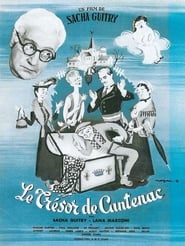
The Treasure of Cantenac (Le trésor de Cantenac)
Download English Untertitel
English Untertitel-Vorschau
Die ersten 200 Zeilen.
THE TREASURE OF CANTENAC
This work was produced at Photosonor Studios in Courbevoie
Then it was fully developed at Eclair Laboratories in Epinay-sur-Seine
and it's a film by...
Come in.
Rene Genin, priest of Cantenac,
and Roger Legris, village idiot.
How are they? - Very amazing.
Very surprising? Well, my God...
Gentlemen, please.
You're well, Mr. Sacha Guitry? - Until proven otherwise, yes.
Do you have time to make a movie? - We always have half an hour ahead.
Well, sir...
I find your story fascinating, to the extent that...
Hello, miss?
Would you like to send me a complete crew?
Yes, yes, right away. Thank you.
Mr. Fernand Rene.
I'm the village drunk.
You see what you have to do.
Ladies, please.
Mrs. Fusier-Gir, the haberdasher of Cantenac.
Mrs. Pauline Carton, the parish priest's maid.
Do you want to advertise
Milly Mathis, the owner of the cafe,
with Henry Laverne and Paul Demange.
One being her husband, and the other, her lover.
Mr. Marcel Simon, the centenary of Cantenac.
And here is Ramir.
No, but listen... I beg your pardon.
If you all talk at once, I won't be able to write anything down.
- Here's how it starts. - A nice morning...
No, it was one evening.
No, no. It was a Thursday.
It's probably for a movie.
Ronnier will surely edit it.
Mr. Baron de Cantenac, with his son-in-law and his wife.
Ladies and gentlemen, the named villagers:
Robert Seller, the carpenter;
Luce Fabiole, the washer during the day;
Numes Jr., the postman;
Jacques Sablon, the roadmender.
Are you aware of the miraculous event
that happened in Cantenac? - I'm very interested,
I admit it.
- Let me tell you. - Go ahead.
On September 2, at 8:20 a.m...
Here is Sophie Mallet, the goose girl;
Pierre Juvenet, the butcher;
Marthe Sarbel, the baker;
Yvonne Hebert, the ironer;
Claire Brilletti, the nanny;
Georges Spanelly, the architect.
Take the trouble to go up.
Here is Jacques de Feraudy, the blacksmith;
Leon Walther, the butler;
Solange Varennes, the shepherdess; Aziza Ali, the gypsy;
Roger Poirier, the gardener;
Germaine Duard, the servant.
Would you mind going up to the waiting room?
This is Bob Roucoules, the doctor;
Paillette, the midwife;
and Grethen, the carpenter.
Come up, gentlemen.
Varougeanne, the gypsy;
and finally Bever, the gravedigger.
That's how it ends.
- And it couldn't have ended better. - We all think so.
What are all these people? They're nice.
They just told me about an extraordinary film subject.
In this film, you will play the role of Mademoiselle,
if miss wants it.
Provided that you play the role of Baron de Cantenac.
I can refuse nothing to the baron.
He is a man, in fact, who never denies himself anything.
Gentlemen, we're starting a new movie in a month.
Francois Caron, would you like to be the production manager?
Francois Gir, be my assistant.
Renoux, do the decorations.
Ramettre, be the operator.
And please call up the recruits again.
Mr. Louis, sound engineer.
Miss Lefevre, be the script girl.
Mr. Muller, be the stage manager.
Oh, and here's Louiguy!
Do you want to make music? Yes? So much the better.
Three, four!
Once upon a time there was a small village which
sat modestly between Paimpol and Draguignan.
It was a lovely little village. There are no ugly villages
when viewed from a distance.
Its name was Cantenac.
It had been there for centuries and
it had never been talked about before.
Imagine what's coming
to happen to it is a miraculous adventure.
And it is precisely this adventure that I'm going to tell you about.
But I have to start at the beginning, and
I want to ask you the following question:
do you know what a village is?
Do you know how it starts?
Well, it starts with a castle.
It's hard to believe, but that's the way it is.
A great lord decides one day to have himself built
a magnificent castle.
When you have such a castle built,
we need many things.
To build it, we need everything.
And to live there, we need bread, milk,
fruits, vegetables and flowers.
Alas, we need meat.
How not to hang
the beauty of this rider and the nobility of the gesture of the worker.
Maintaining the lord has no more harmony
no grace than the gesture of a worker
when he does his work with love.
So close to the castle a village rises,
which the day before was still only a hamlet,
and which seems to come out of the ground at the call of the steeple.
You have to have your reason for being on earth.
This is why the castles of old knew how to
make themselves useful by creating villages
which sometimes became towns.
Because give and take.
When the village feeds the castle,
the chateau supported him by providing him with work.
And that's how in the 16th century, our little village was born,
and such is the lord who brought him into the world.
It's been around for almost 500 years.
But it must be admitted that it has hardly existed for 150 years.
It barely survives, poor thing.
Because it no longer has a castle. It's finished.
Since the Revolution, since 1793.
But let's put an end to all that,
because now the village rooster
tell the rooster in the steeple that it's 5 o'clock.
The bell tower repeats it and others will say it.
Now the houses are slapped by the shutters.
Then at the thresholds of the doors and in the frames
of the windows appear, puffy and almost all sullen,
5, 10, 1 5, 20 faces of peasants.
Let's get to know them. We are going to learn some great things.
Because there are many extravagant things in this village.
And speaking of extravagant things, here
without further ado is the boozer of the place
and the village idiot.
This sweet drunkard is a subject of curiosity:
we have never seen him drink and we always see him drunk.
It's because he hides to drink.
In my opinion, he should do the opposite.
He should drink openly and hide when drunk.
As for this little guy who sneaks around, who appears, who disappears,
who likes to fade away, to prank everyone, he
plays a fairly discreet role in the adventure,
although it is essential. We will soon have the proof.
Oh! It gets dark early this morning.
Since she is coming to us, allow me to present her to you.
Why does she walk like this? Why so many ways?
Why is she wearing her hair this way?
Because she had been to Paris one day.
She deserved a lesson, and Prosper gave it to her.
And this lesson did him great good.
She knew love, and soon she became the village crane.
That's what it's like to have been to Paris.
But let's be serious. Here we have two men in evidence:
the mayor and the priest.
Both have their own strongholds, and
it's not just the road that separates them.
The mayor is disbelieving, profane, sectarian.
He clings to his opinions as if someone wanted to take
them from him, whereas no one in Cantenac shares them.
It is the same with the priest, poor, dear and holy man.
Nobody talks to him. He doesn't talk to anyone.
Here is the reason.
Between this mayor, who sits on the edge of the
wells, as if to prevent the truth from coming out,
and this priest whom everything divides: the character and
the ideas, the mission of one, the function of the other,
yes, between these two men, there is something.
One thing that makes their hostility grow more serious every day
and deeper still.
These men are both brothers, and they are twins.
The fight had been terrible between them not long ago, and it
is claimed that one evening they had both come into conflict.
The two men had fought bitterly over the
villagers, who soon, not knowing which way to go,
and desiring to lead a peaceful existence on
earth without closing the sky irremediably,
one day made the double determination
not to set foot in church again,
nor to meetings organized at the
town hall for an obvious purpose.
These people preferred to have no opinion of any
kind, neither political nor religious, no, no, no!
"May they both work it out and leave us alone."
However, there are two concessions that everyone,
Panurge's sheep if there ever was one, willingly made:
every 4 years they voted for the mayor, and
at the time of death, the night having come,
they called the priest.
The Treasure of Cantenac subtitles in other languages
Kommentare
No comments yet. Be the first to leave one.