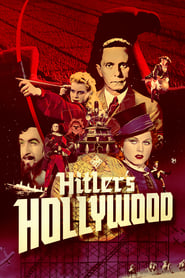
Hitler's Hollywood (Hitlers Hollywood)
Λήψη English Υπότιτλων
Πληροφορίες έκδοσης
Ετικέτες
Προεπισκόπηση υποτίτλων English
Οι πρώτες 200 γραμμές.
-Doctor? -Yes.
Anything missing?
No, I have everything.
Good, then have a think.
I'm thoroughly happy. It couldn't be better.
Then all's well.
Yes, indeed, gentlemen We're happy indeed
Because from now on The world belongs to us
Yes, indeed, gentlemen
Worries are far away
We do what we enjoy
Whoever disturbs us Before he twigs it
We'll have soft-soaped
Yes, indeed, gentlemen
You can bet on it
Indeed, indeed, indeed!
Germany in the middle of the 19305.
At first sight, a peaceful country.
This is when my mother was born.
They were my father's childhood years.
Hitler's domination had stabilized.
The effects of the economic crisis were invisible.
The unemployed had gone from the streets.
The regime's enemies had been silenced or exiled
or arrested, or already murdered.
Jews were the scapegoats.
Outlawed and to be exterminated.
Most Germans who remained had adjusted themselves with the regime,
if they weren't already Hitler's supporters.
Cinema offered an additional distraction.
Nazi cinema was fantasy and a dream factory.
It wanted to be a second Hollywood. Hitler's Hollywood.
Attention!
Nazi cinema was theatrical,
illusionary.
It was bigger than life. It wanted at all costs to be monumental.
Emotion and spectacle; something for the heart and the eyes.
It was nearly always ambivalent.
She, too, first worked in Germany.
We barely know these films.
But there is no reason to look away.
They are better than their reputation.
Many are worth a second look.
A look that focuses on the details and disregards the surface message
without losing sight of it.
Many know more and disclose much more than they would admit.
The best of them are self-reflective
and reveal to us something beyond themselves.
What are these films about? What do they reveal? And conceal?
Nazi cinema was show business. Exaggerated. A spectacle.
It sometimes feels as if everything was just one big film.
All this is part of our collective memory.
All this lives on in our subconscious.
What does cinema know that we don't?
Let's take a look.
Just three days after seizing power
the new Chancellor, Adolf Hitler, attended a film premiere
at the UFA Palast in Berlin.
A submarine film shot during the Weimar Republic
which stylized the German fight in WI as heroic self-sacrifice
and foreshadowed some of the central themes of Nazi propaganda:
camaraderie and duty as the cardinal rule,
the soldiers' collective as a meaningful unit.
Go down to 30 meters.
Silently. No movement in the submarine.
And being prepared to sacrifice yourself for the fight to go on.
A film steeped in a mythical yearning for death.
Our lives no longer belong to us.
They're no longer ours, Boehm! Are they?
We have to go on for as long as there is still breath in us.
On the submarine, again and again,
until the clear Lord sets us free.
Sleep well, fellows.
The regime did not celebrate life,
but for the cult of death Hitler and his people always found
new and spectacular images.
The propaganda events of the annual memorial for the dead
at the Feldherrenhalle and the Königsplatz in Munich.
At the party celebrations, witch's Sabbaths of dehumanized masses.
Above all, in the magically illuminated dark of night,
where they felt most at home.
And also in their films.
Film was the Hitler regime's primary media of communicating with the masses.
I know...
Farewell.
What did these Germans dream about?
Nazi cinema seemed to be fascinated by death.
A number of films are drowning in scenes of yearning for death.
I can't see you.
Aels!
Constant death sequences.
A Fascist philosopher wrote of "being towards death".
It was in this glamorous mise-en-scène of death,
that cinema came closest to the regime.
Every death was a happy death in Nazi cinema
and often absurdly kitsch.
"I do not want to die in vain.
I would love to perish on a hill of sacrifice
for the Fatherland.
To bleed the blood of my heart
for the Fatherland.
And heralds of victory descend.
We have won the battle.
Live on high, O Fatherland.
And do not count the dead!
For you, sweet one! Not one too many has fallen."
What kind of a nation was that
to need poets to be able to kill and to die?
Still the world does not collapse
It still carries on Still the world does not collapse
It will be gay again
It will be sky blue again
What did these Germans dream about? They clearly dreamt of idylls:
Of a safe family life. Of unspoilt nature.
Of a sound home.
Nazi cinema created an artificially perfect world.
Traditionalism and entertainment.
What is striking about Nazi cinema is a total lack of irony.
Instead there's a rather forced cheerfulness.
That German laughter that the world was soon to fear.
An era that, in retrospect, was not very amusing,
appears in films
as a time of constant, if rather strained joviality.
The key figure of Nazi film politics was Joseph Goebbels.
The Propaganda Minister, "patron of German film".
The highest ranking PR man of the totalitarian state.
He controlled radio, press, and every area of art.
Cinema was most important to him. He made it his personal affair.
The Third Reich was unthinkable without propaganda,
and propaganda without film.
There were no more auteur-filmmakers.
There was one real auteur in the Nazi state:
it was Joseph Goebbels himself.
He controlled scripts, cast lists, finished films, auditions.
Goebbels vigorously stamped his own style on the regime.
To some extent, the whole Third Reich is Goebbels' film, Goebbels' oeuvre.
Goebbels said,
“Propaganda is an art form.
Propaganda has just one objective,
and that objective is to conquer the masses.
Alluring people into an idea so in the end they are captivated by it,
and can no longer free themselves from it."
Political synchronization. This meant that over 2,000 film professionals
were banned from working and driven out of the film industry.
Many left Germany.
Marlene Dietrich, who was already working in Hollywood, left for good.
Fritz Lang also left Germany despite the new regime's flattery.
Georg Wilhelm Pabst also left. But he was unlucky.
In 1939, his crossing to America was already booked,
he visited his mother with his French passport.
War broke out and Pabst couldn't return.
So he had to film in Germany and arrange himself with those in power.
The result of this balancing act was Paracelsus.
We're in a madhouse! Come on.
What is propaganda? Propaganda is enchantment, not force.
Its objective is to bring society in line and to mobilize it
through mass mania.
Pabst shows a Medieval world removed from the German present
yet not, in fact, so dissimilar.
Pabst shows total mobilization,
a mass all moving in trance-like rhythm.
For a moment, they seem to be completely unified with their leader.
A representative of reason stands in juxtaposition,
feeling he has landed in a madhouse.
He fights against the mania as well as ideologues
and against death.
"Propaganda is totalitarian, regressive and nihilistic.
You remove any remaining substance from meaningful terms,
and use their shell to advertise with an enticing appearance.
From beneath the tumult of propaganda a skull appears."
Since 1933,
the film theorist Siegfried Kracauer had been living in exile,
as were his friends, Adorno and Benjamin.
"Critical theory".
In exile, Kracauer wrote his great historical work,
"From Caligari to Hitler", on cinema in the Weimar Republic.
He also wrote an important but little-known study
about totalitarian propaganda.
According to Kracauer, cinema is a seismograph of its time,
an indicator of the cultural subconscious of an era.
Cinema knows something that we don't know.
It has an underlying meaning that can be exposed.
If that is true, and we believe it is,
what does Nazi cinema reveal about the Third Reich and its people?
What is the effect of their myths and narratives,
their blatant lies and hidden truths on today's German cinema?
What does German cinema tell, that we have forgotten?
The first effective, if very obvious, propaganda film
was Hitlerjunge Quex.
Hans Steinhoff's film tells of Quex, a working class boy.
It is set at the end of the Weimar Republic.
The chaos of the images and the musical references
represent the chaos of a democracy on the brink of civil war.
Music plays a central role.
Sing!
People, listen to the call...
Can't you sing?
I'll teach you.
-People, hear... -People, hear the...
The call for the last battle.
More English subtitles for Hitler's Hollywood
- HitlersHollywood(2017)[BluRayCADAVER] · 47 downloads · 2020-11-11
- Hitlers Hollywood 2017 LiMiTED BDRip x264-CADAVER · 67 downloads · 2018-11-12
Σχόλια
No comments yet. Be the first to leave one.