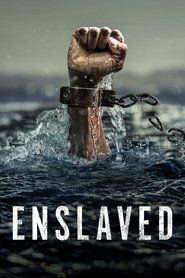
Enslaved
Λήψη English Υπότιτλων
Πληροφορίες έκδοσης
Ετικέτες
Προεπισκόπηση υποτίτλων English
Οι πρώτες 200 γραμμές.
The ocean floor still holds traces
of the transatlantic slave trade,
but it also tells another story.
There were hundreds of slave rebellions.
Stories of uprising and uplifting.
Everybody didn't just hang their head and come over.
You're talking about stories of resilience,
and it wasn't possible for people to make these journeys
unless you had a network of people who were striving
to ensure the freedom of others.
The Africans managed to kill most of them
and they commanded to sail the ship back to Africa
and return them to their homes.
The African American
who were on the edges of the river banks
realized what was happening,
that this was their moment, that they should run,
that they should take that one chance at freedom.
The slaves had songs with hidden meanings,
with double meanings, coded songs.
I know that people on that wreck
made it to freedom.
It's not just a story of victims.
It's a story of heroes.
We're in the shadow of Fort Amsterdam,
which is the first fort where prisoners
were held enslaved in this country.
When we talk about what became the slave trade,
it couldn't have all transpired in peace.
There had to be moments of uprising
and people resisting.
Think about the people who trafficked Africans,
they were so few of them
compared to the number of people they were carrying.
The audacity to think that a few men
could subdue hundreds,
and when they got to plantations,
thousands of enslaved people...
That required so much violence and fear.
It's amazing that they rise at all.
You've got your wife, your children, your husband.
The other guys have the guns and the police
and the system.
It's very hard to resist.
You can either be whipped
into complacency or fear
or you can be mad as hell when they open that hole
and you come out of there it's like, "Argh."
People were rising up. People were fighting back.
People were making plans.
Africans were not accepting this state of affairs.
And I want to know how much resistance was going on,
what forms did it take and where?
In the United States, for many,
resistance took the form of the Underground Railroad.
On this mission, we're not looking for a slave ship.
We're diving to find something that's pretty much
the exact opposite, ships of freedom.
These were ships that took runaway slaves
from America into Canada,
from slavery to freedom.
So, all of you are going to be diving in an area
that is significant in terms of the Underground Railroad.
There was a network, a network of people
and places that were significant in helping freedom seekers
that were traveling along routes in order to escape plantations.
You're talking about stories of resilience.
People being able to make this journey
from the south to the north,
and it wasn't possible unless you had that network
that was in place.
The way that people communicated was mouth to ear.
People would be able to describe a person
in terms of where they lived at, what area they were going to,
what name that they responded to.
A network of people who were striving
to ensure the freedom of others.
So, they may know that there is a house or shelter
three or four miles up the road, right,
and then once they get there, they figure the rest of it out.
"I have no idea where I'm going
or how I'm going to get there, but I'm going."
At the same time,
there were bounty hunters tracking people
based upon descriptions.
And if you were caught aiding and abetting
a freedom seeker then you can risk
up to six months in jail and $1,000 fine at that time.
How do you even go about figuring out who to ask,
or where to go to?
When you're growing up on a plantation
and you're not allowed to read, you learn how to read people.
It would be an unspoken form of communication,
where they understood that sense of trust in one another.
So, my third great grandfather, Josiah Henson,
he was a slave for 41 years of his life
and he took his four children and made this journey
from Kentucky over 600 miles to Western New York.
Two of his children were so small,
he had to carry them in a knapsack on his back,
the entire journey.
And he was able to cross over into Canada
in October of 1830.
Here's the waters.
Here's the terrain that your ancestors cross,
so you can be here, so a lot of us can be here.
We'll try and do you and your ancestor justice.
There's so much about the slave trade
that makes Africans sound like passive captives,
but was there resistance?
Did they ever take matters into their own hands?
Yes, on a lot of occasions,
and actually historians estimate
that as many as one in 10 of the slaving voyages
had at least one episode of rebellion from the captives.
Was it hard to stage a mutiny on a ship like this?
Slave ships were constructed in a very particular way
to minimize the likelihood of rebellion.
Captives would be below several decks,
they would be quite far away
from where the crew might be sleeping.
They would be in such cramped quarters,
it would be hard for them to physically organize themselves.
And there would be armed crew members
on duty around the clock.
The cannons could be turned inwards
and used to shoot at the captives
if there was a rebellion.
The people who were designing ships to use in the slave trade,
tried to make the ships resistance-proof.
It's incredible that people held under such oppressive conditions
could launch rebellions.
Were any of them actually successful?
Yes.
One we know most about was that of the "Amistad."
This was an attempt to transport some captives
from Havana to another part of Cuba.
The crew was very small, so this large number of Africans
managed to kill most of them.
But they kept a couple of them, including the helmsmen alive
and they commanded him to sail the ship back to Africa
and return them to their homes.
And in the end, they were set free,
and a number of them did return to their homes in Africa.
How successful were these rebellions when they happened?
Well, in most cases,
they weren't really very successful at all.
And I suspect many of the captives were aware
that they were not likely to succeed...
But some of them preferred to die fighting,
particularly if they had been warriors
in their earlier lives.
And even those who were aware
that they were not likely to succeed,
preferred suicide.
So, that yearning for freedom could manifest in a rebellion,
or it could manifest in suicide
with the hope that in death you would be free?
We know of one case which happened
at a place called Igbo Landing in Georgia in 1803.
And this was a mass suicide.
The Igbo people are known to be fiercely independent.
Yes.
The entire group of captives from the ship were unloaded.
They looked over the ocean,
they realized how far they were from Africa,
that they would probably never see their loved ones
or homes again,
that whatever was going to happen to them in America
was not likely to be anything they would want to endure.
So, they turned around and walked one after the other,
into the water, and then they drowned.
So, my third great-grandfather, he was Josiah Henson.
Saladin told us that ferry boats on the Great Lakes
often operated secretly as freedom boats.
So, he introduced us to historian John Polacsek,
an expert on sunken ships in the Great Lakes.
John took us out to a very specific spot on Lake Michigan,
where a steamer called "The Niagara" sank.
We're out here on the site.
This is where "The Niagara" is, about 50 feet down below.
"The Niagara" was part of the Reed fleet
which is out of Erie, Pennsylvania.
The Reed family were major abolitionists,
and anytime you wanted to forward a fugitive slave,
you could contact one of the Reed boats.
Once they got on the boat,
the fugitives would blend in as crew members
until they had the opportunity to get to Detroit,
get on the ferry,
go across the mile to Windsor, Canada,
and then they would be free.
Was the "Niagara" a fancy high-end boat?
Yes, it was.
There were as many as 300 people
who were bringing their livelihood,
their whole families with them
And we know that the fugitive slaves
worked in the galley?
That's right, as waiters and other crew members.
Enslaved subtitles in other languages
More English subtitles for Enslaved
- Enslaved S01E06 Abolition 1080p AMZN WEB-DL DDP5 1 H 264-TEPES · 5 downloads · 2020-10-21
- Enslaved S01E05 Resistance 1080p AMZN WEB-DL DDP5 1 H 264-TEPES · 4 downloads · 2020-10-13
- Enslaved S01E04 New World Cultures 1080p AMZN WEB-DL DDP5 1 H 264-TEPES · 7 downloads · 2020-10-06
- Enslaved S01E04 New World Cultures 1080p AMZN WEB-DL DDP5 1 H 264-TEPES · 6 downloads · 2020-10-06
- Enslaved S01E03 Follow the Money 1080p AMZN WEB-DL DDP5 1 H 264-TEPES · 8 downloads · 2020-10-01
- Enslaved S01E03 Follow the Money 1080p AMZN WEB-DL DDP5 1 H 264-TEPES · 5 downloads · 2020-10-01
- Enslaved S01E02 Rationalization 1080p AMZN WEB-DL DDP5 1 H 264-TEPES · 4 downloads · 2020-09-26
- Enslaved S01E02 Rationalization 1080p AMZN WEB-DL DDP5 1 H 264-TEPES · 6 downloads · 2020-09-26
Σχόλια
No comments yet. Be the first to leave one.