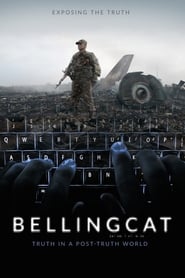
Bellingcat: Truth in a Post-Truth World
Elŝuti English Subtekston
Eldonaj informoj
Etikedoj
Antaŭrigardo de English subtekstoj
La unuaj 200 linioj.
"Truth does not belong to the order of power, but shares an original affinity with freedom."
This is a BBC news special.
A Malaysian passenger plane with around 300 people on board
has crashed close to the Ukrainian border with Russia.
There are unconfirmed reports that it was shot down.
The Malaysian airliner had been flying normally
without problems and...
An American journalist has been beheaded
by ISIS terrorists.
A video showing the horrific killing
was released on the internet a short while ago,
along with a message to the United States...
Devastation in the rebel-held Sucari neighborhood of Aleppo
on Wednesday.
Activists blame a barrel bombing by government forces.
At least 100 people have been killed
The flight would have been at cruising altitude,
which means it would be at about 32,000 feet.
For someone to mistake that for a hostile aircraft
between Russia and Ukraine would be difficult.
It's difficult to see
how this could just be a mistake.
This is nonsense.
There are no Russian armed forces
anywhere in the east of Ukraine.
A horrific scene in Charlottesville, Virginia.
A white nationalist rally that descended
into deadly violence and chaos.
The image is just coming in.
Unfortunately, the Russian-backed separatists
who control the area
continue to block the investigation.
The separatists are removing evidence
from the crash site
all of which begs the question,
what exactly are they trying to hide?
We have to make sure that the truth is out.
Before any official investigation
into the tragedy of flight MH17 is complete
the website of one citizen journalist claims
to have connected the dots.
Bellingcat is run by Eliot Higgins,
a 36-year-old laid-off office worker.
Among Bellingcat's favorite tools
are YouTube and Google Earth.
Something Higgins used to back his claim
that Russia faked satellite images
to blame the Ukrainian army for the MH17 crash.
When I was younger I was super, super shy.
When I was at University,
I couldn't even leave the house, I was so shy.
Terribly nerdy as it sounds,
I was really into computers and gaming.
I was very withdrawn as well, so I got into computers.
It's what that kind of people do.
I used to play these games a lot and I would like join a group.
Inevitably I would end up the leader of the group,
because I would really get into stuff.
I've always been like that.
I have this kind of obsessive tendency
where if I like something
I'll really get into it.
Growing up, my interests were very counter culture.
So, I was very interested
in the way US foreign policy affected the world.
Of course we have things like the first
and second Iraq war,
and you know, all the mess America was making.
When social media became popular in 2007, 2008,
we had smartphones
and those two technologies combined with apps
that allow you to take photographs
and share it immediately with the entire world.
The fact that you could do that was revolutionary.
- -
This is something I've been working on
for a presentation
it's about the white nationalist's violence.
-Whose streets? -Our streets.
-Whose streets? -Our streets.
-Whose streets? -Our streets.
There was this image taken, showing him attacking that guy.
So we wanted to know who this could be.
We looked for all the photographs and videos
of these white nationalists and we found this guy.
Now, he has certain similarities,
for example he has a very similar shirt on.
So, we looked for more images and photographs
and we found this photograph
which appeared to be the same person.
So we compare him
and the one thing that stands out
is the pattern of moles on his neck
is exactly the same.
What we started doing is looking
at the people who stood around him.
Because what happens
is some of these people turn up in tweets
by this account "Yes, You're Racist,"
where they actually name the individuals in question.
They show they have social media accounts.
What we're able to do is go to these social media accounts
and look through the people they follow.
And we come across this guy here.
If we go to his page,
we can look at the photographs he's got
and again you can start seeing matches.
So you can see the moles on his neck
match the pattern of moles there.
So, you know, he appears to have been committing a crime.
So, what we're trying to do
is see if we can ID the people behind these.
And this kind of work
is becoming more and more interesting
to law enforcement.
I originally was going to come here
and talk to you about a revolution
but with the discussion of the post-truth world,
it feels like a counter revolution now.
And it's been a very peaceful and quiet revolution,
thanks to smartphones, thanks to social media...
and thanks to the vast amount of information
now available online to anyone.
And this revolution has allowed a new field to grow.
I like to call this field
"online open source investigation."
We can use it to influence the powerful,
we can use it to challenge the powerful
and we can bring them to accountability as well.
Now, I started Bellingcat
because I wanted to teach people how to do this.
It used to be that the tools of media production
were in the hands of the media.
And with the rise of the internet,
that is no longer true.
With vlogging starting in 2000
and social media starting in 2004
and YouTube, which I think started in 2005,
now the tools for media production
have been given to the people formerly known as the audience.
Historians will look back,
I think, and recognize that this was the time
almost 20 years after the internet emerged
where the kind of realities
of our networked environment became true.
In human history,
when we've had these moments of significant change
whether it was the printing press,
or radio, or television, we've had similar moments of...
Oh, my goodness,
what is it going to mean?
And we're there right now, but we do have to recognize
the seriousness of what this means
because ultimately,
this technology is a reflection of humans.
So, for the last five years we've been terrified
about artificial intelligence and robots.
The horrible truth is,
the thing that might bring us down
is technology that simply reflects
our worst aspects back to each other.
I'd just been looking at Twitter
and I noticed there was a new ISIS video.
And someone said there's James Foley on it.
This is James Wright Foley,
an American citizen of your country.
I just felt like I needed to do something
so that's why I thought I'd see
if I could find out where this had taken place.
The first thing I noticed
was that it was in this dry and arid area
but in the distance you can actually see
a very green and fertile area.
And if you're familiar with the terrain around Raqqa
which is obviously the stronghold at this point
you could see this valley with this river running through it,
and it's very green
but the foothills around it were very dry and arid.
These are obviously very dusty, hilly areas
but you can see, in the distance,
all these individual trees.
So when you look at Raqqa,
this is exactly what you're seeing.
You're seeing this green valley with these hills.
I basically just went through and followed this line,
looking for similar terrain.
You can see here it's very, very rough indeed.
So I thought it was a likely location.
Then I started looking
at all these little background details,
like these trees and the road
and comparing them to imagery
that was visible from that line of sight.
Once I had a possible location,
I published it to kind of see if I could generate a discussion
around where this could have happened.
Then, several months later, that's why I started Bellingcat.
Bellingcat doesn't have institutional support.
They don't have a big building at The Hague or Brussels,
where they do their work.
More English subtitles for Bellingcat: Truth in a Post-Truth World
- Bellingcat Truth in a Post-Truth World 2018 720p WEB-DL x265 HEVC-HDETG · 44 downloads · 2021-07-25
- Bellingcat Truth in A Post Truth World 2018 1080p WEBRip-RARBG-English · 28 downloads · 2021-05-18
- Bellingcat Truth in A Post Truth World 2018 1080p WEBRip-RARBG🔥 · 33 downloads · 2020-10-29
Komentoj
No comments yet. Be the first to leave one.