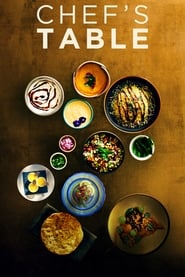
Chef's Table
Elŝuti English Subtekston
Download English Subtitle Files for Mobile (6)
Antaŭrigardo de English subtekstoj
La unuaj 200 linioj.
Today's quake coming just after 4:00 in the morning.
The epicenter coming near the city of Modena,
and we can expect the worst of the damage in that area, I think.
We're hearing of factories in rural areas collapsing
and historic structures, like bell towers, being brought crashing down.
One lunch, we had the restaurant fully booked.
There were like this very strong shake,
and everyone was running out and street was going like a wave.
Was crazy moment.
After the earthquake, the consortium Parmigiano
came to me saying, "Massimo, you have to help us.
This is a disaster.
360,000 big wheels of Parmigiano are damaged.
That could be the end of
half of the production of Parmigiano-Reggiano.
And if you don't act very quick,
everyone is gonna go out of business and we gonna lose everything."
So I went to the consortium. I said to the president,
"I have the idea.
We're gonna do a recipe on Riso Cacio e Pepe.
We're gonna make a risotto,
and we're going to cook the rice using the Parmigiano."
The president was like...
"Really? Are you sure you're gonna--"
"Don't worry. Don't worry, it's gonna be great.
We're gonna make a dinner
in which, all over the world, everyone can cook that recipe."
I want to show everyone what happened to Modena
and help them sell everything they produce.
Japan, London, New York, everywhere...
they were cooking Risotto Cacio e Pepe.
40,000 people, they were cooking Risotto Cacio e Pepe.
All 360,000 wheels were sold...
they were sold out.
No one lost a job.
No cheese maker closed the doors.
That was a recipe as a social gesture.
- That's Massimo Bottura! -Ciao.
-Ciao, vecchio. - Ciao.
-Ciao, ciao. - Massimo.
Ciao.
Wait.
Ma'am...
how are these? These chanterelles?
The chanterelles are good.
The porcini are no good. You have to come in the morning
to get porcini mushrooms.
Wait, what's this?
Caesar's mushrooms. The Caesar's mushrooms are good.
They're a little...
There are some good ones. Look!
I'll have good ones in the morning, Massimo.
Tomorrow morning, we'll come tomorrow morning.
You could get them now, but come a little earlier.
I'll come around 9:30, 10:00.
-Yes, when the good stuff is on display. -Okay.
-Now, this morning I have... -Okay.
Bye.
Have a nice day.
Hey there.
Look, it's the maestro.
Give me, give me a...
One of the, the...
The ones in front that just came out.
Give me that one in front, how is it?
Will you split it with me?
Yes, with pleasure.
My God, it's good.
Can you send some of this to Francescana?
A mixture, half a crate of these and half of these.
Really, really good ones. Do you have...
These are the...
Mmm.
Massimo brings something else to the plate besides food.
That's the goal of one of the world's greatest restaurants.
He's arrived at his own formula for what being a three-Michelin star is about.
For Massimo, it's about the art, it's about the music,
it's about the place, it's about the ingredients.
It's not just about the food.
It's about the whole concept behind the food
that makes it into something far more interesting.
Every time I go to the restaurant, I'm always astounded by what I see.
All of these dishes were made with traditional Modena ingredients,
but used in a different way than the way a trattoria would use.
One of the most important ingredients in his food is memory.
His memory of tasting things and of the way things were made,
and taking those memories
and re-interpreting them in a more modern way.
He's the most important chef in Italy.
He has three Michelin stars.
In San Pellegrino's 50 Best restaurants list,
he's number three.
I hope to see him in the number one spot!
...spoon tarts, spaghetti with cream sauce,
lobster bisque. March!
March!
He's a rock and roller. He's an exciting, dynamic guy
who seems to me ready to go 24 hours a day.
Always excited about food, excited about wine,
excited to communicate to you what he knows about Italy.
Massimo's artistic sensibility
is unlike anything that had ever been done before.
There is no one who's doing what Massimo is doing.
Today, he's an icon in Italy.
But when he started, the whole of Italy was against it.
It was a type of treason.
He was considered a traitor of Italy.
Modena,
it's a small town with a very, very strong gastronomic tradition.
The Modenesi are very demanding about food.
The actual country of Italy is 150 years old.
The actual traditions are 26 centuries.
So, you have people who have very, very deep roots.
If you ask any Italian where you can find the greatest food in the country,
the answer is usually, "Mom."
Massimo takes a dish that you can find at home
and brings it into a restaurant in a different way
than it'd ever been seen before,
and that's why in the first years of this restaurant
you never found anybody from Modena in the dining room.
It wasn't what Mom did, and so they were upset by that.
As a chef,
he takes what his mother made and turns it into something divine.
I grew up in a very large family
with three older brothers, one smaller sister.
But all the aunt and the grandmother, they were living with us.
I was kind of very energetic child
and I was running around as crazy,
and my older brother, they didn't like it, so they were chasing me.
And my safety place was in the kitchen under the table
where my grandmother was rolling pasta.
My grandmother was defending me with the wood, the matterello,
as we call matterello to roll pasta,
from my older brothers, "Get out of here!
Leave him alone. He's the youngest one."
So, from under the table,
I was looking at the world in a different perspective.
The flour was falling from the table
and I was on my knees,
and in that moment,
I was stealing from under the table the tortellini.
So when they ask me, "What is the plate of your life?"
It's a tortellino, but it's a raw tortellino,
because that's the moment in which I was stealing the raw tortellino
just made one second before from the hand of my grandmother.
That's why food is so important for me
because in many different creation I do,
you can find that I'm trying to take you, in that moment,
back to where you were a child.
Can I drive the tractor?
No, come on! I'm telling you.
Max, can I drive the tractor?
No, because it must be extraordinary.
He's serious. He wants to drive the tractor.
No, no, I don't want to cause trouble.
Does he have a tractor license?
No, a wagon license.
Yes, yes.
- -Ah!
Massimo is someone you kind of have to chase.
He's always ten steps ahead of you.
He's running down the street, and you're in his shadow.
Everything that comes to his mind gets thrown out there on the table immediately.
There's no editing.
There's no being cautious about his ideas.
Massimo's volcanic in that way.
My role, and it's very fun and it's very entertaining,
is always kind of catching up with Massimo to be a witness.
If I don't write down, take note, decode what the recipe is about,
and find a way to make that accessible to other people,
nobody's going to.
One of the things that I love about him
is that he's always creating without even touching one ingredient.
We'll have been at the movies,
and we'll walk out of the movies and I'll say,
"So, what'd you think about the film?"
And he'll say, "I don't know, I just... I wasn't really paying attention.
I was thinking about a way of making...
mozzarella invisible,
and if you could drink that
and have all the flavor of tomato and mozzarella,
how cool would that be?"
And I would think, "God, he really didn't watch the movie."
Lara is so important for what we do.
She'll look at the things from distance
so she sees everything very clear.
When you have a relation, you speak the same language.
If you speak the same language, you can share a dialog.
We share the language of creativity
and the language of dreams.
Ciao, ciao, ciao.
1998, when his father, Umberto,
came to eat in Osteria Francescana,
at the end of the meal, he said,
"This is very good,
but you should start thinking about the aging process.
The aging process is Modena.
The whole area is about slow, slow passing of time."
There is no shortcut for producing Parmigiano-Reggiano cheese,
and this is the reason that we not taste the cheese,
Chef's Table subtitles in other languages
More English subtitles for Chef's Table
- Chefs Table S04 · 66 downloads · 2018-04-14
- chefs table s03 · 65 downloads · 2017-08-25
- chefs table s02 · 33 downloads · 2017-08-20
- Chef's Table season 3 episode 1 · 37 downloads · 2017-05-13
Komentoj
No comments yet. Be the first to leave one.