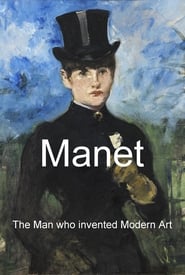
Manet: The Man Who Invented Modern Art
Descargar subtítulo en English
Información de lanzamiento
Etiquetas
Vista previa de los subtítulos en English
Las primeras 200 líneas.
If anyone ever asked me
who was the most mysterious
and enigmatic painter I know,
the one who's hardest to pin down,
I know who my answer would be.
The man who painted that.
Édouard Manet.
People say Manet invented modern art,
that he's the greatest revolutionary of the 19th century.
And of course, I love his work.
I adore it.
But put me in a corner
and force me to tell you
exactly why
and I don't think I can.
I've looked and looked and looked at his paintings.
Without being boastful,
I know an enormous amount about him,
and yet, I've never penetrated to his core
and really understood him.
Nor has anyone else.
This is Manet's most notorious picture,
Olympia, the most controversial and provocative nude
of the 19th century.
When this was shown, at the Salon of 1865,
the gates of hell opened up
and their contents poured down on Manet's head.
What a scandal.
What uproar.
What drama.
This caused a rumpus, too.
And this.
And this.
And even this.
It's as if everything Manet painted
wasn't what you are supposed to paint.
He moved the goalposts
and rewrote the rules.
The man was a rebel through and through.
Though he never looked like one.
Now this can't go on.
We can't let a painter as revolutionary
and magnificent as the man who did that
slip through our grasp.
It's time to crack his code.
Time to break his secret.
Time to get to the bottom of Édouard Manet.
The Île de la Cité,
that mysterious and secretive gothic island
in the middle of the Seine,
where the hunchback of Notre Dame resided.
This was the original heart of the city.
It's surrounded by water, easy to protect,
the ancient epicenter of being French.
And it was also where Manet's father worked,
over there at the Palais de Justice.
The Manets were lawyers and judges.
For eight generations, they dispensed wisdom
and rules to their fellow Frenchmen.
Manet's father, Auguste, was a judge.
His father had been a judge, too.
And the grandfather before that.
So, not surprisingly,
they expected little Édouard,
born 23rd of January, 1832,
to become a judge as well.
The father was a really important figure
in the French judiciary.
He worked here in the Palais de Justice
as the head of the civil courts,
presiding over domestic disputes,
arguments over wills and copyright.
A thoroughly respectable figure
who would never, ever have wanted
his eldest son to become
one of those new-fangled artists.
The idea that a Manet would one day to grow up
to paint this or this
would have been utterly discombobulating to Auguste,
and I think it's worth suggesting,
right at the outset,
that one of the reasons Manet did paint this
and this was because he knew
what they'd make of it at the Palais de Justice.
And that only spurred him on.
Manet's mother, Eugénie-Desirée Fournier,
had a more inventive background.
Because she was the goddaughter of the King of Sweden.
Eugénie was 20 when she married Auguste Manet.
He was 34.
She brought with her a generous Swedish dowry,
and, more importantly for Manet,
a rare passion for music.
She trained as a singer,
and was good enough to sing at small, private concerts
and other people's soirees.
And this passion for music
was to be her most rewarding gift
to her eldest son.
Music was to play a critical role
in Manet's work and life.
Manet grew up in a changing city,
and flux was his inheritance.
The modern age was arriving in Paris at a brutal lick,
and no one was ready for it.
The French emperor, Napoleon the Third,
nephew of the first Napoleon
had seized power in a low-grade coup d'etat,
promising to make France great again.
As great as she had been under the first Bonaparte.
A little man with a big name,
Napoleon the Third had one eye on history,
and the other on his legacy.
But everywhere Manet would have looked as he grew up,
tradition and modernity were tussling for the soul
of the new France.
This tussle continued in Manet's own family as well.
His parents wanted him to study law
and keep up the family tradition of producing judges.
But Manet's own heart was elsewhere.
There's a photo of him as a young boy,
the only one I've seen.
So alert, such a piercing gaze.
Too intelligent and questioning, surely, to be a judge.
His first ambition was to join the Navy,
and when he was 17, he set off on a long sea voyage
to Rio de Janeiro, which taught him so much about the sea.
And perhaps a little about Latin women, too.
When he came back, he failed his Naval exams.
The only thing Manet was ever going to be
was an artist.
The chap with a walrus mustache is Thomas Couture.
In his time, the most appreciated painter in Paris.
Couture ran a workshop for young artists,
and after lots of badgering,
Manet Senior finally agreed to let Manet Junior
study in Couture's workshop in 1850.
Manet stayed there for six years,
which, at 120 francs a year,
adds up to a very long, and very expensive apprenticeship.
Couture had made his own reputation in 1847
when he showed this grotesque,
flesh-laden monstrosity at the Paris Salon.
It was called, Le Romains de la décadence,
the Roman orgy,
and that, alas, is exactly what it showed.
An enthusiastic Roman love-in
featuring a cast of hundreds.
Although he was responsible for this monstrosity,
Couture would always advise his pupils
to paint the world around them.
The new Paris, the trains, the factories.
"Don't paint someone else's history,"
he would advise them, hypocritically, "paint your own."
And that's exactly what Manet did.
You must have noticed that the French
harbor an interesting and resilient compulsion
to make big, urban statements.
They all do it.
Mitaron with his grand at the Louvre
Pompidou with his extraordinary and pipey center,
and all these ostentatious building projects
can trace their origins back to the dreams of one man,
that ruthless rebuilder of Paris, Baron Haussmann.
Haussmann wasn't actually a Baron,
he was just Monsieur Haussmann,
but he called himself Baron to give himself
some appropriate status.
And between 1853 when the Emperor made him
prefect of the Seine,
and 1870 when he was sacked for being so unpopular,
Haussmann transformed Paris.
And I mean transformed.
Pretty much everything we think of as Paris today
was Haussmann's doing.
These big Parisian vistas.
The huge, wide boulevards.
Haussmann did it all.
So what's all this got to do with Manet?
As it happens, rather a lot.
First off, it's important to recognize
that the Paris he was living in
for most of his adult life was a city in flux.
A giant demolition site, looking for its final shape.
Manet couldn't get away from the smell of change.
Nor could anyone else.
But there's something more, something crucial.
When Haussmann was knocking down the old neighborhoods,
he was knocking down the old certainties as well.
People's personal geographies were being crushed.
The inner maps they'd inherited.
I was in Beijing just before the Olympics,
and the same thing was happening there.
The old cantons were being demolished.
All the undesirables moved out into the suburbs.
An ancient city was being forced to become a modern one.
Whether it wanted to or not.
Manet's Paris was like that as well.
And this alienation of the people,
the removal of their sense of place,
Comentarios
No comments yet. Be the first to leave one.