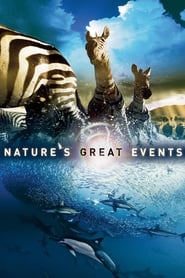
Nature's Great Events
Descargar subtítulo en English
Información de lanzamiento
Etiquetas
Vista previa de los subtítulos en English
Las primeras 174 líneas.
The power of the sun drives the seasons,
transforming our planet.
Vast movements of ocean and air currents ...
bring dramatic change throughout the year.
And in a few special places, these seasonal changes ...
create some of the greatest wildlife spectacles on Earth.
One of the most awe-inspiring events ...
takes place in the vast open plains of East Africa.
Once a year, 3 million animals ...
gather in a small corner of the Serengeti.
This is the greatest concentration of grazing animals on the planet.
But the herds only stay for a few months ...
before continuing on their epic journey.
And when the Great Migration moves on,
the predators they leave behind become suddenly vulnerable.
How can they survive until the Great Migration returns?
The eastern edge of the Serengeti is dominated by a volcano,
known to the Maasai people as Ol Doinyo Lengai,
the Mountain of God.
It's one of many volcanoes, that have shaped the landscape here ...
for millions of years, that lie along Africa's Great Rift.
To the west lie the grasslands of the Serengeti ...
and a particularly fertile area known as the short-grass plains.
For a few months each year,
hundreds of thousands of grazers cram into this corner of the Serengeti.
And of course, wherever you find grazers,
you find predators.
More meat-eaters hunt and scavenge on the short-grass plains ...
than anywhere else in Africa.
For lions in particular, this is, for the moment, a savannah paradise.
With so much food on offer, it's a good time to raise young cubs.
But lions are territorial.
Each pride only controls a small area of grassland.
They can only hunt the animals that come into their territory.
So, to give these cubs a good start,
they'll have to make the most of this bonanza ...
while it's here.
When the great herds move on, the lions can't go with them,
and prides like this one face a stern test.
What happens next ...
is a side of lion life that is rarely seen.
It's May.
The rains that watered the short-grass plains have moved north ...
and the vast herds follow, seeking out fresh green pastures.
Wildebeest are so in tune with the seasons ...
that they can hear thunderstorms 30 miles away,
and they home in on the scent of wet soil ...
that carries the promise of fresh grass.
Unlike lions, wildebeest are free to travel ...
wherever the quest for food leads them.
This young calf is at the start of an incredible 7-month journey.
Without rain, the grasslands behind them wither and die.
Within weeks the short-grass plains start to turn brown.
Within a few months, they're unrecognisable.
90% of grazing animals have moved on.
Not a single wildebeest remains.
It's now August. With so few animals here,
the short-grass plains are no longer a great place to be a lion.
For the lion pride living at the southern edge of these plains,
in a place known as Ndutu,
the test now is to survive until the herds return again.
The Ndutu pride has 4 lionesses and 7 cubs,
and already they're struggling to find enough food and water.
The youngest are weak and underweight.
Surrounded by other lion prides with their own territories,
the Ndutu pride must make the most of what they can find here.
But there isn't enough food for them all.
This male cub is not only hungry, he's sick.
On this morning the pride is heading for a woodland ...
where there is more cover and more animals to hunt.
It's a long journey for the exhausted cubs.
For the weakest male it's a real struggle to keep up.
He's trying, but slowly he gets left behind.
This is a brutal world. The lionesses simply cannot wait.
If they don't keep hunting and eat soon,
they, too, will become weak,
and then there'll be no hope for any of them.
Warthogs are a valuable catch at this time of year.
The lives of the cubs depend on a successful outcome.
While one lioness slowly creeps forward ...
another approaches from cover.
It's been a while since their last kill,
and all the hungry pride pile in.
All, that is, except one.
A mile away, a young life is fading away.
The kill has come too late for him.
At less than a year old,
these cubs are still totally dependent on the lionesses.
To survive, they must keep up.
Only 3 months into the dry season,
the Ndutu pride is down to 6 cubs.
Sadly, this young male will not survive.
It's late August, and the rains are still moving north,
taking the grass and the wildebeest ...
even further away from the Ndutu lions.
With no territory to enclose them,
the wildebeest can travel wherever they like.
But a calf, just like a lion cub, still has to stick close to mum.
The biggest danger is getting lost in the vastness of the herd ...
as it treks up to 30 miles a day.
Back at Ndutu, the dry season is biting harder.
There's little grass here, but that's not a problem for some.
Giraffe find most of the nutrients and moisture they need in acacia leaves.
And, like impala, they can cope well in the dry season.
Serengeti mice positively thrive in the drier months ...
thanks to the abundance of seeds.
So some of the smaller predators, like wild cats,
still find plenty of food.
This kitten is unlikely to go hungry.
Perhaps surprisingly, it's the creature often called the king of the beasts ...
that is suffering the most.
It's early September, and on this afternoon ...
there are only 2 male cubs with the Ndutu lionesses.
And they're little more than skin and bone.
What's happened to the rest?
Sadly, it seems others have been left behind.
One young female cub is just 2 miles away.
She's limping and the black patches on her face ...
reveal that she's losing her fur.
But she hasn't given up. She calls for her pride.
She's hears a faint call, and hurries towards it.
And is reunited with one of her brothers.
Nearby there is prey. But these cubs are unable to hunt.
They are still too young.
If they're going to survive, they must rejoin the pride.
While she still has strength, she continues to try and make contact.
Far away, the lionesses also call constantly.
And listen for their lost youngsters.
Even a sick cub joins in the search for his sisters and brothers.
But there are no replies.
After an hour of calling, the lionesses can wait no longer,
they must move on.
The pride will have to move to another part of their territory ...
if they are to find food.
None of them have eaten for days ...
and now the chances of being reunited with the lost cubs ...
seems remote indeed.
It's September, one of the driest months in Ndutu.
The wildebeest herds are over a hundred miles away,
having followed new pastures to the northern edge of the Serengeti.
But they have a huge challenge of their own to face.
They must cross the Mara River.
Over several days, the herds crowd together at the water's edge.
The adults seem to sense a hidden danger.
But the numbers keep piling up on the river's edge ...
and ultimately they face the danger together.
The crocodiles are spoilt for choice ...
but they can only take one victim at a time.
There is safety in numbers here ...
and most of the wildebeest make it across to the grasslands beyond.
Back in the south, the Ndutu plains are tinder-dry.
Seed and insect-eaters can scratch a living,
and the smaller cats like serval, that hunt them,
can still find plenty to eat.
And a cheetah mother is managing to keep her cubs fit and healthy ...
on the small antelope that remain.
It's now October, the peak of the dry season,
and the Ndutu pride are resting in the heat of the day.
In a bizarre twist of fate, one of the two male cubs has died,
but amazingly, the lost female, with the black face patches,
has found her way back.
She's still weak, and clearly hasn't eaten for days.
Meanwhile, it's getting hotter.
Just when it seems life couldn't get any worse, it does.
Flames race across the Ndutu pride territory,
burning the last of the grass and any remaining bush cover.
At first glance there's little left here.
Yet animals like impala quickly return to investigate.
The impalas' world has changed beyond recognition.
There's nowhere left to hide.
The Ndutu pride has also lost the cover they use for hunting.
The young female may have survived her first fire,
but her chances of a meal have fallen even lower.
For the cheetah family, the fire is not such bad news,
Nature's Great Events subtitles in other languages
More English subtitles for Nature's Great Events
- Natures Great Events S01 1080p BluRay x264-aAF · 82 downloads · 2014-04-30
- BBC Natures Great Events 1of6 The Great Melt XviD AC3 MVGroup org · 55 downloads · 2011-12-29
- BBC Natures Great Events 6 The Great Feast [HDTV 720p and 1080p SRT] · 47 downloads · 2010-03-23
- BBC Natures Great Events 5 The Great Flood [HDTV 720p and 1080p SRT] · 52 downloads · 2010-03-23
- BBC Natures Great Events 4 The Great Tide [HDTV 720p and 1080p SRT] · 46 downloads · 2010-03-18
- BBC Natures Great Events 2 The Great Salmon Run [HDTV 720p and 1080p SRT] · 44 downloads · 2010-03-17
- BBC Natures Great Events 1 The Great Melt [HDTV 720p and 1080p SRT] · 45 downloads · 2010-03-17
- BBC Natures Great Events XviD AC3 MVGroup org · 39 downloads · 2009-04-30
Comentarios
No comments yet. Be the first to leave one.