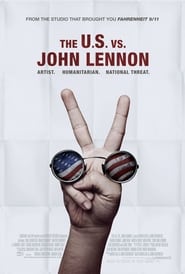
The U.S. vs. John Lennon
Descargar subtítulo en English
Información de lanzamiento
Etiquetas
Vista previa de los subtítulos en English
Las primeras 200 líneas.
All the people that say the movement, the revolution is over.
They ought to see what's going on right here, 'cause it doesn't look over to me.
This is like a dream,
seeing 15,000 people in one place
demanding freedom for John Sinclair.
I was sentenced to 91/2-10 years
in July of 1969
for giving two joints to an undercover policewoman.
All this time that John Sinclair has been in jail
because of his opposition to the government,
that government has dropped 21/2 Hiroshimas a week
every week since July 1969, when John was imprisoned.
And all that time,
Richard Nixon was trumpeting, "The war is winding down."
We had this concert,
and it was broadcast all over the state.
It was the biggest thing that ever happened in Michigan.
Stevie Wonder, Bob Seger,
Rennie Davis, Jerry Rubin,
Bobby Seale of the Black Panthers.
All power to the people.
Thank you very much. Right on.
Power to the people.
The stage was set to make a big impact.
"If we can make this concert be huge..."
And then Jerry Rubin talked John Lennon and Yoko Ono
into coming and playing at our concert.
We had no idea that there were FBI agents
writing down the lyrics in the audience.
That's when the FBI began to see
the beginning of the power of John and Yoko.
The power structure, especially during the Nixon administration,
which began in 1968, was extremely paranoid
about anyone who they perceived to be counter-culture,
counter-administration, antiwar,
and, of course, John Lennon fell squarely in that arena.
When somebody in show business
comes and participates in a political rally,
he or she is doing something
that is a very great personal sacrifice,
and even a personal risk.
Certainly, they feared what a figure like John Lennon represented.
Anybody who sings about love and harmony and life
is dangerous to somebody who's singing about death
and killing and subduing.
He was making friends
with a lot of people that our government
wanted to put in jail.
He was a high-profile figure,
so his activities were being monitored.
I think they wanted me to know to scare me,
and I was scared, paranoid.
He believed all of his telephone conversations were being monitored.
"He believed that he was being followed around New York City.
He believed that friends that he had thought were friends
were secret informants for different intelligence communities.
We were just shocked,
and we were really scared.
Another effect of the Sinclair thing
was it probably further alerted the FBI,
John Mitchell, Haldeman,
Ehrlichman, and Nixon as to this threat to them,
that something needed to be done
to neutralize John Lennon.
Childhood was something that, um...
he couldn't shake it.
It was there all the time.
And at night when we were in bed,
he would be talking about it, his mother...
Especially his mother.
He was an orphan, really.
He was abandoned by his father,
and to all intents and purposes,
abandoned by his mother.
Can you imagine growing up
and realizing that neither your mother nor your father
really wanted you?
So it's no wonder he turned out a rebel.
Being born working class, it was a natural...
I knew... I was taught to hate and fear the police,
hate and fear the establishment,
and to fight it.
He had a chip on his shoulder for anybody who would tell him
how to live his life and what to do
and when to talk and when not to talk.
I was always in trouble.
Every school I went to, I was thrown out.
Everything I got involved in, I was always in trouble,
so I was always against the wall.
This is Doug Layton and Tommy Charles
reminding you that our fantastic Beatle boycott is still in effect.
We have not forgotten what The Beatles said.
The Beatles made a statement in all the newspapers
that they're getting more better than, uh, Jesus Himself.
Originally, I was...
I pointed out that fact in reference to England,
that we meant more to kids than Jesus did
or religion at that time.
I wasn't knocking it or putting it down.
I was just saying it.
I think simply on the basis of statistics and fact,
his statement is untrue.
No one is more popular than Jesus.
I just didn't mean what everybody thinks I meant.
I'm not anti-Christ or anti-religion
or anti-God.
So many people have built buildings in the name of Christ,
and what have people done for The Beatles?
What have they done for us?
I'm not saying that we're better or greater
or comparing us with Jesus Christ as a person,
or God as a thing or whatever it is.
I just said what I said and it was wrong
or it was taken wrong,
and now it's all this.
We urge you to take your Beatle records,
pictures, and souvenirs
to the pickup points about to be named,
and on the night of the Beatles' appearance in Memphis,
August 19,
they will be destroyed in a huge public bonfire
at a place to be named soon.
It doesn't matter about people not liking our records
or not liking the way we look or what we say.
They're entitled to not like us,
and we're entitled not to have anything to do with them if we don't want to,
or not to regard them.
We've all got our rights, you know?
Clearly, Lennon already was thinking about
this thing of being the lovable mop tops
is not really their goal in life anymore.
Lennon in particular is more willing
to take on a critical stance,
a rebellious stance.
This, I think, is the beginning,
where Lennon sets out on the path
that's going to bring him into direct conflict
with the Nixon administration six years later.
The thing the '60s did
was show us the possibility and the responsibility that we all had.
It wasn't the answer.
It just have us a glimpse of the possibility.
We intend to convince the communists
that we cannot be defeated by force of arms
or by superior power.
I have today ordered to Vietnam
the Air Mobile Division and certain other forces
which will raise our fighting strength
from 75,000 to 125,000 men almost immediately.
I joined the Marine Corps out of high school
in September of 1964,
and I volunteered to go to Vietnam.
They could not have sent someone more dedicated.
They could not have sent someone who was willing
to follow their policy more than myself.
While leading my squad across an open area,
I was shot to the right shoulder.
It went through my right lung, collapsed my lung,
hit my spine, and severed my spinal cord,
paralyzing me from my mid-chest down.
Vietnam was not an easily accepted war on the part of the population.
It didn't have a 9/11 that we had.
It didn't have a Pearl Harbor.
It didn't have the motivating factors
that would have encouraged a high degree of patriotism.
So it was an unpopular war,
and got to be more and more unpopular as it lingered
and as people doubted more and more
that it had any real purpose.
Some 2 million Vietnamese died in that conflict.
That did not show life, liberty,
and the pursuit of happiness at its best.
...2, 3, 4!
We don't want to fight your war!
1, 2, 3, 4!
We don't want to fight your war!
The ferment was considerable,
with a leading role played by young people throughout.
People who were normally supposed to be apathetic
and obedient and passive
were actually entering the political arena
to press their own demands and organizing to do something about it.
In this age of protest,
one of the most recent finds 4,000 Londoners
decrying British support for U.S. Action in Vietnam.
There were a few minor scuffles, but no arrests.
The demonstrators were stopped from approaching
Prime Minister Wilson's Downing Street home.
The whole culture had become radicalized,
and it's in this atmosphere that The Beatles
were being forced to engage with the world.
Do you mind being asked questions?
For example, in America people keep asking you questions about Vietnam.
Does this seem useful?
It seems a bit silly to be in America and for none of them to mention Vietnam
as if nothing was happening.
But why should they ask you about it? You're successful entertainers.
That is the thing...
It's because Americans always ask showbiz people
what they think about this sort of...
The U.S. vs. John Lennon subtitles in other languages
More English subtitles for The U.S. vs. John Lennon
- U S vs John Lennon, The 2006 WEBDL-1080p-monkee en hi · 13 downloads · 2025-10-29
Comentarios
No comments yet. Be the first to leave one.