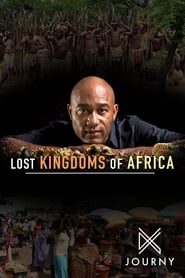
Lost Kingdoms of Africa
Descargar subtítulo en English
Información de lanzamiento
Etiquetas
Vista previa de los subtítulos en English
Las primeras 200 líneas.
Africa, where the human race began.
Nearly a billion people live here,
and it's a continent
with an incredible diversity of communities and cultures.
Yet we know less of its history than almost anywhere else on Earth.
But that's beginning to change.
In the last few decades, researchers and archaeologists have begun
to uncover a range of histories
as impressive and extraordinary as anywhere else on Earth.
It's a history which has been neglected for years,
and it's largely without written records.
But it is preserved for us in the gold and statues, in the culture,
art, and legends of the people.
My name is Gus Casely-Hayford.
Over many years I've studied the history and culture of Africa.
As an art historian,
I'm used to drawing stories from mute objects from the past.
I'm going to discover the history,
and find out what really happened to the lost kingdoms of Africa.
Many of the stories of Africa are told here,
the British Museum in London.
This is where thousands of artefacts
collected, bought, and taken from the continent ended up.
When they were first discovered,
objects from the ancient kingdoms of West Africa stunned the world.
None more so than these extraordinary plaques.
They came from what was once the kingdom of Benin,
and are around 500 years old.
When the British came upon these objects in 1897, they thought,
"There's no way they could have been created by Africans."
They were amazed at the detail and the intricacy.
They were seen as being something completely revolutionary
to the British, and you can understand why.
These aren't carvings, they're 16th century casts
in copper-rich alloys of brass and bronze.
Over 900 plaques are thought to have been made.
To produce each one, the artist would need to know
how to make and fire a clay mould,
and how to melt the metals to pour into it.
It's an incredibly difficult skill to master.
The combination of relatively sophisticated science and artistic accomplishment
baffled most European 19th-century observers.
They couldn't believe that so-called primitives had been capable
of producing work of the same standard
as their European contemporaries.
These amazing objects just didn't match the Europeans' view
of West Africans.
The questions were, where did they get the technology
to develop this amazing bronze work,
and where did they find the materials?
But the clue as to how such artefacts were manufactured
are there for the finding,
but I think they will reveal much
about the West African kingdoms that created them.
I want to know why they were made, what they mean,
and what that tells us about the time and place they were produced.
And there are some symbols that seem to reoccur.
The leopard, the snake, the crocodile,
so obviously they were very important.
I'm going to find out what they mean,
and why they were so important to these people.
These recurring images remind me
of the symbolic motifs in Renaissance art.
I think they carry hidden layers of meaning,
beyond the understanding of the imperialistic Brits.
So what do the bronzes tell us about the kingdom of Benin,
and its power, and its culture,
and what does the technology required to make them
tell us about pre-colonial West Africa?
I'll travel to modern-day Nigeria,
where the kingdom of Benin reached its height in the 16th century.
And I'll reach even further back in time,
and explore a panoply of ancient cities and kingdoms in West Africa,
founded many centuries before Benin.
I'll look for evidence in what's now Mali,
of how ancient culture and technologies made Benin
and its bronzes possible.
The centre of power of the kingdom of Benin was Benin City.
Today it is one of Nigeria's thriving cities,
home to over a million Africans.
The main circle in the centre is dotted with statues,
public art depicting Benin's history.
For 600 years, until the late 19th century,
it dominated this part of West Africa.
But the kingdom's former scale and power are not immediately obvious,
unless you know where to look.
Dr Ekhagusa Aisien, author of several books on Benin's history,
is taking me to see a 500-year-old feat of engineering.
At the kingdom's height in the 16th century,
a series of moats and earthen walls
protected the city and its surrounding land.
It was a defensive system, that consisted of a ditch,
and then a rampart.
What little survives is overgrown and barely recognisable,
but archaeologists have found evidence of a vast network
of trenches and walls up to nine metres high.
They zigzagged around the city area for an incredible 4,000 miles.
Benin really was the capital of this part of Africa.
That is, the eastern part of the west coast of Africa.
Benin was the principle town.
It was an important centre of the culture of this part of Africa.
It was an important centre of the political reach,
along the huge area
of the eastern portion of the west coast of Africa.
The kingdom was governed from a vast palace
by a hereditary ruler, the Oba.
His subjects were animists - believers in the idea
that souls and spirits existed not only in humans,
but in animals, plants and the earth itself.
At its height it exerted political, military, and economic control
over an area stretching almost 40,000 square miles.
In the 19th century the British saw the kingdom as an opportunity
to extend their influence in Africa.
They established a trade agreement,
but when Benin reneged on it, relations deteriorated.
A British delegation ignored warnings not to approach the Oba
and were massacred,
leaving just two survivors from over 200 people.
A month later, in February 1897,
1,200 British soldiers arrived in response.
The city walls didn't stop the British punitive expedition,
and the city was razed to the ground.
At the Royal Palace, they found artwork
that they couldn't believe had been created by Africans.
Around 2000 pieces were taken, sold, and distributed to Western museums.
The Oba was deposed, and died in exile.
It was a catastrophic defeat for the kingdom of Benin,
but that's not the impression you get from the modern monument
in the centre of the city.
It shows a Benin warrior
standing victorious over his dead and dying British enemies.
I actually see it as a triumph of narrative,
that we will continue as a nation, whatever.
Ultimately, it tells the story of a victorious nation,
victorious in the sense that it proudly tells its stories,
whether it's in the Benin Bronzes
or whether it's in monuments like this today.
In Benin, it seems history isn't written by the victors,
it's written by the artists.
And the kingdom of Benin disappeared only for a short time.
In 1914, the British restored the monarchy to Benin City
to help administer their Nigerian colony,
and a modest palace was rebuilt.
The traditions of the kingdom that have survived,
are maintained from an enclave in the city centre.
I've been granted a royal audience,
an opportunity to attend the Oba's court,
where hereditary and appointed chiefs gather each day.
When His Royal Majesty the Oba of Benin enters,
the Chiefs greet him with, "God save the King".
THEY ALL GREET HIM
This is more than a symbolic institution.
The Oba and his chiefs rule on issues brought to them
by ordinary people.
Their judgment carries authority here,
and the kingdom exists in parallel with the Nigerian state.
With a leopard at the Oba's feet and standard bearers at his side,
it's like one of the Benin bronzes come to life.
This is the kind of occasion
he believes the plaques were designed to mark.
Those bronzes were not made for museum pieces.
Initially, in the absence of photography and writing,
they were made to depict certain events in the palace,
or the community, or some festivals.
That's why you see them,
they were made as in the absence of photography.
That's what they were made for initially, yes.
And how important are the bronze-casters, the smiths,
the people who actually make these objects?
They are a guild, a royal guild,
specifically to be trained in these things in the olden days.
The bronze casters' guild exists today.
Their main business is tourist souvenirs,
but the makers are still an exclusive group of craftsmen,
with high social status.
Membership of the royal guild is hereditary.
Ikponmwusa Inneh's family have been bronze casters
for as long as anyone can remember.
The skills that created the 16th century bronzes
are still evident today.
You see, it's liquid now. You can see the flame.
The process begins with a simple clay shape to act as a core.
So then you cover the core with wax?
With wax, then you start your details,
the mouth, the nose, the eye.
And then you cover it... With the mud. With the mud.
This is the soft mud which we use to cover them,
so you cover the hole with the mud, soft mud, after the designing.
The details in the wax will leave their impression on the clay mud.
When the object is heated, the clay will harden,
and the wax will melt and drain out.
Molten metal will fill the space left by the wax.
Inside the fire is like this pot,
and with this scrap metal, you load this pot.
In the 16th century, the craftsmen melted down copper bracelets
brought by Portuguese traders to create brass and bronze.
Nowadays, any metal seems to do.
So you can put something like a car aerial?
A car aerial, this is scrap metal, and then you put them in here,
then I'll put it inside the fire here.
Lost Kingdoms of Africa subtitles in other languages
More English subtitles for Lost Kingdoms of Africa
- BBC: Lost Kingdoms of Africa - Second Season (2012) TV · 39 downloads · 2017-06-16
- bbc Lost Kingdoms of Africa: Series 2 · 27 downloads · 2012-11-20
- BBC Lost Kingdoms of Africa 3of4 Great Zimbabwe PDTV XviD AC3 MVGroup Eng · 39 downloads · 2010-04-15
- BBC Lost Kingdoms of Africa 2of4 Ethiopia PDTV XviD AC3 MVGroup Eng · 31 downloads · 2010-04-09
- BBC Lost Kingdoms of Africa 1of4 Nubia PDTV XviD AC3 MVGroup Eng · 38 downloads · 2010-04-07
- bbc-lost kingdoms of africa 2Ethiopia · 30 downloads · 2010-02-12
Comentarios
No comments yet. Be the first to leave one.