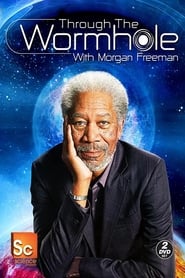
Through the Wormhole
Laadige alla English subtiiter
Väljalaske info
Sildid
English subtiitrite eelvaade
Esimesed 200 rida.
Colossal beauty.
Awe-inspiring intricacy.
Are the wonders of our universe a cosmic accident
or the result of intelligent design?
For centuries, religion and science were bitter foes.
Now science actively searches for our creator.
Some physicists think he's hidden in the math.
Neurologists think she might be in our brains.
And computer coders believe God is one of them
and that our world is nothing more than his simulation.
Through the Wormhole 1x01 with Morgan Freeman Is There a Creator? Original air date on June 9, 2010
Space.
Time.
Life itself.
The secrets of the cosmos lie through the wormhole.
Through the Wormhole 1x01 with Morgan Freeman Is There a Creator? Original Air Date on June 9, 2010
every culture claims a God,
an all-powerful entity
that created the world and directs our fate.
But why do we share this belief in a cosmic creator?
Did we dream it up to serve a need in our psyche or culture?
Is God really out there --
up there?
This is a journey into the science of God.
I promise you it's quite a trip.
Some of what we'll find almost defies belief.
Sometime in the early '70s,
I bought my daughter an ant farm.
She soon got bored, but not me.
I was memorized by this little menagerie
squeezed between two panes of glass.
And I wondered, what could they ever know about me,
the one who built their world?
What can we ever learn about who or what created us,
stranded as we are in this colony of humanity?
For as long as scientists
have struggled to understand our place in the universe,
there have been those who've hoped to get a glimpse of God.
400 years ago, the great astronomer Galileo Galilei
had a ground-breaking insight.
Nature's grand book is written in the language of mathematics.
From that time to this,
scientific geniuses like Newton and Einstein
used math to dig deep into the workings of nature,
to search for God
through the equations that defined the laws of physics.
The latest mind hoping to join these illustrious ranks
is Garrett Lisi.
The universe
can very successfully be described mathematically.
You have to imagine how the world's working
in a certain circumstance
and then use reason and mathematics
to develop a description of how that might be happening.
But it's imagination
that breaks the trail before reason enters.
After earning his Phd,
Garrett escaped the confines of academia
in search of adventure and a space in which to think.
Rather than go into a normal academic-track job,
I just split off for Maui, became a surf bum,
and did the research I wanted to --
mostly spent time doing physics research and surfing.
But all of our attempts to understand nature
so far have been fragmentary.
There's one set of rules for tiny atoms,
another for giant objects like stars and galaxies.
And the two sets of math don't fit together.
What physicists like Lisi seek
is a single, overarching theory,
a mathematical design that explains everything.
Garrett thinks he may at last have found
this theory of everything.
And if he's right, God could be one heck of a mathematician.
Garrett's work is at a leading edge of physics.
Before we plunge into this mind-bending math,
we first need to back up a bit,
because it's possible
there's already evidence for a creator in the math.
Andy Albrecht is a leading cosmologist.
Hello, how are you?
He's also a renowned chocoholic.
I'll have the chocolate soufflé and a latte.
Just as a perfect chocolate soufflé
relies on a precise mixture of ingredients
baked at a specific temperature for an exact time,
so our universe looks the way it does
because of a precise balance between four fundamental forces.
The four forces we know and love
in the world around us
are gravity, electromagnetism --
those you've probably heard of.
Then there's also the weak force and the strong force.
They're a little bit more specialized
but absolutely essential
to make the world work the way it does.
Gravity, in many ways,
is the force we know first.
We try to walk, and we fall down.
That's because of gravity.
When you carry something a little too heavy and it falls,
it's because of gravity.
Electromagnetism tells us how the chemistry works.
When you cook something, the energy you use
is ultimately electromagnetic energy.
Weak force is about a billion times less strong
than electromagnetism,
and it's responsible for radioactivity.
The potassium in a banana is radioactive.
If the rate were too high, it could destroy us.
The sun is basically a nuclear reactor.
The strong forces release energy in the nuclear reactions.
One of the remarkable things is, when you add it all up,
all these forces have to be exactly the way they are
for life as we know it to exist.
Change any one of them, dial the parameters,
and something will go wrong --
the planet will disappear,
the sun will shut down,
the DNA will come unraveled.
Some people call it the Goldilocks paradigm --
not too much, not too little, everything's just right.
Oh, that's perfect.
Some physicists believe
this precise calibration of forces is evidence of God.
Dr. John Polkinghorne did pioneering work on the quark,
a fundamental subatomic particle.
He is also a knight commander of the British Empire, a Sir.
And after a lifetime
of distinguished scientific inquiry,
he was inspired to follow a new line of work...
As a priest.
I do indeed believe in God, yes, indeed.
Yes, in fact, I'm an Anglican priest,
so it would be rather shocking if I didn't.
Those four fundamental forces are the portfolio of things
that bring about the physical processes of the world.
And a very interesting fact about the world
is that those forces,
in their specific strengths that they have,
have to be very close to what we actually observe
if we were to be here to observe them,
because it turns out that only a world
whose forces are very similar to the ones that we experience
would be capable of producing carbon-based life.
John finds it difficult to imagine
that the fine-tuning of our universe
has happened by accident,
that there is no divine hand behind it.
This fine-tuning makes it clear we don't live in any old world.
We live in a very particular universe.
And why is that? Why are we so lucky?
Of course, religious belief offers you
a very straightforward and attractive explanation.
But scientists are split
over whether this balance of forces
is a sign of intelligent design.
In fact, it could be nothing more
than a roll of the cosmic dice.
Dr. Alan Guth is a revered figure in cosmology.
His theory of inflation
is the accepted idea of how the early universe formed.
Inflation says that right after the big bang,
the universe expanded phenomenally fast,
doubling in size 100,000 times in just a fraction of a second.
Inflation helps explain
how the world we know could have come into existence.
But inflation has another head-spinning implication --
there ought to be more than one universe.
An important feature of this process of inflation
is that when inflation stops,
it doesn't stop all over at the same time.
What tends to happen is it stops in some places,
and those then become universes.
And elsewhere, in what we now call a multiverse,
inflation would go on,
and only later, more pocket universes would form.
And there can be an infinite number of these pocket universes
formed altogether by this process
that we call eternal inflation.
The point is that if there really is a multiverse,
we would be living in just one of these many pocket universes.
That could be, for example, our universe right there.
Each of these pocket universes
could have different laws of physics.
In our universe,
the four forces are aligned in a perfect way.
Together, they allow life to coalesce and flourish.
But each pocket universe in Alan's multiverse
could have a completely different balance of forces.
Maybe electromagnetism is weaker,
and perhaps gravity is way more powerful.
The result --
an entirely different universe with no chance of human life.
To Alan, our universe
is not carefully crafted by a divine being.
It's just a lucky roll in a cosmic crap shoot.
The precision and complexity of our world
is enough to make even the sanest cosmologist
go just a little bit crazy.
Through the Wormhole subtitles in other languages
More English subtitles for Through the Wormhole
- Through the Wormhole S02E06 Are there parallel universes · 51 downloads · 2018-02-08
- through the wormhole s08e04 is gun crime a virus internal 720p HDTV x264-DHD · 67 downloads · 2017-05-17
- through the wormhole s08e03 can we hack the planet internal 720p HDTV x264-DHD · 56 downloads · 2017-05-10
- through the wormhole s08e02 can we cheat death internal 720p HDTV x264-DHD · 64 downloads · 2017-05-04
- through the wormhole s08e01 is the force with us internal 720p HDTV x264-DHD · 69 downloads · 2017-04-26
- Through the Wormhole S07E04 Can We All Become Geniuses 720p WEB-DL x264-Sleepless · 72 downloads · 2016-10-10
- Through the Wormhole S07E04 Can We All Become Geniuses 720p HDTV x264-DHD · 50 downloads · 2016-09-22
- Through the Wormhole S07E04 720p HDTV x264-DHD Can We All Become Geniuses? · 54 downloads · 2016-09-21
Kommentaarid
No comments yet. Be the first to leave one.